The first thing you notice in a serious collection isn't the trophy plant. It's the bench in the back corner — usually a fluorescent-lit shelf in a converted bedroom or basement — where a half-dozen unflashy seedlings are growing under domes. A Philodendron lynamii no bigger than a thumbnail. A wild-collected Anthurium dressleri throwing its second juvenile leaf. A Monstera sp. from a specific drainage in Chocó that hasn't been described yet. None of them photograph well. None of them are worth showing off. They are, almost without exception, the reason the collector got out of bed at 4 a.m. to mist before work.
An expensive collection looks different. It looks like the front page of an auction site: mature A. warocqueanum in matching nursery pots, a wall of variegated Monstera, a Philodendron spiritus-sancti centered like a chandelier. There is nothing wrong with any of those plants. The question is whether they're in conversation with each other, or just lined up like cars at a dealership.
The difference between inventory and a collection
A collection has a thesis. It doesn't have to be a written one — most aren't — but you can read it off the shelves within about ten minutes. Maybe it's velvet-leafed Andean Anthurium from a specific elevation band. Maybe it's the Philodendron subgenus Pteromischum, those scrambling vines almost no one grows because they look weedy until they don't. Maybe it's Hoya from Sulawesi, or section Gymnopus begonias, or the Monstera that aren't deliciosa, adansonii, or dubia.
Inventory, by contrast, is a shopping list with humidity. It reflects what was available and aspirational on Instagram in a given eighteen-month window. You can tell because the plants don't share a logic. A Philodendron gloriosum next to a Hoya carnosa 'Compacta' next to a string of pearls, all wilting at slightly different rates because they want completely different things and the room is split-the-difference.
The collector with a thesis can talk for an hour about why they don't grow something obvious. Ask them about Philodendron melanochrysum and they'll say, politely, that it's lovely but they're not interested in the Cardiocaulon-adjacent climbers right now. Ask the inventory-keeper and they'll say they're trying to find one in the four-leaf size for under three hundred dollars.
Anyone with a credit card can buy a mature warocqueanum. Only a collector buys the seedling next to it and waits seven years.
Breadth is harder than depth
Depth is easy to admire and relatively easy to buy. Thirty Anthurium in one room, all from one section, is a real accomplishment but a legible one. Breadth is harder. Breadth means you've decided to grow a Cyrtosperma johnstonii that needs to sit in water, and three feet away a Hoya that wants to bone-dry between waterings, and you've engineered the airflow and the watering rhythm so neither one suffers.
The collectors I trust most tend to grow across at least three families competently. Araceae, of course. Then something difficult from a second family — Begoniaceae, Apocynaceae, Gesneriaceae, Marantaceae, Piperaceae. Then a wildcard: orchids, ferns, a single Nepenthes they've kept alive for a decade. The wildcard matters. It's the proof that they've learned to read a plant rather than memorize a care sheet.
Breadth also forces humility. You cannot bluff your way through a Bulbophyllum if your only frame of reference is a velvet philodendron. The plant will tell you, quickly, what you don't know.
The plants that quietly disappear
There is a category of plant that enters the trade, briefly, and then vanishes. Not because it died out — though sometimes that too — but because it didn't photograph well, or it grew too slowly, or it required something the average buyer wouldn't provide, and the nurseries stopped propagating it. Philodendron 'Painted Lady' used to be everywhere; for a while it was almost impossible to find outside of old collections. Anthurium splendidum comes and goes in waves. The blue-form Philodendron from Ecuadorian collectors in the early 2010s — some of those clones are now genuinely scarce in cultivation, even as their named cousins go for less than they did five years ago.
Serious collectors notice these disappearances and act on them. They take cuttings when a friend downsizes. They keep a backup of anything they'd be sad to lose. They trade rather than sell, because trading keeps a clone alive in two collections instead of one. When a small grower in Florida posts a single Anthurium debilis on a Saturday morning, the collectors know what it is and the speculators don't.
This is the unglamorous work of horticultural memory. It's also why the most interesting plant in any given collection is rarely the most expensive one. It's the one that came from someone who got sick and had to rehome their greenhouse, or the cutting traded at a society meeting in 2017, or the wild-source seedling from a vendor who has since stopped exporting.
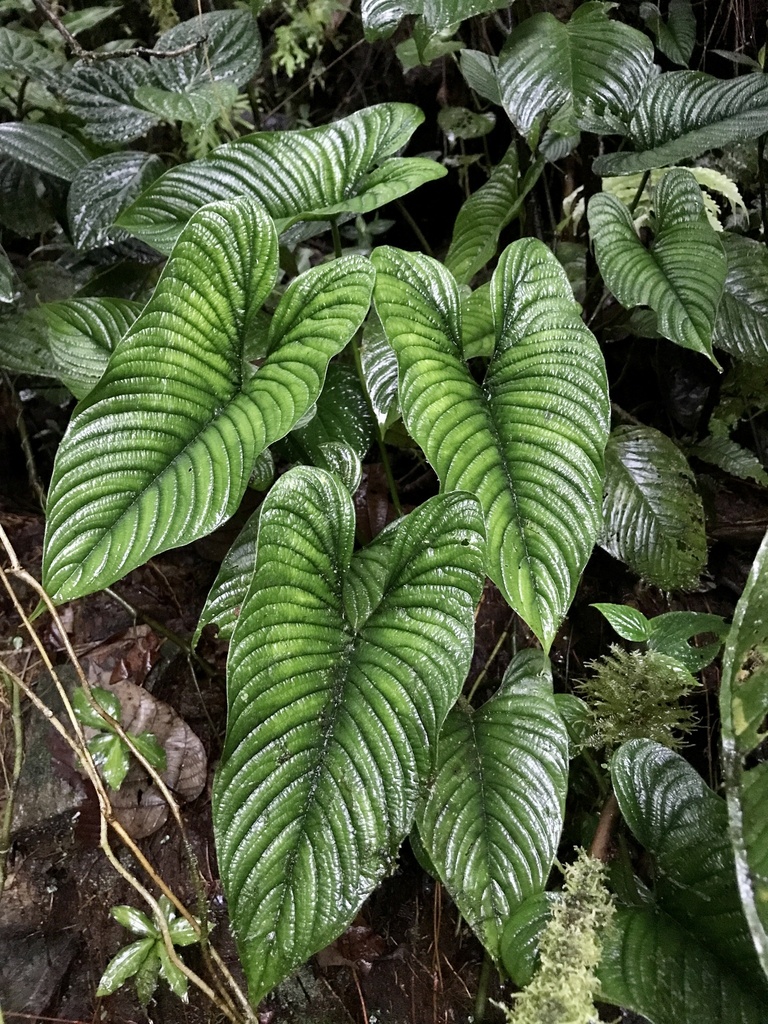
Provenance, and why it matters more than rarity
Rarity is a market condition. Provenance is a fact about a plant. A Philodendron labeled simply 'spiritus-sancti' tells you almost nothing; one labeled with the grower's name, the year of propagation, and ideally the lineage back to a known mother plant tells you what you actually need to know — whether it's the real species, whether it's likely to look the way you expect at maturity, whether you're paying for the plant or for the name on the tag.
The best private collections keep records. Not necessarily a spreadsheet — though many do — but at minimum a tag that survives repotting, with the source and the date. When that plant eventually moves on, the next collector knows what they're getting. This is how cultivated material stays meaningful across decades instead of degrading into a fog of mislabeled cuttings.
It's also the single thing that separates collecting from accumulation. A plant without provenance is a decoration. A plant with provenance is part of a chain that you've now joined.
The discipline of saying no
Every serious collector I know has a list of plants they have deliberately not bought. Sometimes for ethical reasons — wild-collected material from unstable sources, plants whose trade is propping up habitat destruction. Sometimes for practical reasons: they know their conditions won't grow it well, and they would rather not own a plant they can't keep happy. Sometimes for aesthetic reasons that are harder to articulate but no less real.
This is the discipline that distinguishes a collection from a hoard. Square footage is finite. Attention is more finite. A room with forty plants you understand intimately is, by any meaningful measure, a better collection than a room with two hundred you rotate through resentfully. The expensive collection often fails this test. It mistakes the credit card for the curatorial decision.
Saying no also means accepting that some plants belong with other people. The Anthurium clarinervium you've kept alive for three years but never loved should go to someone who will. The trade is healthier when plants move toward the collectors who want them most.
What the room tells you
Walk into a private collection and look at the substrate first, not the leaves. If every plant is in the same chunky aroid mix regardless of what it is, you're in an expensive collection, not a serious one. The Hoya wants something different from the Anthurium, which wants something different from the terrestrial Philodendron, which wants something different from the Begonia. A collector who has been at it long enough mixes media by plant, not by aesthetic uniformity.
Then look at the airflow. A whisper of movement across every leaf, even on the bottom shelf. Then look at the light — not the brightest spot, but the gradient. Is there a place for the high-light Hoya and a place for the shade-loving Philodendron verrucosum? Then, finally, look at what's growing. A serious collection has plants in every life stage: seedlings under domes, juveniles building up, adults flowering, something old and a little ratty that they've been growing for twelve years and refuse to throw out.
The room is the collection. The plants are downstream of the conditions, and the conditions are downstream of the years of paying attention. That's the part you can't buy. It's also the part that, once you've seen it, you can never quite stop trying to build.