📷 peganum / Flickr (CC BY-SA 2.0)
Field Guide · Anthurium
Not every dark-veined velvet leaf is a clarinervium — here's how to read the real thing, and which anthuriums belong next to it on your shelf.
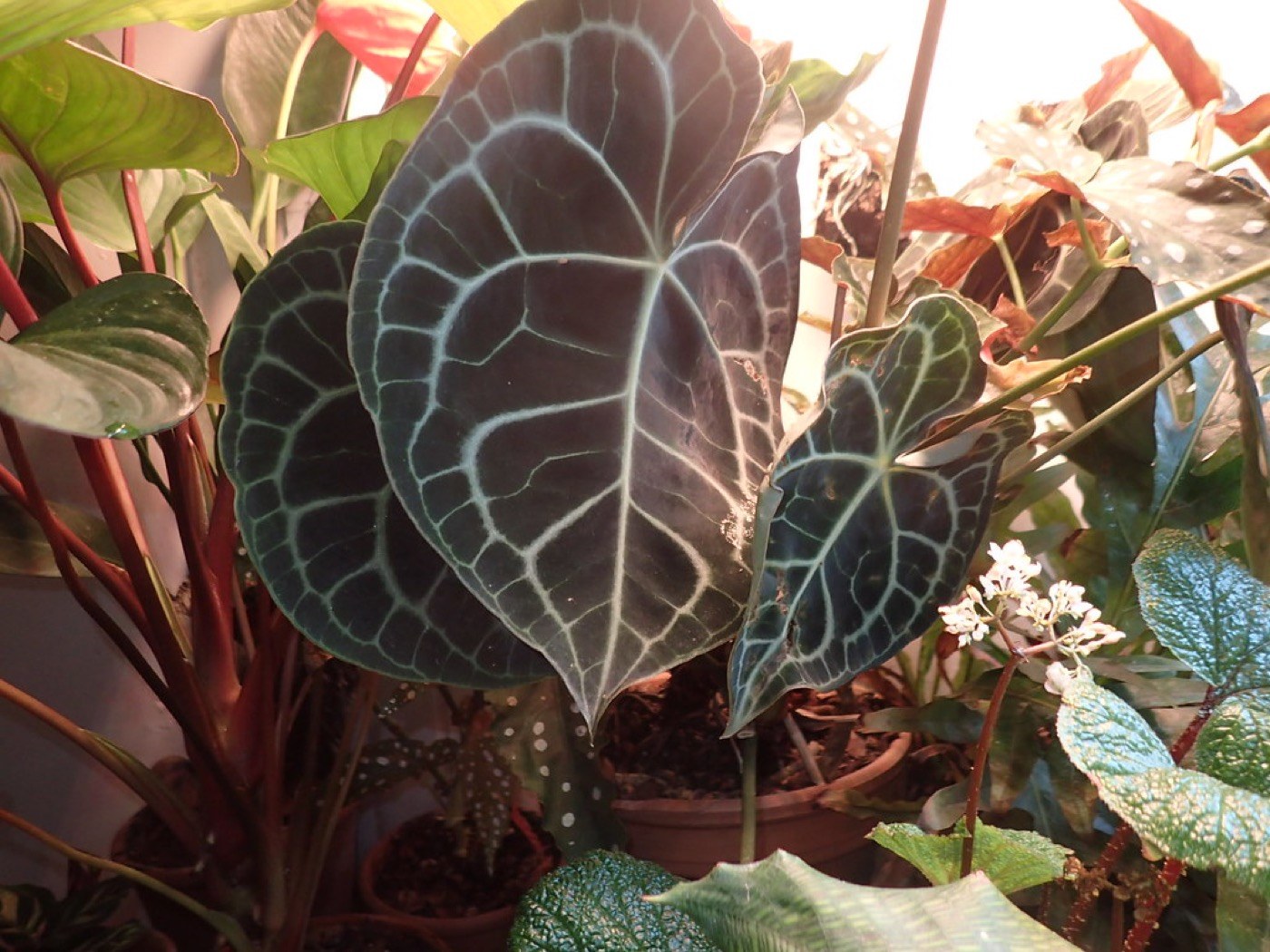
The type by which most velvet anthuriums are measured. True specimens show a thick, stiff, cordate blade with sharp white primary venation on a deep matte-green surface — the contrast is almost printed, not just pale. Petioles are D-shaped in cross-section with a pale abaxial surface, and mature leaves typically reach 25–40 cm. Seedling variation is wide; named clones selected for density of silver venation and symmetrical sinus are worth paying extra for.
Gold standardWhere clarinervium is rigid and architectural, crystallinum produces thinner, pendent leaves with a crystalline sheen that shifts in low-angle light — the venation is silver but the texture reads differently, more iridescent than chalky. Plants climb readily in maturity and prefer something to grip. The juvenile phase produces heart-shaped leaves easily confused with clarinervium; look at the leaf base — crystallinum has a narrower, more tapered sinus. A foundational species any serious collection should include.
Essential comparisonBigger in every dimension than clarinervium — blades regularly exceed 50 cm in cultivation on well-grown adult plants, with four-angled, prominently winged petioles that immediately distinguish it from its relatives. Venation is similarly white but the lamina surface has a coarser texture, almost suede rather than velvet. Slower to offset and slower to size up than crystallinum, but the payoff in foliage scale is substantial. Do not confuse the widespread seed-grown stock with select clones; petiole wing width varies considerably.
Maximum impactArguably the darkest ground color in the section — mature leaves approach near-black with ice-white venation that creates a stark, high-contrast pattern found nowhere else at this size. Less common in cultivation than clarinervium and correspondingly pricier on the rare occasions quality divisions appear. Petioles are unwinged and round in cross-section, which separates it instantly from magnificum. Patience is required: growth is deliberate rather than fast, and it resents root disturbance more than most.
Darkest groundThe outlier in this group — forgetii lacks the cordate sinus entirely, producing a fully rounded to ovate blade with no notch at the petiole attachment. That alone makes it immediately identifiable and a striking contrast piece beside any sinus-heavy species. Silver venation is present but less bold than clarinervium; the drama comes from the clean, unbroken leaf outline. Grows epiphytically in nature and performs best mounted or in a very fast-draining mix with consistent moisture.
No-sinus contrast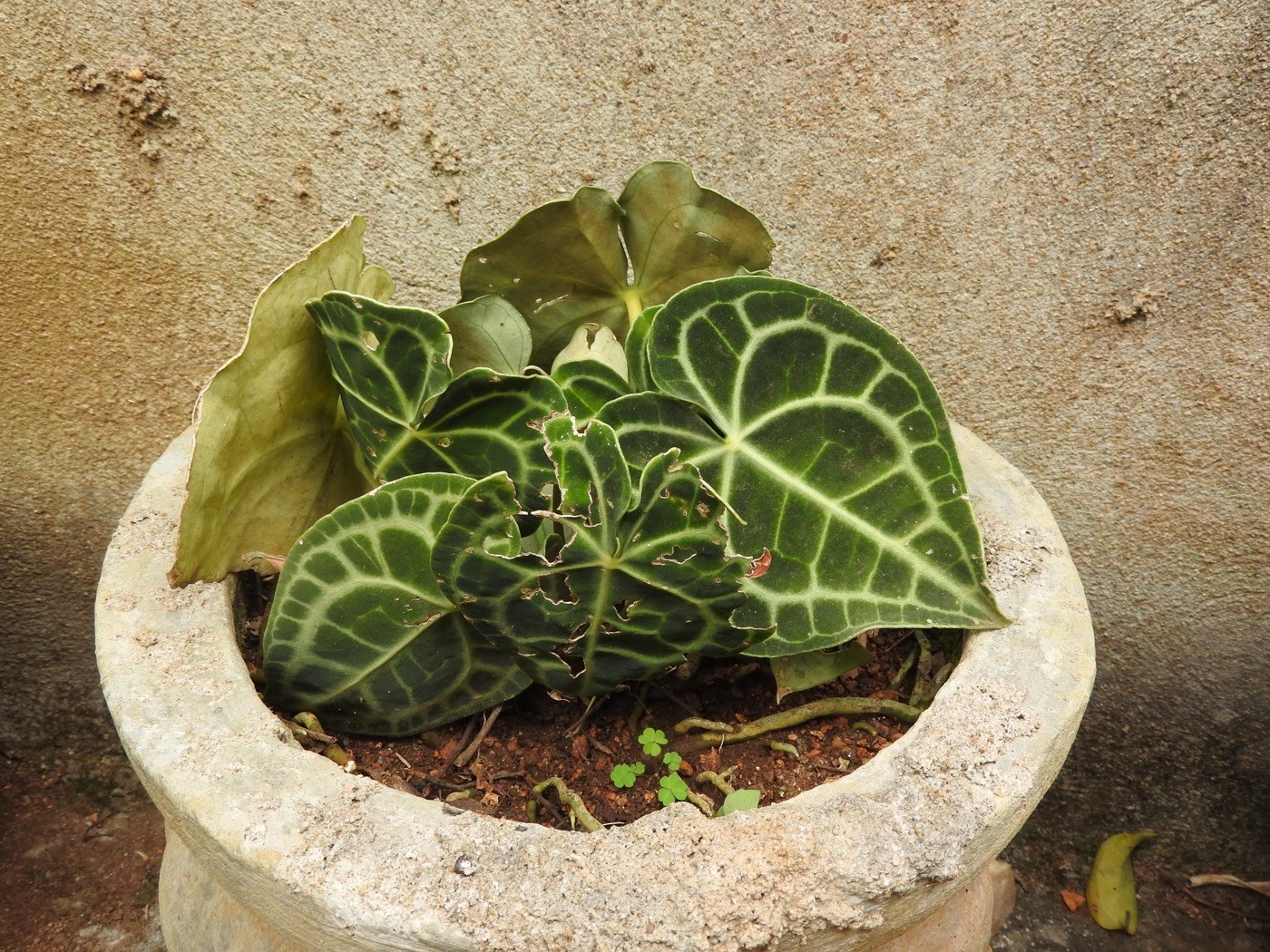
The species is not difficult to find — tissue culture and seed-grown plants move through the trade constantly, and price has dropped. What hasn't dropped is the quality gap between an average plant and a genuinely good one. When evaluating Anthurium clarinervium, start at the petiole: it should be clearly D-shaped in cross-section, with a flattened adaxial face and a pale, almost grayish abaxial surface. Round or nearly round petioles suggest poor provenance or hybridization.
The leaf blade itself should be thick — stiff enough to hold its angle without drooping — and the matte surface should be dark enough that the white primary venation reads as high contrast, not faint. Secondary venation should be visible, fanning out from the midrib in a pattern that looks almost deliberate. In weaker specimens, the venation is narrow and the blade thins toward the margin; on a top-tier plant the silver extends well into the secondary network.
Sinus shape matters too. A deep, well-defined sinus — the notch where the petiole meets the blade — with lobes that nearly touch or slightly overlap on mature leaves is the mark of a plant that has been given room to develop. Crowded plants in small pots stall in juvenile form and never express full venation density. Repot into fresh, airy mix at the first sign the roots are circling, and don't let it sit pot-bound through a growing season.
Every Cardiolonchium velvet anthurium — clarinervium included — fails the same way in most home setups: the roots suffocate before the collector realizes there's a problem. These are not plants that tolerate a peat-heavy, moisture-retentive mix. Build substrate around drainage and aeration: a base of coarse perlite or pumice (40–50% by volume) combined with orchid bark or coco chips, with a smaller fraction of worm castings or a well-aged compost for nutrition. The mix should drain freely within seconds of watering and hold enough moisture to stay barely damp — not wet — between sessions.
Light wants to be bright but never direct. In a north- or east-facing window they'll survive; in a south- or west-facing room set back two to three feet from glass or use a sheer diffuser. Under grow lights, 150–200 PPFD at the leaf surface is a reasonable target. Too dim and venation contrast diminishes; too bright and the dark lamina bleaches at the center — a flaw that doesn't reverse on that leaf.
Humidity above 60% produces noticeably better growth than ambient indoor air. The exact ceiling matters less than consistency: a plant adapted to 65% that suddenly drops to 40% during a dry winter will stall and sometimes tip-burn. A small ultrasonic humidifier in an enclosed shelf or cabinet is more reliable than misting, which raises humidity for minutes and invites fungal spotting on velvet surfaces. Airflow is not optional — stagnant humid air is where Phytophthora and bacterial rot find their opening. Run a small fan on low, directed at the air around the plant rather than the leaves directly.
Overwatering is the obvious error but underwatering causes its own damage in velvet anthuriums — the thick leaves mask moisture stress until roots have already begun to desiccate. The correct cadence is to water thoroughly when the top inch or two of substrate has dried, then let the excess drain completely. Never let the pot sit in a saucer of water. Feel the pot weight if you're uncertain; with a well-aerated mix there's a noticeable difference between a saturated and a dry pot.
Fertilizing too aggressively on young plants is a recurring mistake. A dilute balanced fertilizer — half strength, applied with every second or third watering during active growth — is sufficient. Pushing nitrogen hard produces large, thin leaves with weak venation contrast, exactly the opposite of what makes a clarinervium worth owning. Ease off or stop entirely in low-light winter months when growth slows.
The counterintuitive rule: resist the urge to isolate a new purchase immediately into perfect conditions. Acclimatization matters more than optimization in the first four to six weeks. A plant moved abruptly from a greenhouse at 80% humidity into a home at 55% will drop leaves regardless of how good the substrate is. Keep it slightly drier than usual, maintain consistent temperature, and let it find its footing before adjusting humidity upward gradually. Patience at this stage prevents the kind of root rot that follows stress-weakened tissue.
The Field Guide from Leaf People.