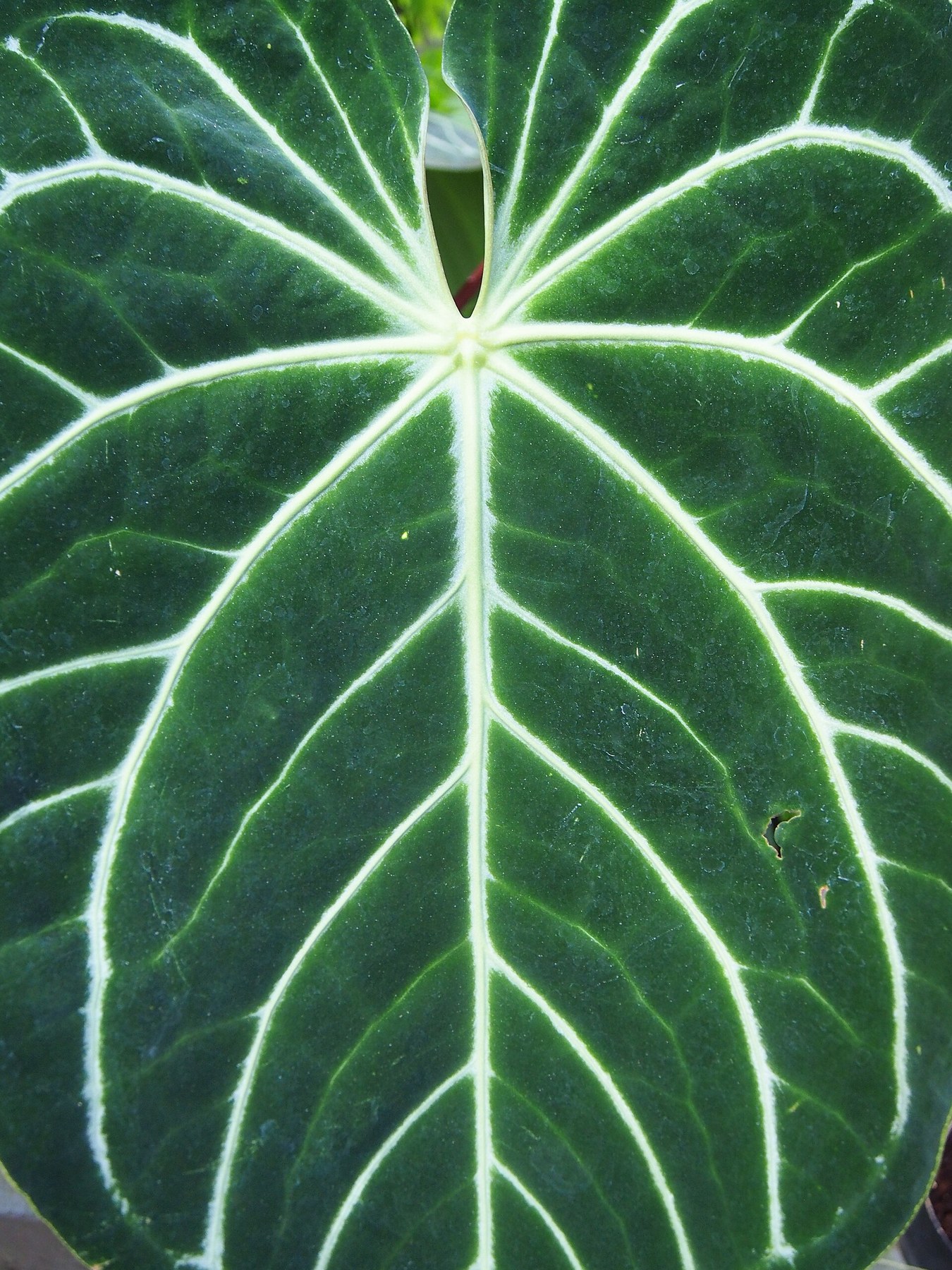
📷 Agnieszka Kwiecień, Nova / Wikimedia Commons (CC BY-SA 4.0)
Field Guide · Anthurium
The cross every seller mentions and few actually have — here's what the real plant looks like, and how to tell from a photo.
The Colombian parent, recognizable by a distinctly winged, quadrangular petiole — run a finger down it and you feel four ridges. Mature leaves are broad, rounded-cordate, and matte velvet with thick chalk-white primary veins. Newer leaves emerge bronze and harden to deep forest green. The most decisive ID feature in any hybrid discussion is that petiole.
Parent AThe Chiapas parent, smaller and stiffer in habit, with a terete (rounded) petiole and a narrow, deeply cordate blade. Venation is finer and more reticulated than magnificum, almost lace-like against a darker green. Leaves are leathery rather than soft-velvet, and the plant stays compact. If a seller's "magnificum × clarinervium" looks exactly like a clarinervium, it probably is one.
Parent BThe hybrid intermediates almost everything. Petioles are subtly ridged but not fully winged; leaves are broader and softer than clarinervium but narrower and more elongated than magnificum. Venation is bold like the magnificum side but with finer secondary tracery from clarinervium. New leaves flush coppery-pink and hold longer than either parent.
The hybridA widely circulated reverse cross that leans darker and more cordate than the standard F1. Petioles read closer to terete with faint angling. The blade is heavy, near-black in low light, with stark silver primaries. Plants sold under this name vary wildly — ask for photos of the petiole cross-section before you buy.
Named cloneNot the hybrid in question, but the one most often confused with it in listings. Papillilaminum contributes a long, pendant blade and intense black velvet; the magnificum side keeps the petiole quadrangular. If the listing photo shows a long, narrow drooping leaf, you are looking at a papillilaminum cross, not a clarinervium one.
Easily confused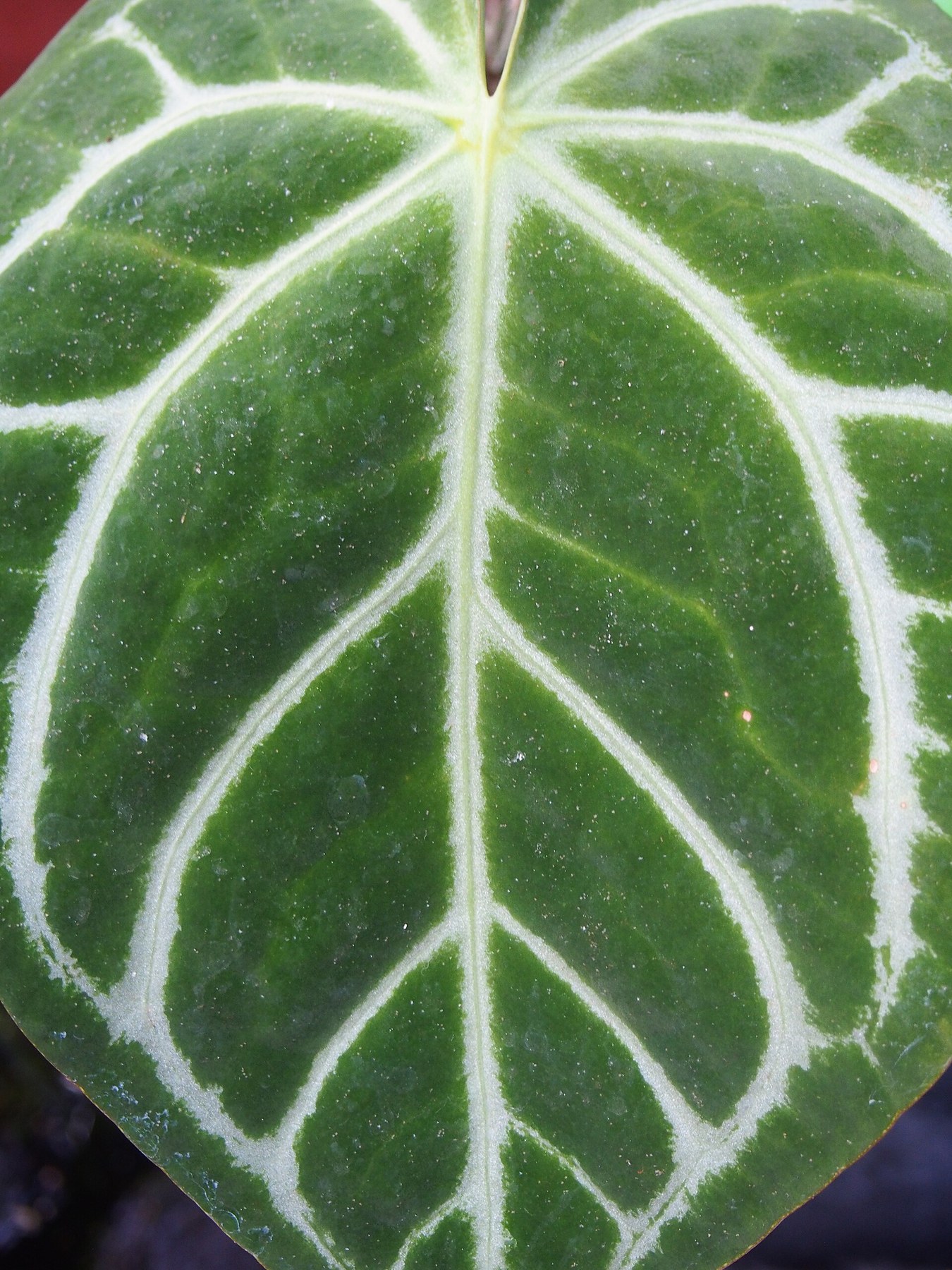
Most mislabeled hybrids in this group can be sorted in under a minute if you know where to look. Start with the petiole. Magnificum has four distinct sides, often with a winged edge that catches highlight. Clarinervium has a rounded petiole, smooth in profile. An F1 hybrid sits between — faintly angled, sometimes ridged on the upper face only, never fully quadrangular and never perfectly round. If the listing has no clear petiole shot, ask for one. A seller who knows what they grew will already have it.
Next, look at leaf shape and proportion. Clarinervium is small, stiff, and deeply heart-shaped with a narrow sinus. Magnificum is broad and rounded, almost shield-like at maturity. The hybrid elongates the clarinervium blade and softens the lobes, producing a leaf that is longer than wide but still clearly cordate. Pure clarinervium rarely exceeds a leaf length of about 25 cm in cultivation; a 35–40 cm velvet leaf with bold white veins on a young plant is almost certainly the hybrid or a magnificum cross.
Finally, venation pattern. Magnificum gives you three to five thick primary veins, chalky and prominent, with relatively sparse secondaries. Clarinervium adds a dense reticulated net between primaries. The hybrid keeps the bold primaries but layers in finer cross-veining — the leaf looks structured rather than just striped. If the listing shows only the boldest white veins with little detail between them, you may be looking at magnificum itself, not the cross.
Treat the hybrid like the more demanding of the two parents — which is clarinervium. It is epi-lithophytic in habitat, gripping shaded limestone outcrops in Chiapas, and it resents wet feet more than magnificum does. A workable mix: 40% chunky orchid bark, 20% perlite or pumice, 20% coco husk chunks, 10% horticultural charcoal, 10% sphagnum. The mix should hold a wet squeeze without dripping and dry to barely damp within four or five days in a 6-inch pot.
Water when the top third of the mix is dry. These are not drought plants — magnificum in particular wilts hard if pushed too far — but soggy substrate kills more anthuriums in collections than anything else. Roots are thick, white, and want oxygen. Aim for humidity above 65% with steady airflow; below 55% the velvet thins and leaves emerge crinkled. A small clip fan moving air across the canopy does more for leaf quality than another humidifier.
Fertilize lightly and constantly rather than in pulses. A balanced liquid feed at quarter strength every watering works better than monthly heavy doses. Flush the pot with plain water once a month to keep mineral buildup off those white veins — salt crust on a velvet leaf is permanent.
Velvet anthuriums want bright indirect light — roughly 150–250 µmol/m²/s, or a bright north window, or a couple of feet back from an east window with sheer diffusion. Direct sun bleaches the velvet to a flat olive within a week and scorches the thin tissue between veins. Too little light, and the hybrid sulks: new leaves come in smaller than the last, petioles stretch, and the bold venation fades.
The most common mistake with this cross is overpotting. Sellers ship in 6-inch nursery pots; buyers move them straight to 8-inch decorative pots with dense aroid mix. The root ball stays wet, the new roots rot before they extend, and the plant declines over two months in a way that looks like a humidity problem. Pot tight, in something with drainage holes you can see through, and only step up when roots are circling.
The second mistake is trusting the label. "Magnificum × clarinervium" is the most over-applied hybrid name in the trade, often slapped onto seed-grown clarinervium with slightly elongated leaves, or onto unrelated dark velvet crosses. Buy from growers who can show you the mother plants, or who at least photograph the petiole. The hybrid is real, it is beautiful, and it is worth the price when it is the right plant — but you have to look past the listing title to know what you are buying.
The Field Guide from Leaf People.