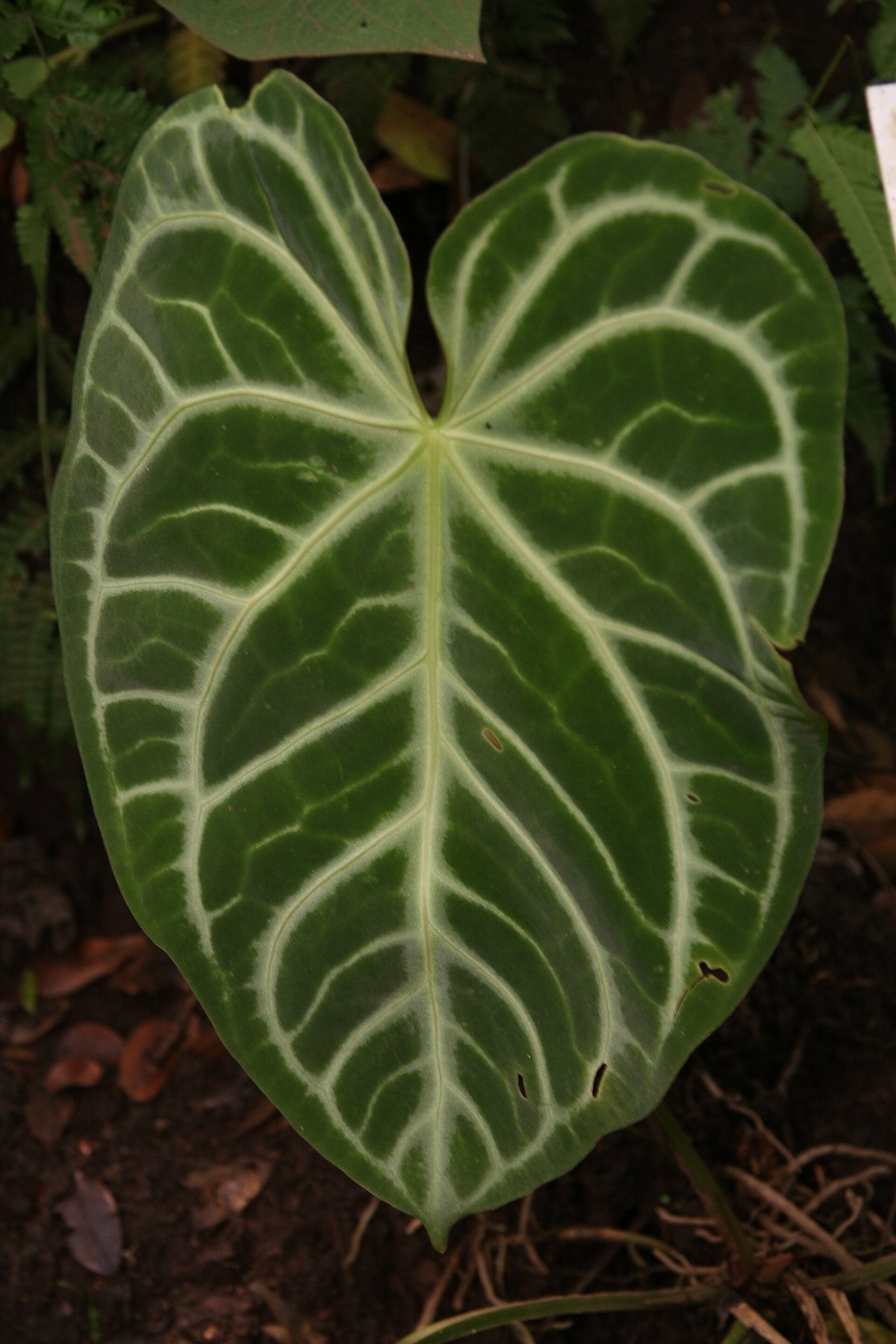
📷 Photo by David J. Stang / Wikimedia Commons (CC BY-SA 4.0)
Field Guide · Anthurium
Same silver veins, same velvet finish, two very different plants — sort them out by petiole, leaf shape, and how they hold themselves.
Endemic to limestone outcrops in Chiapas, Mexico. Thick, almost cardboard-stiff cordate leaves with bone-white venation on deep blackish-green. Petioles are terete and short, holding leaves close to the crown in a tight, upright posture. The easier of the two to grow indoors because it tolerates lower humidity and slightly drier media than its South American cousin.
Most forgivingWide range from Panama through the western Amazon. Leaves are larger, thinner, more elongate, and emerge bronze-pink before settling to matte green with silver veins. Petioles are sub-terete to faintly grooved and longer, so leaves arch outward rather than stack. Wants warmer nights and more consistent humidity than clarinervium — the most common reason it stalls in collections.
The classicThe third plant people drag into this argument, and the easiest to settle: magnificum has distinctly quadrangular, winged petioles you can feel with a fingernail. Leaves are huge, velvet, and slightly more olive-toned, with broader white veins. Colombian, lowland-warm, and a strong grower once it settles. If the petiole has four flat sides, it isn't crystallinum.
TiebreakerIncluded because it's the velvet anthurium that genuinely shouldn't be confused with the other two — but constantly is online. The leaf is peltate: the petiole attaches inside the blade margin, so there's no basal sinus, no lobes. Smaller overall, rounder, with fine silver veining. If you can't find the notch where the petiole meets the leaf, it's forgetii.
No sinus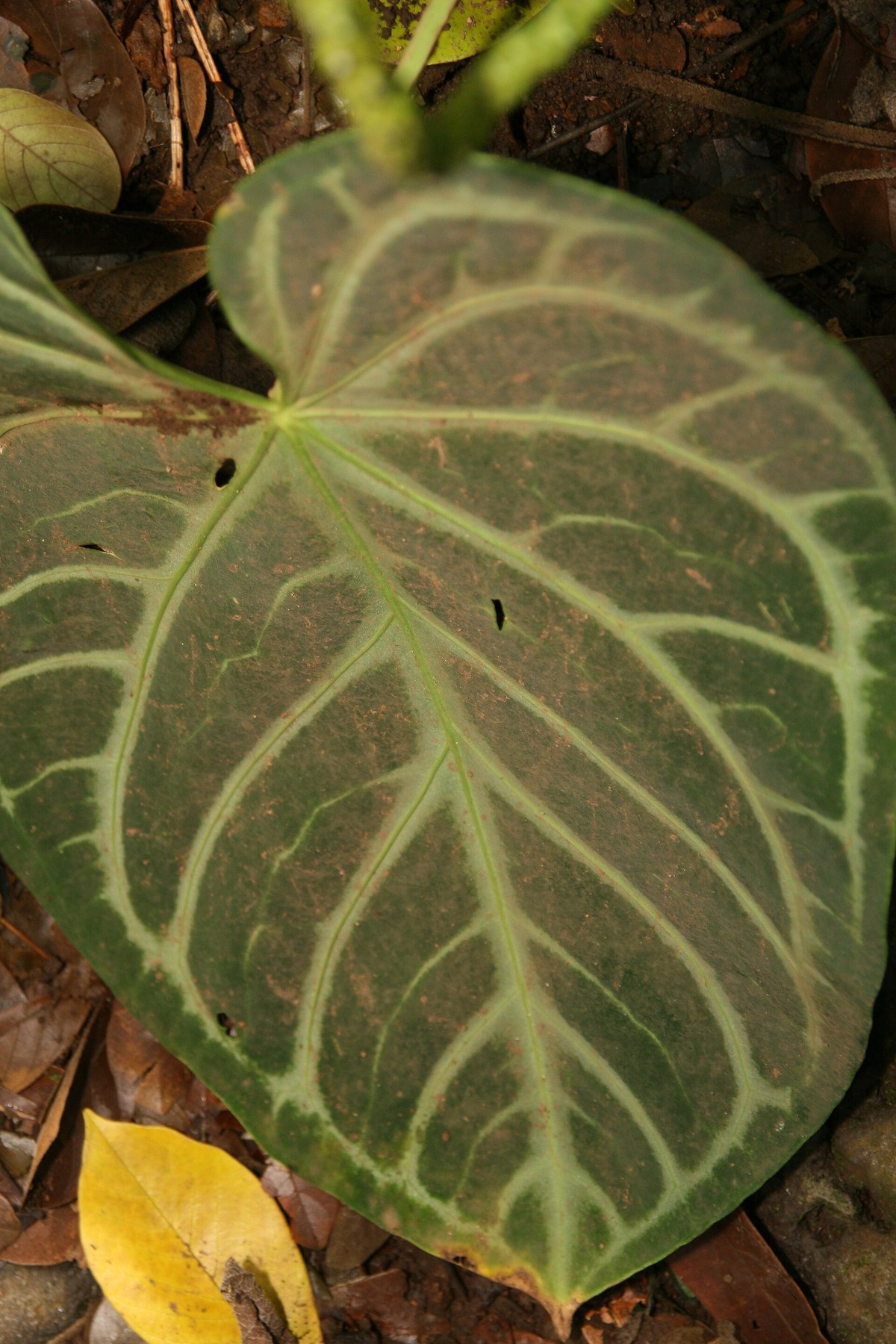
Forget leaf color. Both species sit in the same matte-green-with-silver-veins range, and both flush bronze on new growth under good light. Color is the worst diagnostic character in this genus and the one every mislabeled nursery tag leans on.
Start with the petiole. Roll it between your fingers. Clarinervium is terete — perfectly round in cross-section, like a pencil. Crystallinum is sub-terete, often with a faint adaxial groove running its length. If you feel four distinct edges or any wing, you're holding magnificum and the argument is over.
Then look at leaf substance and shape. A mature clarinervium leaf is thick, stiff, and almost flat when you flex it; the outline is broadly cordate, nearly as wide as long, with deep rounded basal lobes that often overlap. Crystallinum leaves are noticeably thinner, more pliable, and distinctly longer than wide — ovate-cordate, drawn out to a finer drip tip. Hold a leaf of each up to a window: clarinervium blocks the light; crystallinum glows faintly through.
Finally, posture and habit. Clarinervium is a true lithophyte from limestone cliffs and grows as a compact rosette, leaves stacked close to a short, slow stem. Crystallinum is a hemi-epiphyte that climbs modestly; petioles are longer, leaves are held outward and slightly pendant, and an established plant looks loose and architectural rather than tight and shingled. Two plants of equal leaf count will not occupy the same volume of air.
Both species fail in peat-heavy aroid mixes that stay wet for days. Build an open, chunky medium: roughly two parts medium orchid bark, one part perlite or pumice, one part coarse coco chips, and a handful of horticultural charcoal. Some growers add a little sphagnum for moisture buffering — fine, as long as the mix still rattles when dry. Roots want to find air between every drink.
Clarinervium comes from seasonally drier limestone habitat and accepts a real dry-down between waterings. Let the top third of the pot approach dry, then water heavily until it runs through. Crystallinum is less patient; it wants the mix to stay lightly moist but never sodden, and it sulks faster when roots dry hard. Pot both in something that breathes — net pots, slotted orchid pots, or terracotta — and forget about decorative ceramic until you know the plant.
Humidity is where most indoor crystallinum collections quietly decline. New leaves emerge crisped at the margins, then the plant stops pushing. Aim for 70–85% with steady airflow; below about 60% you'll see the damage on every flush. Clarinervium will hold leaves at 50–60% but looks visibly better higher. A small clip fan running constantly does more for both species than any mister, humidifier, or pebble tray.
Fertilize lightly and constantly rather than heavily and rarely. A quarter-strength balanced liquid feed at every watering, flushed clear with plain water once a month, keeps the silver veining sharp. Both species are sensitive to salt buildup — brown, papery leaf edges are usually fertilizer accumulation, not low humidity.
Bright indirect light. Not a sunny windowsill. A few feet back from an east window, filtered south, or under a decent LED at roughly 100–250 µmol/m²/s for 12 hours. Direct midday sun bleaches velvet leaves in an afternoon and the damage doesn't repair — the leaf carries the scar until it abscises. If a leaf looks flat olive instead of deep green-with-silver, it's getting too much light.
Keep nights above 65°F / 18°C. Crystallinum in particular stalls below that and may rot at the crown if cold nights coincide with a wet pot. Neither species enjoys a cold draft from a winter window, and neither tolerates the bone-dry air of a forced-air heating vent — move them in October, not December.
The recurring mistakes: potting too large (roots circle wet medium and die back), watering on a schedule instead of by weight, wiping leaves with anything oily or shiny (velvet is microscopic papillae — leaf shine products flatten the optical effect permanently), and buying a labeled crystallinum that turns out to be a hybrid. If the new leaf comes in green without a bronze flush, or the petiole shows wings as it matures, you have something else. That's not always bad — crystallinum × magnificum crosses are vigorous and beautiful — but know what you're growing before you blame yourself for how it looks.
The Field Guide from Leaf People.