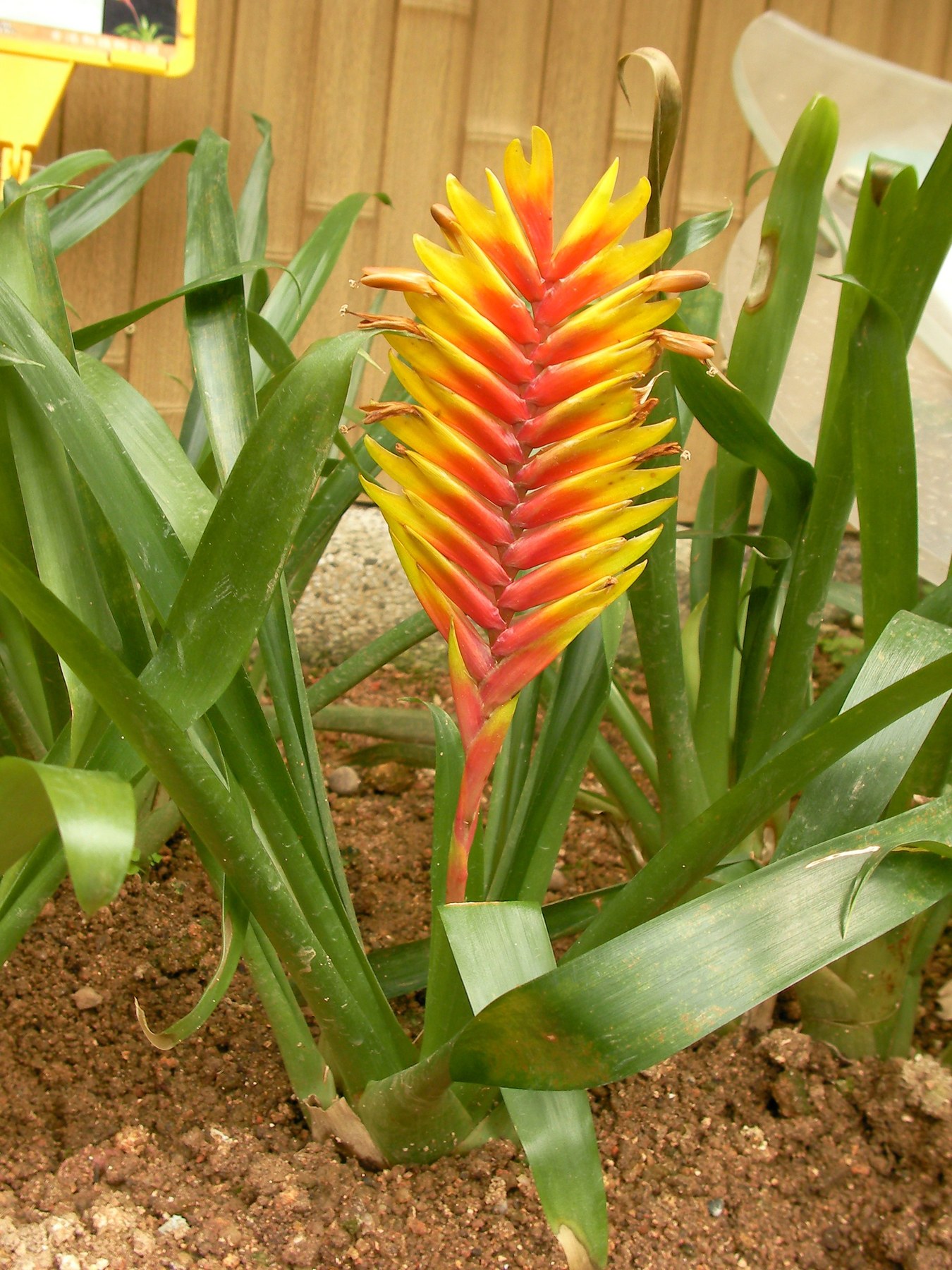
📷 Tequila 03:09, 30 June 2007 (UTC) / Wikimedia Commons (CC BY-SA 3.0)
Field Guide · Vriesea
Architectural tank bromeliads that thrive on neglect, drink from their own cups, and earn their place beside the velvet philodendrons.
The so-called king of bromeliads, native to the Atlantic forest of southeastern Brazil. Broad, strappy leaves to 60 cm carry irregular dark green crossbands that look genuinely inked on. It tolerates lower light than most Vriesea — bright shade is enough to keep the banding crisp — and a mature rosette will hold a liter of water in its central tank. Slow, patient, and worth the wait.
The flagshipA foster cultivar selected for heavy oxblood reticulation over olive-green leaves. Wants brighter light than hieroglyphica — close to what a thin-leaf Anthurium would take — to pull the dark pigment forward. The rosette flattens with age into a near-perfect pinwheel about 70 cm across. One of the few bromeliads that reads as moody rather than tropical-cheerful.
Best patternThe flaming sword, from Venezuela, Trinidad, and the Guianas. Dark green leaves with horizontal purple-black bands, and a flattened scarlet bract spike that can stand 60 cm above the cup for months. It is the most widely available Vriesea in the trade and the most forgiving of average humidity. A good plant to learn the genus on before spending on a mature hieroglyphica.
Start hereA Colombian species with chartreuse leaves freckled in darker green — closer in mood to a Philodendron gloriosum than a typical bromeliad. Stays compact, around 40 cm across, which makes it useful in shelf collections where hieroglyphica would crowd everything. Likes the same warm, airy conditions as a thin-leaf anthurium. Color holds best in bright indirect light without direct sun.
Shelf sizeA stable cream-and-green longitudinally variegated cultivar, parentage typically traced to gigantea and fosteriana lines. The variegation is sectoral and reliable — no reverting nonsense — and the plant grows to a substantial 70–90 cm rosette. Needs more light than the species Vriesea to keep the pale stripes from etiolating. The one variegate in this genus genuinely worth the asking price.
Worth the splurge
If you grow rare Philodendron and Anthurium, you already have the conditions a Vriesea wants: warmth, bright indirect light, moving air, and a grower who pays attention. The genus contains roughly 250 accepted species across Central and South America, most of them epiphytic tank bromeliads with central cups that collect rain, leaf litter, and the occasional drowned insect. They evolved to live attached to a branch in the canopy, which means their root system is small, mechanical, and almost entirely about anchorage.
That biology is the point. A Vriesea does not want what a Philodendron gloriosum wants from its substrate. It wants almost nothing from its substrate. It drinks from the cup, feeds lightly from debris that falls in, and asks the roots to hold it upright. For a collector who has spent years overthinking aroid mixes, the relief is real. You can mount one to a slab of cork, water the tank, and move on.
Architecturally they also do something the aroids cannot. A mature V. hieroglyphica or fosteriana reads as a single flat sculpture — a rosette held in one plane — which gives a shelf or a grow tent visual rhythm that vining and creeping aroids alone never quite achieve.
Treat the roots as an afterthought, because the plant does. A loose mix of orchid bark, perlite, and a little long-fiber sphagnum in a small pot is plenty — roughly the same airy blend you would use for an Anthurium clarinervium, but in a vessel one or two sizes smaller than instinct suggests. Overpotting kills more Vriesea than underpotting. If you mount, cork bark or tree fern with a thin sphagnum pad behind the base works well; tie with fishing line or coated wire until the roots grip, usually three to six months.
Light is where collectors with an aroid-only background tend to underdeliver. Vriesea splendens and hieroglyphica accept the bright-shade end of the spectrum, but fosteriana, ospinae, and variegated hybrids like 'Vista' want noticeably more — call it 200 to 400 µmol/m²/s, or the kind of light a Hoya would be happy in. Pigmented patterning is light-driven. A 'Red Chestnut' grown in low light becomes a dull green plant with hints of where the color should have been.
Airflow matters more than humidity. 50 to 70 percent relative humidity is comfortable, but a still, wet cup at 80 percent is how you end up with rot at the meristem. A small clip fan running near the collection solves this entirely.
Keep the central tank filled with clean water — rain, RO, or distilled if your tap is hard. Flush it every one to two weeks by tipping the plant and refilling, because stagnant tank water grows things you do not want growing in your tank water. The substrate, by contrast, should approach dry between waterings. Wet roots plus a full cup is the classic way to lose a Vriesea, and the symptoms (leaves pulling loose from the base with a wet snap) come too late to fix.
Feed lightly. A quarter-strength balanced fertilizer added to the tank monthly during active growth is enough; foliar misting at the same dilution works as well. Heavy feeding pushes soft, pale growth and can burn the cup tissue. Skip fertilizer entirely in the months the plant is not pushing new leaves.
The three mistakes I see repeatedly from aroid people moving into bromeliads: potting them deep in a moisture-retentive aroid mix, watering the substrate instead of the cup, and treating low humidity as the problem when the real problem is low light. Fix those three and a Vriesea will sit in your collection for a decade, throw one spectacular inflorescence, produce a pup or two from the base, and quietly hand the rosette over to the next generation. The mother dies after flowering — this is normal, not a failure — and the pup, separated when it is roughly a third the size of the parent, starts the cycle again.
The Field Guide from Leaf People.