There is a particular kind of collector frustration reserved for plants that refuse to behave the way your infrastructure expects. You build the moss pole. You mist it, you pack it, you tie the stems up with soft jute. The plant ignores all of this entirely, sending its rhizome sideways off the edge of the pot instead, a pale green elbow dragging across the table. This is Philodendron mamei. This is also, depending on which morning you discover it, either a maddening plant or a clarifying one.
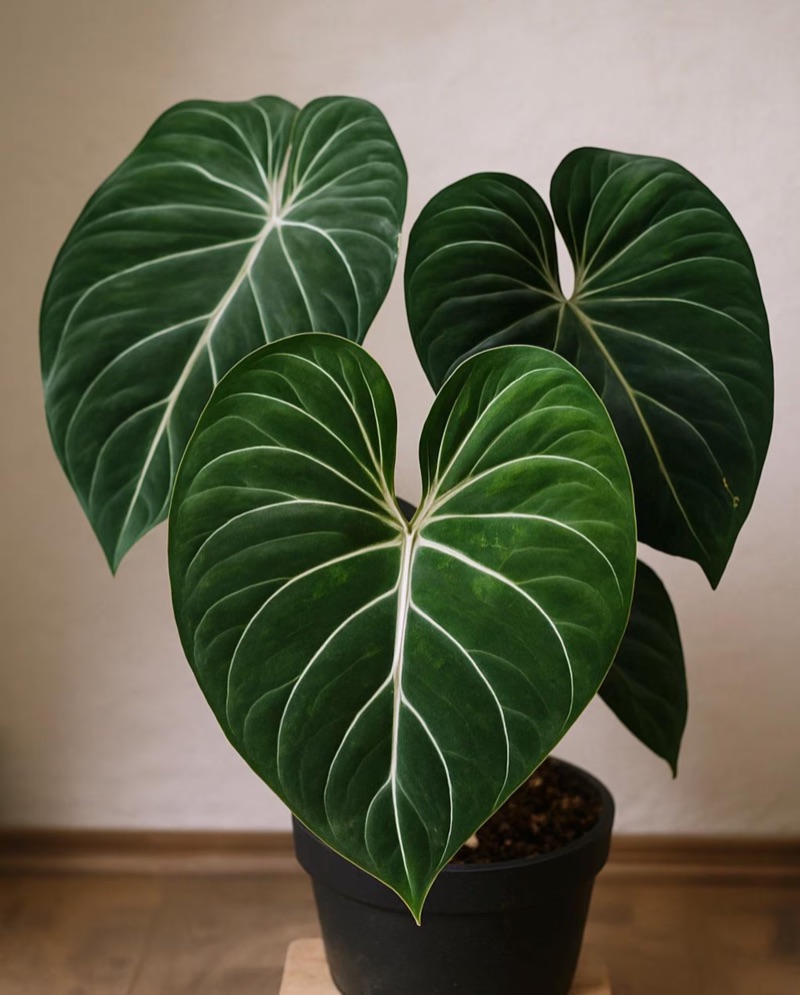
Philodendron mamei is native to Ecuador, where it grows as a terrestrial and semi-epiphytic crawler across the forest floor and low bank faces — not up into the canopy. Its closest relatives in habit include P. sodiroi and the hybrid that circulates under the trade name P. 'Sodiroi Ornatum', all of them sharing that same low, horizontal ambition. The leaves are silver-washed, deeply cordate, velvety to the touch in juvenile stages, and the petioles are geniculate — they bend at the node in a way that angles each blade outward, away from the center. Understanding that geometry is the first step to growing the thing well. Almost no one who sells it explains it.
What the Rhizome Is Actually Doing
A climbing philodendron — a gloriosum-style creeper or an erubescens type reaching for a pole — operates on apical dominance. Energy goes upward. Nodes emerge vertically, each one pushing the growing tip higher while older leaves lower on the stem persist or senesce. The plant has a clear axis. You can stake it, train it, read its progress in a straight line.
P. mamei operates differently. The rhizome is the stem, running horizontally just at or below the soil surface, and each node along it produces a single leaf on a long petiole. There is no upward axis to speak of. The growing tip advances laterally — across the substrate, over the rim, into air if nothing stops it. The plant is reading the forest floor, not the canopy. What it wants is forward.
This matters for diagnosis. When a mamei produces small leaves, the instinct is often to assume it needs more light or more fertilizer. Sometimes that is true. But more often, the rhizome has run out of pot and coiled back on itself, or it has climbed the interior wall and dried out at the node, or the substrate is dense enough that forward movement requires more energy than the plant currently has. The leaf size is downstream of rhizome health.
The rhizome wants to walk, not climb — build infrastructure for horizontal travel and the plant rewards you immediately.
The Planting Problem
Most people plant mamei the way they would plant any philodendron: centered in the pot, rhizome buried to mid-depth, substrate packed around the base. This is wrong in several ways at once.
First, centering. A crawler planted in the center of a pot has, at best, half a pot's worth of forward travel before it hits a wall. Plant instead at the edge — the back edge if you're displaying it against a wall, or one side edge if it sits on a shelf with clear travel space. The growing tip should point toward open substrate, with the entire diameter of the pot ahead of it.
Second, burial depth. The rhizome of mamei prefers to run near the surface, where it gets the airflow and the temperature fluctuation that mimics dappled forest-floor conditions. Burying it deep causes two problems: the nodes can't sense the surface environment well, and the substrate around the rhizome stays wet longer, which is the direct path to rhizome rot. Lay it on top of, or only shallowly into, the mix. A light top-dressing of chunky material — coco chips, coarse perlite — keeps the rhizome from desiccating at the surface without waterlogging it below.
Third, pot geometry. A standard round nursery pot gives roughly equal space in all directions, which is fine for a clumping plant but wasteful for a directional one. Long, shallow troughs — the kind sold for outdoor planters — are ideal. So are wide, low azalea-style pots. The goal is surface area, not depth. A mamei in a trough can travel eight to twelve inches of linear substrate before it needs repotting, and during that travel it will push out its largest leaves.
Substrate Logic for Something That Travels
The mix that works for a hemi-epiphyte like P. gloriosum — one that climbs mossy banks and enjoys some root exposure — is close to what mamei needs, but with a specific adjustment for lateral drainage. Vertical climbers can tolerate slightly denser mixes because gravity pulls water away from the root zone passively. For a horizontal rhizome sitting near the surface, you need the mix to drain and aerate from the side, not the bottom.
A workable base: two parts coarse perlite, two parts orchid bark (fine to medium grade), one part coco coir, and a small amount of worm castings or aged compost for slow nutrition. This reads chunky. It should. Compaction is the enemy. When you press your finger into the surface, it should offer resistance, not yield like potting soil. You can add horticultural charcoal if you're nervous about anaerobic pockets around the rhizome — it helps less than good drainage geometry but doesn't hurt.
What to avoid: peat-heavy mixes that compact over time and hold moisture at the surface. Also avoid fine-grade bark, which packs densely enough to impede rhizome penetration. The rhizome needs to push through the medium like a hand through coarse gravel, not like a hand through wet sand.
Light, Humidity, and What the Velvet Actually Requires
The silver patterning and velvety texture of mamei leaves are adaptations to low-light, high-humidity understory conditions. The velvet surface — trichomes, microscopically — increases the leaf's surface area for gas exchange and helps the plant manage moisture at the leaf boundary. In cultivation, this translates to: the plant is adapted to handle lower light than many philodendrons, but it does not prefer it. Bright, indirect light produces larger leaves with more pronounced silver flash. Direct sun bleaches and scorches.
Humidity above 60% is where the velvet stays velvety. Below that, leaves can feel papery by the time they fully expand, and new growth sometimes edges with brown before it hardens. A grow tent, a cabinet with a small ultrasonic humidifier, or a naturally humid room — a bathroom with a skylight is not a fantasy, it's a real setup that works — all achieve this. What matters as much as the humidity number is airflow. Stagnant humid air is a disease vector. A small fan running on low keeps the air moving without desiccating the rhizome.
Temperature: above 60°F at night, ideally 65–80°F through the day. Mamei has less cold tolerance than it's sometimes given credit for. A single cold draft from a window in January can abort a leaf that's been unfurling for three weeks.
The Closely Related, the Confused, and the Worth-Chasing
Philodendron sodiroi is the silver-leaf species most often confused with mamei in the trade. The petiole is the tell: sodiroi has a more pronounced sheath, and the silver patterning tends to be more uniformly distributed across the blade rather than concentrated at the midrib and primary veins as in mamei. Both are crawler types; both need the same planting approach. If you're ever uncertain which you have, grow it well and wait — the mature leaf shape and petiole sheath will clarify.
The hybrid P. 'Sodiroi Ornatum' (sometimes sold simply as 'Ornatum') circulates at collector sales and tends to push larger leaves earlier than either parent, which is why it's popular. It is not a named cultivar with a stable lineage in the way that, say, a registered Hoya clone is — treat provenance claims with skepticism. What matters: it crawls the same way, needs the same infrastructure, and rewards the same planting logic.
If you want to chase further in this direction: P. gloriosum is the species that gets most of the attention, with its white-veined, heart-shaped blades that can reach two feet across in a well-set-up grow space. It crawls more aggressively than mamei, demands even more lateral pot space, and will punish you faster for a dense substrate. But the plants are related in habit if not in taxonomy, and the hard lessons from mamei transfer directly.
Propagation Without Ruining the Rhizome
Cutting a rhizomatous philodendron for propagation feels violent in a way that node-cutting a vining species does not. You are bisecting the main axis of the plant. Do it wrong and you stall both halves. Do it at the right moment and both sections push new growth within a month.
The right moment is when the rhizome has at least two or three nodes behind the cut point that have already produced mature leaves, and when the cutting itself has at least one node with a healthy leaf and a visible root or root primordia. Cut cleanly with a sterilized blade, dust the cut surface with powdered sulfur or activated charcoal, and let both ends callous for a few hours before placing them in substrate. Do not water heavily immediately after — you want the wound to seal, not wick moisture.
The cutting can be rooted in the same chunky mix you'd use for a mature plant, laid on the surface and pinned lightly with a floral wire staple if it won't stay put. Humidity above 70%, indirect light, no fertilizer until you see new root activity. The main plant, meanwhile, should push a new growing tip from one of the remaining nodes within four to six weeks, often sooner.
What It Teaches You
There is a version of this hobby that is entirely about acquisition — the next species, the next auction, the next cutting arriving in a small plastic bag with damp sphagnum. Philodendron mamei resists that mode. It is not a fast grower. It does not produce a new leaf every two weeks in an ordinary household setup. What it does is make the care visible in a way that faster plants obscure.
When the rhizome is moving well — crossing the pot surface, each new leaf larger than the last, the petioles standing upright and the blades holding their silver under the light — you know you've gotten the substrate right, the humidity right, the pot orientation right. The plant is a slow-running diagnostic. Every variable you've adjusted shows up in the growth rate and the leaf size, with a lag of four to eight weeks.
That lag is the thing. You make a change and then you wait, and then you see whether you were right. It is a different relationship than the one most people are looking for when they buy a plant. But for collectors who find the waiting generative rather than frustrating, mamei is one of the more honest plants in the genus — a crawler that shows you exactly what it needs, once you learn to read horizontal progress as the signal it actually is.