The first leaf stops you. It arrives narrow and coppery, barely three inches long, and you almost overlook it — just another new growth on a cutting you paid too much for. Then the second leaf comes in darker. The third is iridescent in the right light, shifting from near-black to the deep green of an old wine bottle. By the time the fourth unfurls at twice the size of the first, you understand what the plant is building toward, and you stop worrying about the price.
Philodendron melanochrysum is not the most difficult velvet philodendron to grow. It is not the rarest. What it does, which almost no other species does so dramatically, is change — structurally, proportionally, in the weight and sheen of each successive leaf — as it climbs. Collectors who have run through micans, gigas, and gloriosum tend to describe melanochrysum as the species that recalibrated their sense of what a philodendron could become. That recalibration is worth examining closely.
The Micans Gateway and Why It Works
Most collectors arrive at velvet philodendrons through Philodendron micans. This is not a bad thing. Micans is forgiving in a way that melanochrysum is not quite, tolerating lower humidity and more variable watering with only moderate complaint. Its leaves are small — two to four inches on a mature trailing stem — and that velvety surface catches light in a way that surprises people who expected something merely green. For a grower still calibrating their setup, it offers a real preview of what velvet texture means without demanding a fog machine.
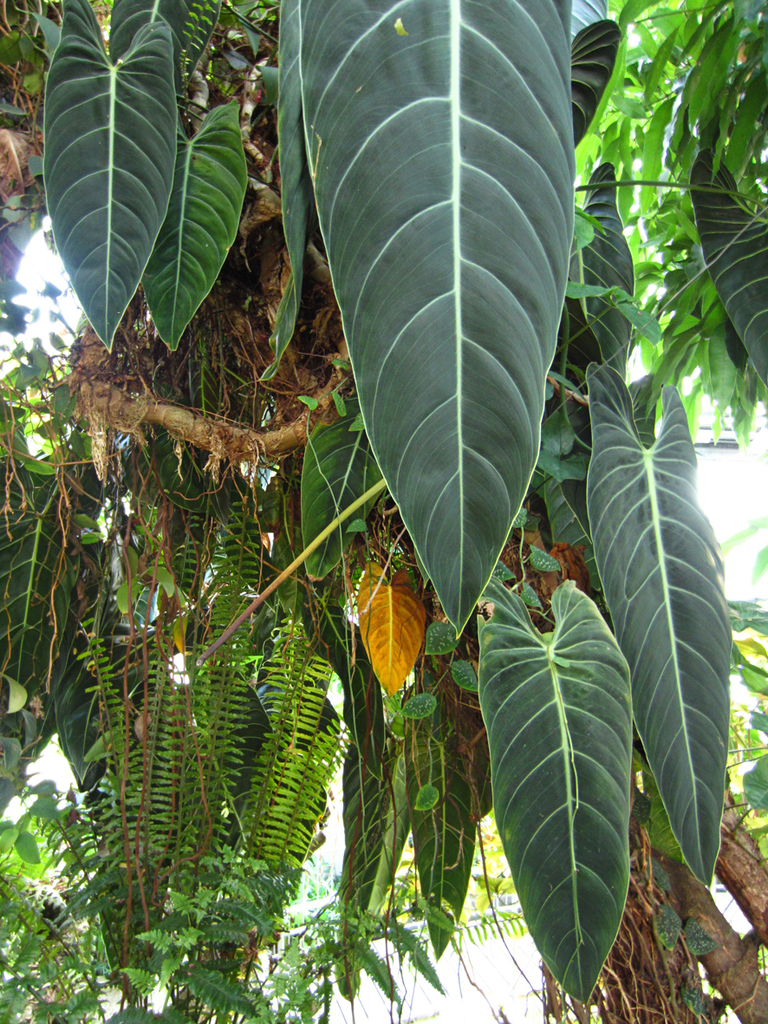
The trouble with micans as a gateway is that it undersells the category. Spend a year trailing it across a shelf and you might conclude that velvet philodendrons are charming but modest. Then you see a mature melanochrysum leaf — eighteen inches of near-black lamina, primary veins outlined in pale gold, surface so dense with trichomes it looks like suede — and the shelf plant suddenly feels like a rough draft.
The jump from micans to melanochrysum is partly about scale and partly about biology. Melanochrysum is a hemiepiphyte from the Andean foothills of Colombia and Ecuador, built to climb tree trunks toward the canopy. Micans trails and scrambles. The difference in growth strategy produces a difference in what each plant can eventually become, and that difference is visible in every leaf.
By the time the fourth leaf unfurls at twice the size of the first, you understand what the plant is building toward.
Juvenile to Adult: What the Pole Actually Does
Collectors sometimes describe melanochrysum as 'slow,' and juveniles can be, especially in suboptimal humidity or on a flat surface. What the word slow usually means is: not climbing. Give the plant an upright moss pole or coco coir totem that stays consistently moist, and the growth rate and the leaf size shift within one or two nodes. This is not metaphor. The root nodes sense the moisture and texture of the vertical substrate, trigger a hormonal response, and the plant commits upward.
Juvenile leaves on an unanchored cutting might run three to five inches long, narrow, and noticeably thinner in texture than what the species is capable of. Once the aerial roots make solid contact with a damp pole and the plant begins ascending in earnest, internodal spacing tightens and leaf size can double with each new unfurling. Adult leaves on a well-established climbing specimen regularly reach fourteen to twenty inches, becoming proportionally wider and developing that characteristic drip-tip — an attenuated point at the leaf apex that channels moisture off the blade and is one of the cleaner field marks distinguishing melanochrysum from its near relatives.
The color progression is just as pronounced. Early juvenile leaves emerge with a strong copper or bronze cast, particularly in bright indirect light. As the plant matures up the pole, new leaves emerge darker, settling into the deep, almost charcoal green that gives the species its common name: black gold. The gold part refers to the venation, pale and precise against the dark lamina, most visible on the underside where the veins catch ambient light and glow faintly. Neither element is subtle on a leaf the size of a legal pad.
Melanochrysum Versus Gigas: Knowing the Difference
The species most commonly confused with melanochrysum at the cutting stage is Philodendron gigas, another large-growing Andean climber with velvet texture and a similar deep green adult coloration. Both circulate in the collector market, both command real money, and mislabeled cuttings appear with enough regularity that it's worth knowing the distinctions before you commit.
Gigas tends to have a more elongated leaf shape at maturity, with less pronounced venation contrast and a slightly matte rather than iridescent surface. The drip-tip on gigas is less exaggerated. Petiole length is a useful early marker: melanochrysum petioles are proportionally long and develop a slight D-shape in cross-section as the plant matures, while gigas petioles tend to stay rounder and shorter relative to blade length. Neither of these characters is definitive from a single juvenile leaf, which is why purchasing from a seller who photographs multiple nodes and ideally an adult leaf is worth the premium over a mystery cutting.
There is also Philodendron 'Melano x Gigas,' a hybrid that circulates under various informal names and occupies an ambiguous space in the market — sometimes sold as pure species, sometimes disclosed as hybrid. If provenance matters to you, and for a plant you intend to keep for ten or fifteen years it should, ask directly and treat vague answers as a soft no.
The Humidity Question, Answered Honestly
Melanochrysum prefers humidity in the 65–80% range. It will survive lower. 'Survive' is the operative word: below 55% relative humidity, new leaves on an actively climbing specimen tend to emerge with minor edge crisping and the velvet surface loses some of its density, the trichomes shorter and less developed. The leaves still grow, but they grow smaller and less characteristic of the species. You are technically keeping the plant alive while systematically preventing it from becoming what it is.
The practical implication is that a passive room humidifier placed near the plant is rarely sufficient in a dry climate or during a heated winter. A dedicated grow tent or enclosed shelf with a humidistat-controlled ultrasonic humidifier is the difference between a plant that performs and a plant that merely persists. Airflow matters too: stagnant humid air at the root zone encourages rot, particularly in the thick coco fiber of a damp pole. A small fan running on low keeps the air moving without dropping humidity below target.
Watering the pole independently of the pot is a practice most serious melanochrysum growers adopt quickly. Misting or top-watering the coir totem every one to two days — while allowing the substrate in the pot itself to approach dryness before the next thorough watering — keeps the aerial root attachment strong without waterlogging the medium. A chunky mix of orchid bark, perlite, and a modest amount of coco coir drains fast enough to support this rhythm.
Light and the Iridescence Problem
The iridescence in melanochrysum leaves — that shifting quality that makes a dark green leaf look almost blue at certain angles — is produced by the microscopic structure of the trichomes and the way they scatter light, not by pigment alone. It is most pronounced on leaves grown under bright indirect light: within one to two feet of an east-facing window, or under a full-spectrum LED set to the 200–400 PPFD range at leaf level. Leaves grown in lower light tend to be larger but flatter in color, the iridescence muted.
Direct midday sun bleaches the velvet surface within a few weeks, washing out the dark pigmentation and leaving the lamina a dull olive. Morning sun for two to three hours is generally fine and can intensify the copper flush on juvenile leaves, which many growers find worth managing for. The practical takeaway is that melanochrysum rewards placement that is thoughtful about intensity and angle, not merely proximity to a window.
What a Mature Specimen Actually Looks Like
Most collector photographs of melanochrysum show juveniles or small adolescent plants — three to five leaves on a fresh pole. It is worth knowing what a mature specimen becomes, because it changes how you plan for the plant from the start. Given a pole of six feet or more, stable humidity, and two to three years of consistent upward growth, melanochrysum produces leaves that command the space around them. A single adult leaf at eighteen inches is larger than many full plants of other species in a standard collection.
The cataphylls — the papery sheaths that enclose each new leaf as it emerges — dry and persist on the stem as the plant climbs, giving the trunk a textured, almost scaled appearance. Some growers remove them; most leave them as an indicator of plant health and as minor structural support for aerial roots finding their grip. The overall architecture of a tall, pole-mounted specimen is striking in a way that has nothing to do with rarity or market value: it is simply a large plant doing what large plants do, occupying vertical space with authority.
There is a particular satisfaction in watching a plant you bought as a three-leaf cutting become something that requires a six-foot pole and a dedicated corner of a room. Melanochrysum delivers that satisfaction on a timeline that rewards patience without punishing it — a year for the commitment to become visible, two years for the leaves to reach full adult size, three years for a specimen worth photographing in something other than macro. That arc is exactly what the species is for.
Why It Resets the Collection
Collectors who have kept melanochrysum long enough tend to apply what they learned to the rest of their setup: the pole moisture protocol, the humidity precision, the attention to light angle and intensity. The species is demanding enough to require these habits and forgiving enough not to punish the occasional lapse catastrophically. It functions, in practice, as a standards-setter for whatever comes after it.
The comparison to micans is not meant to diminish micans, which remains a genuine and underrated species with its own textural qualities and a cascading growth habit that melanochrysum cannot replicate. They are simply asking different questions of the grower. Micans asks whether you enjoy velvet. Melanochrysum asks whether you are willing to build a setup around a plant — to buy the right pole, run the right humidity, position the grow light with intention. Collectors who answer yes tend to find that the answer reconfigures what they expect from every subsequent acquisition.
There are rarer velvet philodendrons. Philodendron splendid (the melanochrysum × verrucosum hybrid) circulates at prices that reflect its scarcity, and true verrucosum from verified Ecuadorian provenance is harder to source cleanly. But scarcity and performance are different axes, and on the axis of what a plant can become in a well-run collection, melanochrysum ranks with the best of them. The first leaf stops you. The fifteenth leaf, eighteen inches of black-green suede with gold veins catching the grow light, makes you understand why you started collecting in the first place.