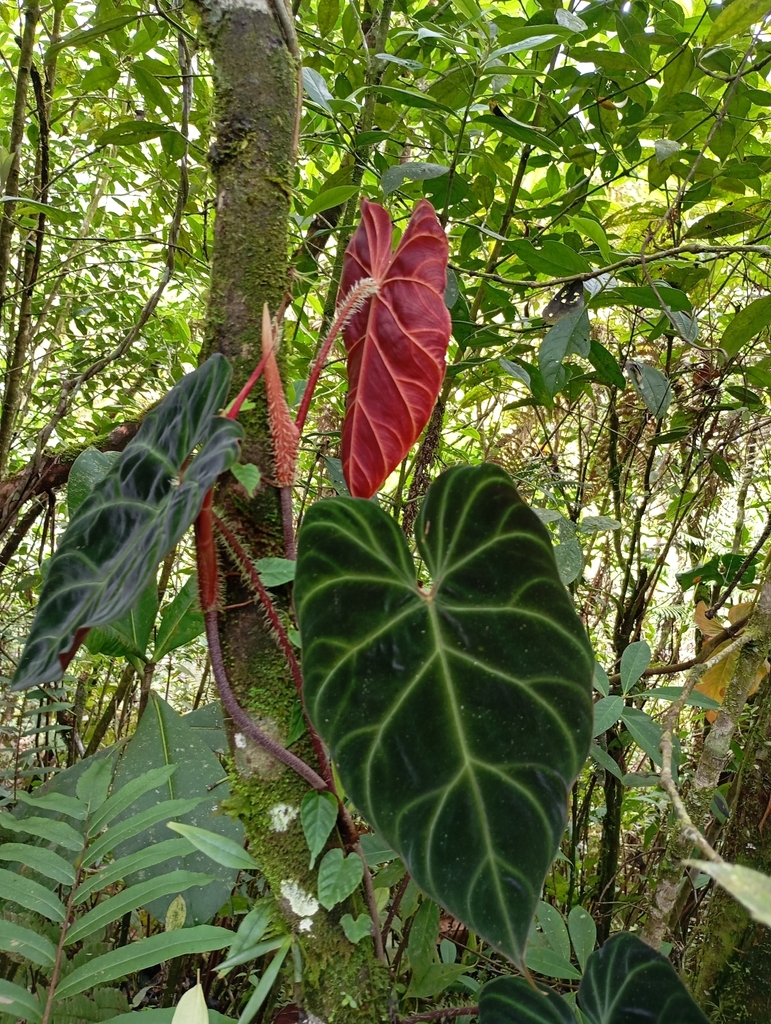
There is a moment, maybe three months into owning a Philodendron verrucosum, when the plant does something that stops you mid-sentence. A new leaf unfurls — slowly, over four or five days, the way these things always take longer than you expect — and the light catches it at an angle that makes you question whether you are looking at a leaf or a window. The deep green lamina shimmers with a blue-gold iridescence, the pale veins pulling the eye in every direction at once, the whole surface behaving less like plant tissue and more like something woven. You understand, in that moment, why people spend years chasing these things.
Then the leaf hardens off, the iridescence fades to a subtler glow, and you notice the petiole: bristling with fine red-orange hairs, sticky to the touch, the kind of surface that collects dust and fungus gnats with equal enthusiasm. This is verrucosum in miniature — spectacular, specific, and profoundly uninterested in your apartment's ambient humidity.
Where These Plants Actually Come From
Philodendron verrucosum grows natively across a broad elevation range in Ecuador, Colombia, Costa Rica, and Peru — but the plants that collectors prize most originate from mid-elevation cloud forest, roughly 1,000 to 2,000 meters, where temperatures are cool, humidity rarely dips below 80 percent, and the air moves constantly through the canopy. That context matters. Every difficulty collectors encounter with this species traces back to the gap between cloud forest conditions and what a grow tent in a spare bedroom can realistically sustain.
The genus Philodendron is vast — over 500 accepted species, with estimates suggesting hundreds more undescribed — but the iridescent Ecuadorian climbers occupy a fairly coherent ecological niche. They are hemiepiphytes, beginning life as terrestrial seedlings before ascending host trees, clinging with the hairy or waxy petioles that make them so tactilely strange. Philodendron gloriosum, the white-veined terrestrial from Colombia, is sometimes grouped aesthetically with these species despite crawling along the forest floor rather than climbing. The two plants share a velvet texture and an intolerance for stagnant, dry air, but their growth habits are completely different, and conflating their care needs is a reliable way to lose both.
The high-elevation provenance of verrucosum also explains its temperature sensitivity. Unlike Philodendron melanochrysum — another dark-leaved iridescent climber, native to lower elevations in Colombia — verrucosum actively benefits from a nighttime temperature drop into the low 60s Fahrenheit. Some growers report that without that drop, leaves come in smaller and the iridescence is less pronounced. Whether that is physiologically confirmed or collector lore is difficult to say, but the pattern is consistent enough across growers that it is worth taking seriously.
The leaf behaves less like plant tissue and more like something woven — and it will remind you of that the second the air dries out.
Reading Iridescence: What You Are Actually Seeing
The iridescence in velvet philodendron leaves is not pigment. It is structural color, produced by a layer of iridoplasts — specialized chloroplasts — arranged just beneath the upper epidermis. These cells are orientated to maximize light capture in the dim understory, and the photonic interference they create is what produces that blue-green shimmer. The plants did not evolve to be beautiful for collectors. They evolved to harvest every available photon on a cloud forest floor where direct sun is a rare luxury.
This has an immediate practical implication: these plants want bright, diffuse light, not low light. The velvet surface and dark coloration are adaptations for efficiency, not shade tolerance. Growers who treat verrucosum as a low-light plant because it looks like a shade plant will get slow growth, pale leaves, and petioles that seem to stretch toward whatever window exists. A north-facing shelf is not doing these plants any favors. East-facing light, or a well-dialed grow light at moderate intensity — around 150 to 250 PPFD for juvenile plants — keeps internodes tight and leaves coming in with proper sizing and color.
The iridescence is also most vivid on fresh leaves and fades somewhat as the lamina matures and the cell structure firms up. This is not damage or deficiency. It is normal. Experienced growers learn to appreciate the full arc — the furled spear, the translucent unfurling, the brief window of peak shimmer, the mature leaf settling into a rich, matte-dark green that holds its own on a different register.
The Petiole Problem, and What It Tells You
Both verrucosum and its close relative Philodendron sodiroi produce hairy or glandular petioles that serve multiple functions in the wild: they may deter herbivores, assist with climbing, or play some role in moisture management that is not fully understood. In cultivation, those hairs are a liability. They catch and hold moisture against the stem, which in a low-airflow environment means rot. They accumulate mineral deposits from tap water. They are where fungus gnats lay eggs when your media stays too wet too long.
The practical response is airflow, not dryness. A small fan running on low, pointed near but not directly at the plant, keeps the petiole surface from staying damp without desiccating the leaf margins. This is one of those care details that separates growers who keep verrucosum alive indefinitely from those who cycle through plants every year. The petioles on a well-grown specimen are vivid — red-orange, almost luminous — and that color intensity is a reasonable proxy for overall plant health. Pale, sparse hairs usually mean the plant is unhappy in some dimension: too dry, too wet, too dark, or rootbound.
Philodendron gloriosum lacks the hairy petioles but presents its own structural signature: a distinctly D-shaped cross-section and a crawling rhizome that moves horizontally along the soil surface rather than climbing. Potting it in a standard round container almost guarantees you will watch it crawl out of the substrate within a season. Serious growers use long, shallow troughs — terracotta planters meant for window boxes work well — to give the rhizome somewhere to go without immediately escaping the pot. It is a small adjustment that makes a large difference in how the plant behaves.
Humidity: The Number That Actually Matters
Sixty percent relative humidity is the floor for verrucosum, not the target. Below that threshold, leaf margins begin to brown, new leaves unfurl crispy or deformed, and the plant shifts resources away from producing large, well-formed leaves. The ideal range is 70 to 85 percent, with good airflow — not stagnant moisture, but actively humid moving air. That combination is easy to achieve in a sealed grow tent with a humidifier and a small fan; it is genuinely difficult to sustain in an open living room in a northern climate in January.
This is the honest version of the care conversation that often gets softened in online discussions. Philodendron verrucosum is not a plant that tolerates a standard home environment and 'appreciates higher humidity.' It requires high humidity in a meaningful, measurable way. Growers who do not have a dedicated enclosure should either invest in building one or choose a species better matched to their conditions. Philodendron hederaceum var. oxycardium will not give you iridescent leaves, but it will grow in a living room without a humidity controller, and that is a real advantage.
For those committed to the enclosure route, the economics and logistics are more accessible than they were a decade ago. Four-by-two grow tents, small ultrasonic humidifiers with hygrostat controllers, and quiet USB fans have all dropped substantially in price. A functional setup that holds 75 percent humidity costs less than a single mature verrucosum specimen purchased from auction. Building the environment before buying the plant is not overly cautious. It is just correct sequencing.
Substrate and Roots: Airy Is Not Optional
The root systems of iridescent climbing philodendrons are aggressive and highly sensitive to compaction. In the wild, they grow into mossy bark, epiphytic root mats, and loose forest duff — media with enormous air porosity and fast drainage. Replicating that in a container means rejecting standard potting soil entirely. A workable mix for verrucosum might be one part fine orchid bark, one part perlite, one part coco coir, with chunks of horticultural charcoal for structure. The goal is a mix that drains completely within seconds of watering and returns to near-dry within two to four days in a humid enclosure.
Overwatering in a dense substrate is the single most common cause of verrucosum decline, and it is worth being specific about what overwatering actually means: it means the roots are sitting in saturated media without access to oxygen, not that the plant received too much water per watering event. A well-aerated mix can be watered to full saturation every time, provided it dries appropriately between waterings. The problem is dense substrate that holds moisture against roots for days. Adjust the media, not necessarily the watering frequency.
These plants respond well to a moss pole or coco coir totem once they reach a size where climbing becomes possible. Leaves produced while the plant is actively climbing a textured surface come in noticeably larger than leaves on unsupported plants — this is not aesthetic preference but a documented response to aerial root attachment. A mature verrucosum climbing a moss pole that stays consistently moist will produce leaves two to three times the size of a cutting grown in a hanging basket. The difference is significant enough to be part of the care strategy from the beginning.
The Species Worth Chasing, and One Worth Skipping
Within the iridescent climber group, Philodendron verrucosum remains the most widely available and, in a well-maintained enclosure, the most reliably rewarding. Its variability is worth knowing: Ecuadorian forms tend toward larger leaves with more pronounced reddish undersides; Colombian highland forms often show more iridescence but stay smaller. These are not formally distinguished cultivars — no established naming system governs these populations — but the variation is real and growers who have grown multiple forms notice it.
Philodendron melanochrysum is the lower-maintenance alternative for collectors not ready to commit to high-humidity enclosures. It tolerates 60 to 65 percent humidity without the same margin-browning drama, produces enormous velvety leaves with gold venation on mature specimens, and climbs enthusiastically on a moss pole. It is not as showy as verrucosum at its best, but its best is more consistently achievable. For growers sitting somewhere between beginner and experienced, it is a more honest starting point.
The plant most often sold under dramatic names — 'Fuzzy Petiole,' various geographic modifiers, unnamed 'cloud forest forms' — deserves skepticism proportional to the price being asked. There is genuine variation within verrucosum, but the naming conventions in the collector market are not governed by any botanical authority, and a seller calling something a 'premium Ecuadorian giant form' at three times market price may simply have good photography. Buy from growers who post consistent documentation over time, not from auction accounts with a dozen dramatic listing titles and no growth photos.
What It Means to Keep These Plants Well
There is a version of velvet philodendron culture that is essentially managing disappointment: plants that limp along at 55 percent humidity, throwing small leaves with brown margins, kept alive but not thriving, serving as a reminder of what the species could be under better conditions. That version is common. It produces the posts asking why verrucosum keeps browning despite 'high humidity.'
The other version requires infrastructure and attention — a controlled enclosure, a substrate that actually drains, a moisture meter used regularly rather than aspirationally, a willingness to recalibrate when a plant signals distress. That version produces plants that make visitors stop mid-sentence. New leaves that take five days to unfurl and reward the wait with an iridescence that seems to change with the angle of the light. Petioles so densely haired they look soft from across the room.
Neither version is wrong as a choice. But they are genuinely different commitments, and the plants are honest about which one they are in. A verrucosum in the wrong conditions will tell you, slowly and then quite clearly, that the conditions are wrong. A verrucosum in the right conditions will produce a leaf that makes you understand why someone once paid more than rent for a cutting. That gap — between sulking and thriving — is exactly as wide as your humidity levels.