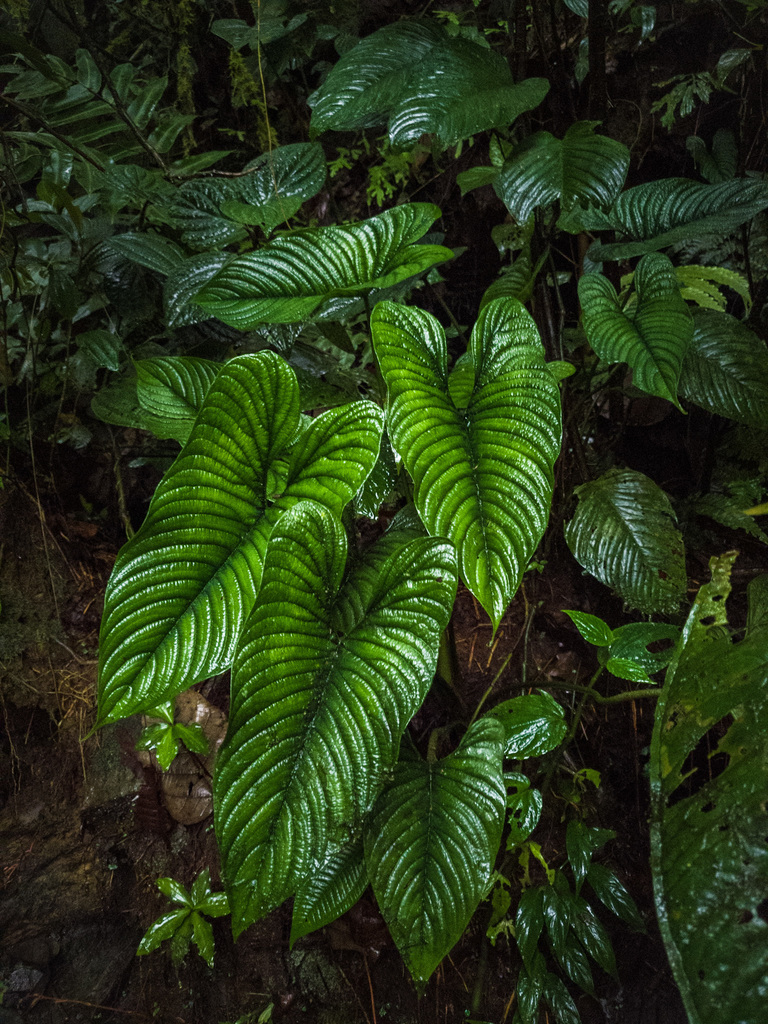
Somewhere in a serious collector's greenhouse — the kind with automated misters, a wall of HLG quantum boards, and a waitlist for cuttings — there is almost certainly a Philodendron gloriosum growing in a terracotta pot on a crawling rhizome, doing exactly what it has always done, in exactly the form it has always had. No variegation. No novelty. Just a terrestrial creeper from the Colombian rainforest floor, producing heart-shaped velvety leaves that can span sixty centimeters, each one veined in white so precise it looks drafted. Nobody will offer four hundred dollars for a cutting. Nobody will argue about its name. That's the point.
The philodendron hobby has been, for the better part of a decade, a hybrid economy. P. 'Ring of Fire', P. 'Florida Beauty', P. 'Paraiso Verde' — names that move like stock tickers, prices that inflate and crash inside a single growing season. Into that noise, a quieter argument has been reasserting itself: that the species — the wild-type, the taxonomically honest plant — is worth more attention than the market gives it. Not because hybrids are wrong, but because the true-species philodendron asks harder questions and rewards the grower who can answer them.
The Hybrid Economy and What It Displaced
The Thai Undulatums, the McDowell hybrids, the endless parade of P. erubescens crosses — the market for philodendron hybrids is not a recent invention, but it reached a kind of critical mass around 2019 and never really retreated. Hobbyists who entered the hobby in that window have grown up thinking of philodendrons primarily as collector objects: things with names and prices, things whose value is tied to scarcity and novelty rather than botanical interest. That framing isn't wrong, exactly, but it is incomplete.
What it displaced was a longer tradition of species collecting — growers who organized their shelves by section rather than Instagram aesthetic, who cared about the difference between Philodendron verrucosum from Ecuador versus Peru because the Ecuadorian form runs smaller, redder on the underside, with shorter petiole hairs. That kind of attention is taxonomically adjacent. It requires knowing what a species actually is, and what variation looks like within a wild population, before you can even begin to appreciate a hybrid's departure from it.
The hybrid market also, quietly, produced a lot of confusion about names. A plant sold as P. 'Splendid' — ostensibly a cross between verrucosum and melanochrysum — could come from five different breeders, with five different growth habits, all trading under the same trade name. When everything is branded, the brand becomes the thing, and the underlying botany becomes irrelevant. Species collectors find this maddening. They are not wrong to.
The species doesn't negotiate. It is what it is — and that's exactly what makes growing it feel like something real.
What Makes a True-Species Philodendron Worth Chasing
The easy argument for species collecting is aesthetic: the plants are beautiful without intervention. Philodendron melanochrysum — the black-gold philodendron, a hemi-epiphytic climber from Colombia's Chocó department — produces juvenile leaves that emerge coppery-iridescent and mature into something nearly black-green, up to ninety centimeters, with a velvety texture that absorbs light rather than reflecting it. No tissue culture lab designed that. It evolved for a specific light regime on a specific forest stratum, and every cell of that leaf is an adaptation, not a selection.
But the deeper argument is about relationship. Growing a true species means you are growing something with a knowable wild distribution, a described ecology, a published type specimen. You can read the original 1854 Schott description of P. gloriosum and then look at the plant in your pot and see the same plant. That continuity — between the botanical literature and the living object in front of you — is something a hybrid named after a grower's Instagram handle cannot offer.
There is also, frankly, the challenge. True species don't always cooperate with indoor culture the way a vigorous hybrid does. Philodendron luxurians, the Colombian-Ecuadorian creeper that is gloriosum's more secretive cousin, resents overwatering with a stubbornness that will rot a cutting in a week if the substrate isn't right. It wants a crawling mount, high humidity, and the patience to watch it produce four leaves a year and call that success. Growing it well is a skill. Growing P. 'Birkin' well is not.
The Taxonomy Problem Nobody Talks About
Here is where species collecting gets genuinely complicated: the philodendron genus contains somewhere north of 500 described species, and the taxonomy is, to use the technical term, a mess. Revisions by Thomas Croat and his collaborators have reorganized sections, synonymized species that were described twice under different names, and occasionally promoted varieties to full species status. A plant you bought as Philodendron sodiroi might be filed under a different epithet in the most recent treatment. This is not vendor fraud — it is the ordinary friction of botanical science applied to a genus from some of the least-collected terrain on earth.
What this means practically is that species collectors need to hold names lightly. Not skeptically — the names matter — but with the understanding that a verrucosum from a reputable source and a verrucosum from a wet market may be the same species with different provenance, or two different undescribed forms that have been lumped under a convenient label. The hobby's best species hunters know to ask: which form, which country of origin, grown from seed or propagated from an established plant? Those questions are not pedantry. They are the difference between adding something genuinely distinct to a collection and adding a redundant cutting.
Hybrids sidestep this entirely, which is part of their appeal. Nobody argues about whether a P. 'Ring of Fire' is correctly named. But sidestepping the taxonomy also means sidestepping the biology, and for some collectors that is too high a price.
Species Snobbery: Is It Earned?
There is a version of the true-species argument that curdles into snobbery — a collector who will tell you that hybrids are for beginners, that real growers chase species, that anything tissue-cultured and trade-named is beneath serious consideration. That position is worth examining rather than simply endorsing.
Hybrids have introduced thousands of people to the genus who would not have found it otherwise. The P. 'Pink Princess' — a chimeric variegated form of P. erubescens, unstable as it is photogenic — has probably done more to build the hobbyist base for aroids than any field guide. That hobbyist base eventually includes the people who start asking harder questions, who look at a Pink Princess and wonder what erubescens actually looks like, who pull up Croat's papers at midnight and start marking want-lists with obscure epithet strings. The hybrid is often the door, and dismissing it dismisses everyone still standing in the doorway.
The more honest version of species preference is just this: species collecting requires different skills, satisfies different curiosities, and produces a different relationship with the plant. It is not superior. It is specific. The collector who can articulate why they grow Philodendron pastazanum alongside P. 'McDowell' — because one answers a botanical question the other cannot — is not a snob. They are someone with clear reasons for the choices on their shelves.
Three Species Worth Actually Growing
Philodendron luxurians is the one most collectors overlook in favor of its more famous creeping relatives. Its leaves are broader and shorter than gloriosum, the venation cream-white against a surface so velvety it reads as matte black in low light. It needs a well-draining peat-free substrate — chunky coir, perlite, orchid bark — and resents sitting wet overnight. Rhizome mounted on a board with long-fiber sphagnum around the roots, it will grow with a consistency that a pot often doesn't produce. It is not easy to find, but specialty aroid vendors in Florida and the Pacific Northwest stock it intermittently.
Philodendron verrucosum deserves its reputation, but the collector who has seen only the Ecuadorian highland form hasn't seen the full range. Colombian and Costa Rican accessions run larger, the petiole hairs longer and sometimes reddish, the underside of the leaf suffused with deep maroon. Growing it in a high-humidity cabinet — 75 to 85 percent relative humidity, temperatures that don't drop below 65°F — will produce the iridescent sheen the leaves are capable of. Drop the humidity and it will grow, but it will look dull, and a dull verrucosum is a mild tragedy.
Philodendron joepii is the genuinely obscure one: a species collected from French Guiana in 1991 by amateur botanist Joe Bogner, its mature leaf lobed into a shape that looks like a design error — two elongated lower lobes dropping past a narrow upper blade, a silhouette nothing else in the genus produces. It climbs, and on a moss pole it will eventually produce the full mature leaf form. It is not for beginners. It requires consistent warmth, high humidity, and a grower patient enough to wait through the juvenile leaf phase, which is unremarkable. When the first mature leaf appears, the plant justifies everything.
What the Species Collector Is Actually Doing
There is a way to understand species collecting that has nothing to do with snobbery or taxonomy or even horticulture. It is about asking the plant to be accountable to something outside the market. A hybrid is accountable only to its grower's aesthetic and the current price per node. A species is accountable to its ecology, its evolutionary history, its described morphology. Growing it well means getting close enough to those external realities to understand them — which is a different project than producing a photogenic leaf for an audience.
That project is also, in a practical sense, conservation-adjacent. The wild populations of P. gloriosum, P. melanochrysum, and dozens of other collector species are under pressure from deforestation in Colombia, Ecuador, and Panama. An established seed-grown plant in a collector's greenhouse is not a conservation program, but it is a record of a plant's form outside its shrinking habitat. The collector who keeps detailed notes on provenance, parentage, and growth behavior is maintaining a kind of informal database. It is not nothing.
None of this means putting down the P. 'Paraiso Verde' cutting on the windowsill. But it does mean that the hobby has room — and arguably needs — people who are growing toward something beyond the next novel leaf, who are willing to spend three years on a joepii because the mature form is exactly what a plant described in the botanical literature looks like, and that correspondence between word and living thing is worth the wait.
The Plant That Started the Argument
Back to that gloriosum in the terracotta pot. It will crawl its rhizome over the lip of the pot this spring and need repotting, which means losing some root mass and resetting the clock on its growth rate. It will not be on any waitlist. It will not appreciate in market value. Nobody on social media will post a sixty-second reel about its petiole cross-section.
What it will do is produce, sometime in late summer, a leaf large enough to cover a dinner plate, with venation so geometrically precise that you will stop whatever you were doing to look at it. That leaf is the same leaf Schott described in Vienna in 1854 from a specimen brought out of Colombia by a collector whose name has mostly been forgotten. The chain from that specimen to this pot is unbroken, and growing the plant is a way of holding the chain.
That is what the true-species philodendron offers that no hybrid can match: not better leaves, not easier culture, not investment value. Just the particular satisfaction of growing exactly what exists — not what someone bred it to be, not what the market decided to call it, but what it is.