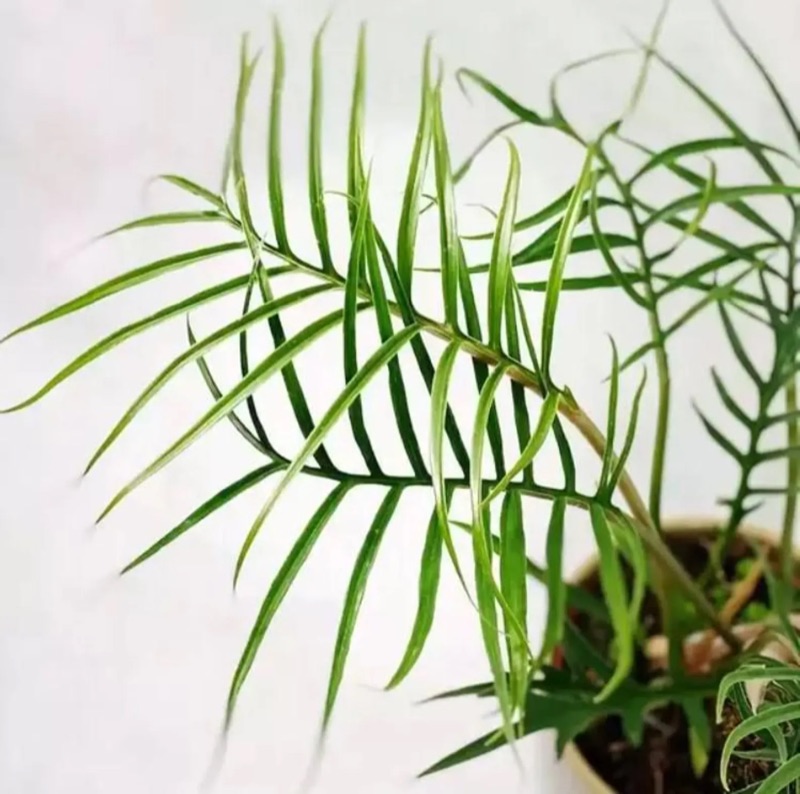
There is a particular moment, familiar to anyone who grows Philodendron tortum, when a new leaf begins to open. It doesn't unfurl the way a gloriosum does — that slow, ceremonious unrolling of a velvet disc. Instead it extends outward like a hand unclenching underwater, the leaflets separating one by one until the full structure hangs in the air: seven, nine, sometimes eleven narrow fingers radiating from a single stem, each one so thin it barely casts a shadow. The whole apparatus looks less like a plant and more like something pressed between the pages of a paleontology textbook.
The skeletal philodendrons — the pinnate-leaved and deeply lobed species that collectors sometimes group loosely as the 'finger' types — occupy a strange position in the hobby. They don't have the velvet, the silver veins, or the collector-grade leaf fenestration that drives auction prices into absurdity. What they have instead is structure. Geometry. A kind of tectonic elegance that rewards attention the longer you stand in front of them. They are the jungle's attempt at minimalism, and they are, in the quiet opinion of people who grow a lot of plants, underrated to a degree that borders on injustice.
The Anatomy of a Skeletal Leaf
To understand why these plants look the way they do, it helps to think about where they grow. Philodendron tortum, native to Brazil and Peru, climbs through the mid-canopy of Amazonian rainforest, where wind moves constantly and light arrives in fragments. A leaf that presents a solid blade catches wind and tears; a leaf that is mostly air bends and flexes and survives. The pinnate structure is not an aesthetic decision — it is an engineering solution, arrived at over millions of years of being alive in a difficult place.
What makes tortum remarkable, even among the skeletal types, is the degree to which the form pushes toward abstraction. The leaflets are not just narrow — they are strap-thin, often only a centimeter or two wide on a mature plant, with a slight twist along the midrib that gives each one a propeller-like tension. The petioles are long and whippy, frequently exceeding the leaf itself in length, and they emerge from the stem at angles that make the whole plant look permanently mid-gesture. Nothing is symmetrical. Nothing is still.
Philodendron radiatum takes a slightly different approach: the lobing is deep but the leaf remains a single blade, cut almost to the midrib in a pattern that suggests something between a monstera and a fern. On a young plant the lobes are few and shallow; on a large, well-fed specimen climbing a substantial moss pole, the blade can reach sixty centimeters with a dozen or more lobes per side, each one tapered to a fine point. The effect is heraldic. It would look at home on a coat of arms.
A tortum at full extension looks like a diagram of movement frozen mid-gesture — all tension and no mass.
Tortum, Polypodioides, and the Question of What We're Actually Talking About
Collector taxonomy is informal and frequently wrong, and the skeletal philodendrons are no exception. Philodendron polypodioides circulates in the hobby under various names, occasionally mislabeled as tortum by vendors who are either confused or hopeful. The two are genuinely similar in growth habit — both are climbing, pinnate-leaved species from South America — but polypodioides tends to produce leaflets that are somewhat wider and less dramatically twisted, and the petiole on a mature plant has a different texture, slightly rougher to the touch. Side by side they are clearly distinct. In a photo on a sales listing, less so.
This matters because the plants behave somewhat differently in cultivation and because buying under a wrong name is a small, persistent frustration for collectors who are trying to build a thoughtful collection rather than a pile of mislabeled cuttings. If a vendor cannot tell you which species they have — if the listing says 'tortum type' or 'skeleton plant' without further specificity — that is information. It tells you something about the provenance of the plant and the care with which it was propagated.
There is also Philodendron elegans, which belongs in any conversation about this group. The leaf architecture of elegans is distinctive: a broad ovate outline, deeply pinnate, with leaflets that are themselves slightly wavy-margined, giving the whole blade a feathered quality. It is more sculptural than tortum in a formal sense, less frenetic, and on a mature climbing specimen it has a gravity that the thinner-leaved species lack. It is also more available than its quality warrants, which makes it a reasonable entry point for collectors who are new to the skeletal types.
Care Without Mythology
The skeletal philodendrons are climbers, and they will not reach their mature leaf form without something to climb. A thin bamboo stake keeps a plant alive; a fat, moisture-retentive moss pole — or a coco coir pole kept consistently damp — triggers the hormonal signals that push a plant toward its adult morphology. This is not optional. A tortum grown in a hanging basket without support will produce leaves that are smaller and less divided than the same plant attached to a vertical surface. The difference between a juvenile and a mature specimen is not just time — it is physics.
Substrate matters here more than with many aroids. These are plants accustomed to growing in decomposing bark and epiphytic debris, not in dense potting soil. A mix weighted toward chunky bark, perlite, and some horticultural charcoal — with peat or coco coir as a minority component — gives the roots the air they need and dries down appropriately between waterings. Root rot in skeletal philodendrons is not a dramatic event; it announces itself quietly, in smaller new leaves and a subtle softening of the lower stem, by which point it is already a problem. Err toward airy.
Light requirements are genuine but not extreme. Bright indirect light — the kind produced by a north- or east-facing window in summer, or by a decent LED grow light at a distance of thirty to forty centimeters — produces compact internodes and full leaf development. Too little light and the internodes stretch, the leaflets narrow further than is architecturally interesting, and the plant loses its structural coherence. Too much direct sun and the thin leaflets of tortum in particular will show tip scorch within a week. The target is bright and diffuse, held consistently.
The Moss Pole as Medium
Serious growers of climbing aroids tend to develop opinions about poles the way other people develop opinions about coffee. Moss poles made from sphagnum packed around a PVC core are the current standard for good reason: they hold moisture well, accept aerial roots readily, and can be extended as the plant grows. But they require maintenance — regular misting to keep the moss from drying out completely, and periodic replacement as the sphagnum breaks down over eighteen months or two years.
Coco coir poles are lower maintenance and take aerial root attachment slightly less eagerly, but they hold their structure longer and are less prone to becoming hydrophobic if they dry out once. For a collector with many climbing plants and limited time, the coco option is defensible. For a collector with one or two specimen-quality skeletal philodendrons that they intend to grow large, the sphagnum pole is probably worth the effort — the aerial root attachment is more secure, and the moisture gradient it creates seems to produce better leaf development in tortum specifically, though this is observation rather than controlled experiment.
The point, in either case, is commitment. A pole that dries out completely defeats its own purpose. A plant that is re-staked every time it outgrows a support develops erratic leaf orientation and uneven internodes. Pick a support system, build it large enough to last three or four years, and then leave it alone to do its work.
What Maturity Actually Looks Like
One of the least-discussed aspects of the skeletal philodendrons is the degree to which the juvenile and adult forms are almost unrecognizably different. A tortum cutting produces leaves that are pinnate but modest — five or six short leaflets, the petiole not much longer than the blade, the overall impression tidy and slightly ferny. Experienced growers call this the juvenile expression, and it is accurate but somewhat misleading, because it implies a gradual linear progression when the reality is more discontinuous.
At some threshold of root mass, pole attachment, and cumulative light hours, a tortum shifts register. The new leaves come out longer. The petioles extend dramatically — thirty, forty centimeters on a vigorous specimen. The leaflets multiply and thin and develop that characteristic twist. A mature plant attached to a tall pole in a good position is not obviously the same organism as the cutting that arrived in a four-inch pot two years earlier. The transformation is one of the genuinely satisfying long games in the hobby, and it rewards patience in a way that faster-maturing species do not.
Radiatum undergoes a similarly dramatic change. The juvenile leaves are ovate with a handful of shallow lobes; the adult leaves are so deeply cut they approach the skeletal quality of tortum from a completely different structural direction. Growing both species side by side on adjacent poles, watching them converge toward a similar aesthetic through entirely different leaf architectures, is the kind of thing that makes a collector realize they have been standing in their growing space for forty-five minutes without noticing.
The Collector's Case for Minimalism
The current market for rare aroids is heavily weighted toward leaves with visible pigmentation — the anthocyanin-flushed undersides of certain philodendrons, the silver tessellation of crystallinum, the impossibly white variegation of a Thai Constellation. These are real beauties and the prices they command are not entirely irrational. But the skeletal philodendrons make a different argument, and it is an argument about form rather than surface.
A tortum at full extension occupies space in a specific way. The shadows it casts change through the day as the light angle shifts. It has dimensionality — actual three-dimensional structure — that a flat velvet leaf, however magnificent, cannot replicate. Placed in front of a white wall in afternoon light, a mature tortum is closer to a mobile than a houseplant, all tension and counterbalance. This is not a minor thing.
There is also the question of longevity as a visual object. Velvet-leaved philodendrons are exquisite when a leaf is new and lose something as it ages and the velvet texture softens. The skeletal types age more gracefully — the structure persists, the form doesn't degrade. A leaf that has been on the plant for a year still reads as the same architectural statement it made when it first opened. For collectors who are building a growing space as a long-term environment rather than chasing the perpetual newness of fresh growth, that durability of impression counts for something.
Where to Begin
For a collector who has not grown in this direction before, Philodendron elegans is the most forgiving starting point. It is broadly available, accepts a range of conditions without immediate protest, and produces adult leaves that are genuinely impressive at moderate maturity — you do not need a two-meter pole and three years of patience to see what the plant is capable of. Grow it in a chunky mix, attach it to a support of any kind, and give it reasonable light. It will tell you quickly whether this aesthetic is for you.
Philodendron radiatum is the next step: more demanding about consistent moisture at the roots, slightly more insistent about bright light, but the payoff in adult leaf architecture is proportionally greater. Give it a tall pole and the patience to let it climb past five or six nodes before expecting adult-form leaves. When it arrives at that stage, it arrives fully.
Tortum is the committed choice. It is more available now than it was three years ago, but prices for well-established climbing specimens remain significant, and the plant will test your substrate and your watering discipline before it shows you what it is. When it does, it is not like anything else in the family. Eleven finger-thin leaflets, each one with a quarter-turn twist, suspended from a forty-centimeter petiole on a plant that has decided, finally, to be exactly what it always intended to become. Worth every failed cutting that came before it.