The leaf unfurls yellow — almost offensively so — and for the first week it holds that raw, saturated citrus tone that makes you check your grow light settings twice. Then it settles. The yellow cools into cream, the cream picks up flecks of chartreuse, and finally, over a month, the whole sector hardens into a pale ivory that will stay on the plant for years. If you were watching for the orange, you had to be there at the right moment. That is the particular cruelty, and the particular pleasure, of warm-tone variegation in hybrid philodendrons.
Most collectors drawn to variegated aroids spent the last decade chasing white. Philodendron 'White Wizard', 'White Knight', 'White Princess' — the naming convention tells you everything about what the market wanted. High contrast, high drama, the kind of half-moon sector that photographs like a studio shot. Warm-tone variegation existed at the margins, in species like P. mamei with its silver blotching, in the yellow flashes that sometimes appeared on P. hederaceum 'Brasil'. But orange? Orange as a dominant, stable, intentional output of a hybrid program? That is newer, stranger, and worth understanding on its own terms.
Where the Orange Comes From
Warm-tone variegation in philodendrons is not a single mechanism. In some plants it is the product of chimeral instability — sectors of tissue with reduced or absent chlorophyll that express carotenoid pigments before they, too, degrade. In others, particularly in hybrids crossing P. gloriosum with more heavily pigmented parents, the yellow-orange flush is tied to anthocyanin expression in juvenile tissue, which means it is transient by design rather than by accident. Understanding which mechanism you are dealing with changes how you manage the plant and what you realistically expect from each new leaf.
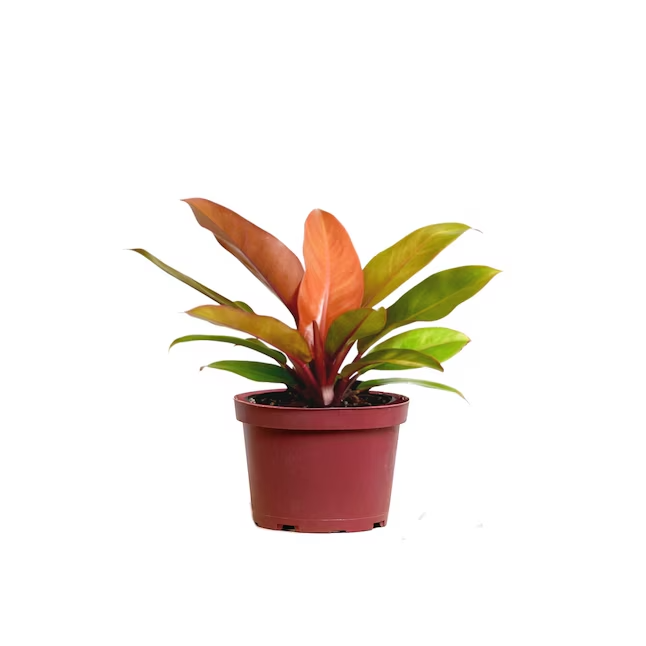
The hybrid most collectors currently point to when discussing orange variegation is the loose category that has accrued around crosses involving P. gloriosum, P. melanochrysum, and various undisclosed parents from Southeast Asian and Central American breeding operations. These plants circulate under trade names — 'Citrus Moon', 'Tangerine Dream', 'Solar Flare' are three that appear repeatedly on auction platforms — but the naming is inconsistent and the lineage documentation is almost universally absent. What can be observed directly is the phenotype: leaves that emerge in the orange-to-yellow range and either hold a warm cream sector long-term or fade to near-white depending on light, temperature, and the individual plant's genetic stability.
P. gloriosum brings the large, velvety, heart-shaped blade and the creeping rhizomatous habit. It does not itself throw warm variegation with any regularity, but its hybrids with heavily veined species like P. melanochrysum seem to produce offspring with unusual plasticity in pigment expression. Whether this is a function of hybrid vigor destabilizing chimeral boundaries, or simply that certain parental lines carry recessive variegation alleles that express more freely in crosses, remains practically unknown. The tissue culture labs that produced stable variegated lines have not published their methods.
The orange phase lasts a week, maybe two. Miss it and you get cream. That ephemerality is precisely the point.
The Ephemerality Problem
Collectors who grow white-variegated philodendrons are used to permanence. A white sector on P. 'White Wizard' is white on day one and white three years later. The sector may shift in size as new growth emerges, may revert entirely if the plant goes heavily green, but the color itself does not change. Orange variegation does not work this way, and the adjustment this requires — perceptual and emotional — is one reason warm-tone hybrids have a steeper learning curve than their photographs suggest.
A new leaf on a stable orange-variegated hybrid might emerge in three to five days from spathe to full unfurl. The orange is most saturated in the first 24 to 72 hours, while the tissue is still thin and held against the light. By day five or six, as the blade hardens and chlorophyll begins to develop in the green sectors, the orange reads more as yellow. By week three it is yellow-cream. By month two it has settled into the warm ivory that will be its permanent color. The green sectors deepen independently, which increases the contrast, but the orange is gone. You photographed it or you didn't.
This ephemerality is not a defect. It is, for a growing group of collectors, the entire point. Growing a plant whose most dramatic moment is brief and unrepeatable demands a different kind of attention than growing a plant you can admire at any time. You check it in the morning. You note when the spathe begins to split. You are, in a way that white variegation does not require, present.
Light, Temperature, and Color Intensity
The intensity of the orange flush is environmentally mediated, which gives growers some real influence over the outcome. Carotenoid expression in leaves is suppressed by excessive light and enhanced by moderate, warm conditions — the logic being that carotenoids in young tissue function partly as photoprotectants, and that under very high light the tissue either produces more chlorophyll faster or degrades the carotenoids before they can accumulate. In practice, growers reporting the most vivid orange phases tend to be running their plants at 1,500 to 2,500 lux during unfurling, with temperatures between 24 and 28°C and humidity above 70 percent.
Cooler temperatures slow the transition from orange to cream, which extends the window of peak color. This is one reason growers in naturally warm climates sometimes report disappointingly brief orange phases — the leaf hardens fast, chlorophyll develops fast, and the orange is gone before they notice it arrived. Dropping night temperatures by three to four degrees during the unfurling period is one technique some collectors use deliberately, though this requires a setup with some temperature control and should not be pursued at the cost of the plant's overall health.
Substrate choice interacts with this in a secondary way. Plants growing in a well-aerated mix — chunky perlite, orchid bark, and a small proportion of coco coir or sphagnum — tend to push new growth more vigorously than plants in heavy soil. More vigorous growth means more frequent new leaves, which means more opportunities to observe the orange phase. The substrate is not coloring the leaf; it is controlling the rhythm of growth that determines how often you get to see it.
The Collector Calculus: Is It Worth the Price?
Warm-tone variegated hybrids trade at a significant premium over green forms of the same species, and the premium is not yet rationalized by the same cultural logic that supports white variegation pricing. The market for 'White Wizard' is large, documented, and liquid. The market for 'Citrus Moon' or its equivalents is smaller, newer, and more volatile — which cuts both ways. Prices have dropped substantially from their 2022 peaks as tissue culture production has scaled, but the plants still command two to four times the cost of unvariegated P. gloriosum hybrids.
The honest collector calculus depends on what you find interesting. If your primary satisfaction comes from a plant that looks striking at any moment of the day, any day of the year, warm-tone variegation may disappoint. The settled cream-and-green leaf is attractive, even beautiful, but it is not the plant in the photograph that made you want it. If your interest is in the growth process itself — if you are the kind of grower who logs soil temperature and documents each new leaf from spathe to maturity — then the brief orange phase is a feature that rewards exactly the behavior you already practice.
There is also a reasonable argument that warm-tone variegation is undervalued relative to its rarity as a stable, heritable trait. White variegation in philodendrons can be induced through tissue culture mutagens and is now produced at sufficient scale to be genuinely accessible. Stable orange variegation that breeds true, or at least breeds consistent, across vegetative propagation is rarer. Whether that rarity persists as more labs enter the space is a question worth watching.
Species Worth Knowing in This Space
Beyond the hybrid market, a handful of species exhibit natural warm-tone variegation or yellow-flush juvenile foliage that intersects with this aesthetic. Philodendron hederaceum 'Brasil' is the most accessible: its irregular yellow-green variegation occasionally throws leaves with a yellow sector that reads warm against the dark green ground. It is not orange, but it is in the same color family, and it is practically unkillable under a wide range of conditions — a useful reference point for understanding how warm variegation behaves across the life of a leaf.
Philodendron 'Ring of Fire', one of the longer-established warm-tone hybrids, produces serrated leaves with sectors that move through orange, yellow, green, and cream as they mature — sometimes all on the same leaf. Its parentage is disputed; some sources attribute it to a cross involving P. wendlandii, others to selections from P. tortum relatives. What is observable is that the color variation is stable across vegetative propagation and that the multi-tone effect on a single mature leaf is genuinely unlike anything else in the genus. It deserves more serious attention than it currently receives.
For collectors who want warm-tone variegation with confirmed, documentable genetics, P. gloriosum x P. melanochrysum hybrids from named, reputable breeders — where the parent plants are photographed and the cross is recorded — are the most defensible purchase. The orange phase may be brief. The settled leaf may be quieter than the auction photograph suggested. But you know what you bought, and you can describe the lineage to the next person who grows a cutting from it.
Photographing What You Cannot Keep
There is a practical dimension to the ephemerality of orange variegation that the collector community has developed an informal culture around: the new-leaf photograph as a form of documentation. On growing forums and collector channels, images posted within the first 72 hours of unfurl carry a different weight than images of mature leaves. They are evidence of peak expression — not just aesthetics but data, proof that the plant produced and that the orange phase was genuine and not a digital artifact.
Photographing an unfurling philodendron leaf requires some patience and a willingness to work with available light rather than artificial sources, which tend to shift warm tones toward yellow or wash them toward white. Morning light through a north or east window, or diffused natural light without direct sun, renders the orange sector most accurately. A reference object in the frame — a piece of white card, a known-neutral surface — helps when sharing images in contexts where monitor calibration varies. None of this is technically demanding, but it represents a specific practice that warm-tone variegation has generated among its collectors, a small discipline of attention that white-variegated plants, available for documentation any afternoon, do not require.
A Niche With Room to Deepen
The collector appetite for warm-tone variegation is real but still forming. The vocabulary for describing it is not yet standardized — 'orange', 'citrus', 'warm cream', 'golden' are used interchangeably for what may be phenotypically distinct expressions driven by distinct mechanisms. This imprecision makes buying decisions harder and makes it difficult to compare notes across growers whose plants may not be the same thing despite sharing a trade name.
What would help: breeders who document and publish parental lines, collectors who log color progression across the full life of a leaf rather than photographing only peak expression, and a slower acquisition culture that allows time to observe how a plant behaves across multiple growth cycles before declaring it exceptional. The orange phase is real. It is worth chasing. But the plant that earns a permanent place in a collection is the one whose settled cream-and-green mature leaf you also find worth looking at — not only the one that blazed for a week in March and then quietly became something else.
The niche is young enough that the growers entering it now will shape what it becomes. That is a reasonable argument for paying attention to it, and for growing these plants with the same rigor you bring to anything else in a serious collection.