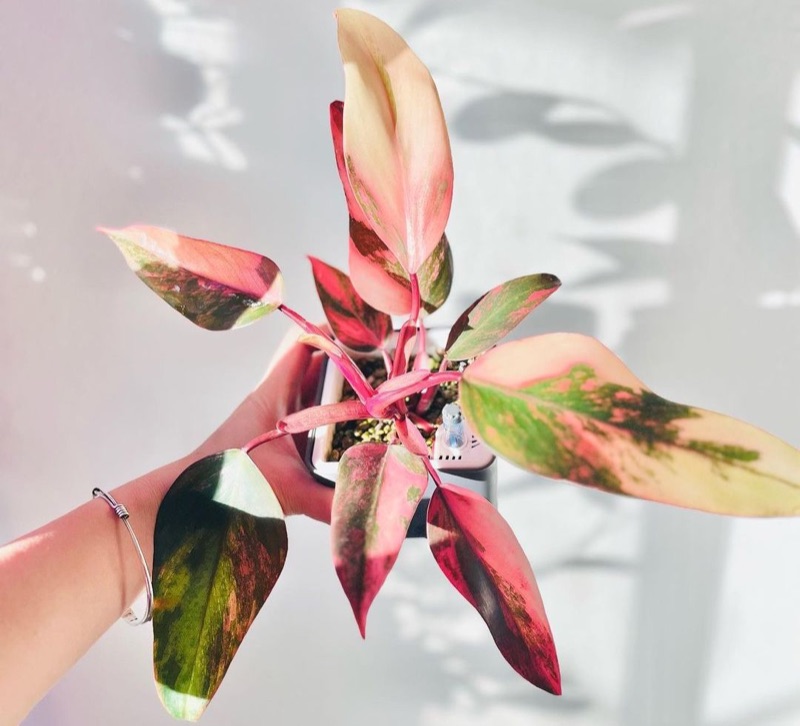
The cutting arrives wrapped in damp sphagnum, rubber-banded inside a ziplock, tucked into a padded envelope that smells faintly of a stranger's grow tent. You ease it out carefully. The node is healthy, the petiole stub clean. And there, unfurling from the axil, is a leaf that justifies everything: blush pink shading into cream, threaded with veins of deep olive green, the whole surface mottled like a painter cleaned a palette against it. You set it under your grow lights and take four photographs. You text two people.
Three weeks later the second leaf opens. It's green. Not mostly green — green, flat, botanical-textbook green. The pink is gone. The cream has resolved into a pale sector along one margin. You study it the way you'd study a poker hand that almost worked. This is the central, maddening arithmetic of variegated Philodendron collecting: the flush that recruited you and the mature leaf that explains why this is harder than it looks.
What Variegation Actually Is
Most of the variegation collectors chase in Philodendron is chimeral — a genetic mosaic in which two or more cell populations with different chlorophyll expression coexist in the same plant. The boundary between sectors isn't random noise; it reflects the arrangement of those cell layers in the apical meristem, the growing tip that produces every new leaf. When the meristem generates a leaf with a high proportion of chlorophyll-deficient cells at the surface, you get cream or white. When it generates mostly normal cells, you get green. The pink that appears in species like Philodendron 'Pink Princess' is anthocyanin pigment masking chlorophyll-deficient tissue — a layer of color laid over the absence of green.
This matters because it means the plant isn't making a decision about each leaf. The meristem's chimeral composition shifts over time, under influence of temperature, light intensity, and what appears to be simple developmental drift. A cutting taken from a highly variegated stem section will often produce more variegated growth than a cutting taken from a green sector — but not always, and not forever. The meristem can revert. It can also push the other direction, toward more white, which in large sectors starves the leaf of photosynthetic capacity and eventually kills it. The collector is chasing a moving target that the plant itself can't quite hold still.
Understanding this reframes what you're actually buying. You're not buying a plant with a fixed aesthetic. You're buying a snapshot of a chimeral state that may or may not persist, produced by a meristem that has its own agenda. Some collectors find this intolerable. Others find it the whole point.
The flush that recruited you and the mature leaf that explains why this is harder than it looks — that gap is where the obsession lives.
The Pink Princess Problem
Philodendron erubescens 'Pink Princess' is the species that introduced a generation of collectors to the specific anguish of chimeral instability. It was circulating in the European trade by the 1970s, appeared sporadically in US specialist lists through the 80s and 90s, and then detonated across the hobby around 2019 when Instagram made the flushed-pink-and-burgundy new growth impossible to ignore. Prices for a single-node cutting hit three hundred dollars in some auctions. People waited months on waitlists.
What those buyers discovered, often after the initial leaves had fully matured, was the reversion problem. 'Pink Princess' grown in low light tends to produce more chlorophyll and less variegation — the meristem compensates. Grown in very high light, you can sometimes push more expression, but you also risk bleaching. Grown too warm and fast, the plant produces leaves quickly and the variegation thins to a narrow margin. The sweet spot is bright indirect light, a warm but not tropical temperature (22–26°C is a reasonable range), and a pace of growth that isn't frantic. Smaller pots, airy mix — chunky perlite, bark, and a little coco coir — help control the pace.
The variegation also isn't uniformly pink even at its best. True half-and-half leaves, with a clean split between burgundy-green and blush-pink, are rare. What you usually get is a speckled sector, a pink blush concentrated toward the midrib, or a heavily mottled pattern where pink and green interlock without a clear edge. That mottled pattern — confetti, some collectors call it — is arguably the most stable form. It's also, by wide consensus, the most beautiful. A collector who tells you they're chasing a half-moon 'Pink Princess' is telling you they're chasing a very specific chimeral accident.
Cream and White: The Costs of Contrast
The white and cream variegates — Philodendron 'White Princess', the white-sectored forms of P. erubescens, certain unstable sports of P. gloriosum and P. mamei — present a different calculation. White sectors contain no functional chlorophyll. They cannot feed themselves. A leaf that is more than about 60–70% white is a liability; it photosynthesizes too little to offset the energy the plant spent making it, and it often dies from the tip inward before it fully matures.
This is why 'White Princess' commands a premium over 'Pink Princess' among collectors who understand the biology: white variegation is rarer partly because the plant cannot sustain high expression without help. You need more light, delivered consistently, and the green portions of the plant have to carry the weight of the white. A heavily white stem section can be stimulated to produce more green by pruning back to a green node and allowing new growth — sometimes that growth re-establishes a more balanced chimeral expression. Or it doesn't. The plant remains pale and stalls.
There is a particular kind of collector patience required for the white variegates. You're managing a plant that is, at the cellular level, running a deficit on certain leaves. The aesthetics reward you. The biology punishes impatience. These are not the plants you pot up in a large container and leave to push growth; they want to be grown slowly, with every input calibrated.
The Role of Provenance and Selection
Behind the plants that make collectors' shortlists is usually a grower who made deliberate selections over multiple generations of propagation. The 'Pink Princess' cutting with reliably high expression didn't emerge from a single spontaneous mutation — it was selected from a population, propagated from its most expressive stems, and selected again. Tissue culture labs in Thailand, the Netherlands, and Florida have worked to stabilize chimeral expression in commercial lines, with mixed results; chimeras are notoriously difficult to propagate through TC without reverting to a single cell type.
This is why sourcing matters more for variegated Philodendron than almost any other category. A cut from a collector who has grown the mother plant for three years, watched its expression through four seasons, and taken only from the most variegated stems carries different information than a tissue-culture plug from a large wholesale operation that has passed through a chain of resellers. Neither is guaranteed. The chimera does what it wants. But provenance narrows the odds.
The reputable sellers in this space — and there are not as many as the market implies — will tell you what they know about the mother plant's expression history. They will photograph the actual cutting, not a representative leaf from the mother. They will not promise you that the variegation will hold. That honesty is a feature, not a hedge. Anyone who tells you a variegated philodendron cutting will maintain a specific level of expression indefinitely is either uninformed or selling you something.
Light, Pace, and the Slow-Growth Argument
The care variable that most reliably influences chimeral expression in Philodendron is light intensity and the pace of growth it drives. Fast growth — warm temperatures, high humidity, constant moisture, large containers — produces leaves quickly, and quickly produced leaves in chimeral plants tend to have less distinct or less extensive variegation. The meristem doesn't have time to fully express the chimeral pattern before the leaf is committed to its form.
Bright indirect light, kept consistent for 12–14 hours under a quality LED panel (Samsung LM301-based boards are widely used in the hobby for a reason), combined with a substrate that dries at a moderate rate, tends to produce the best expression. The plant should be growing steadily but not racing. A new leaf every three to four weeks is reasonable for a mature 'Pink Princess' or 'White Princess' under good conditions. A new leaf every ten days is usually a sign you're pushing too hard for the kind of quality most collectors want.
There is also an argument for keeping variegated Philodendron slightly rootbound — not stressed, but not swimming in fresh substrate either. A tight root system moderates growth pace without imposing drought stress. Combined with consistent fertilization at moderate strength (a balanced NPK with good micronutrients, applied at half the recommended rate but more frequently), this approach tends to produce slower, denser growth with more consistent variegation. It's not a guarantee. It's a way of tilting the odds.
What You're Actually Chasing
Serious collectors of variegated Philodendron will tell you, usually after some prompting, that they're not really chasing the plant they bought. They're chasing a leaf that hasn't happened yet. The plant in the collection is a portfolio of past leaves — documented, photographed, compared — and a set of probabilities about future ones. The one perfect leaf, the one that captures the chimeral pattern at its most articulate expression of pink and green and cream, exists somewhere ahead in the growth sequence. Or it doesn't, and you take a cutting from the most promising node and start again.
This is not a pathology, or not only a pathology. It's a form of attention that serious horticulture always demands. Growing Philodendron gloriosum to its full silver-veined magnificence requires years of patient culture in exactly the right conditions. Chasing chimeral expression in 'Pink Princess' requires years of observation, selection, and tolerance for disappointment. The skills are the same skills. The plants just happen to be asking for them in a way that also produces, occasionally, something that looks like someone threw a handful of watercolors at a dark velvet leaf and got lucky.
The collectors who last in this corner of the hobby are not the ones who bought in at peak price expecting a stable product. They're the ones who found the biology interesting enough to stick around after the first green leaf opened. The chimera keeps moving. So do they.
Knowing When to Let a Plant Go
Part of mature collecting is recognizing when a plant has settled into an expression that doesn't interest you anymore. A 'Pink Princess' that has produced eight consecutive heavily green leaves is telling you something. The meristem has shifted. You can try cutting back to a lower node where variegated growth was last produced, and sometimes this works — new growth emerges with a different chimeral balance, and you're back in business. Sometimes you get green leaves from that node too, and the plant is now a large, healthy, deeply boring P. erubescens.
That plant has value. Someone learning to keep philodendrons alive would be glad to have it. There's no shame in passing it along and redirecting the space and light toward something that's performing. Collection management is real horticulture — knowing what to hold, what to propagate, and what to release is as important as knowing how to water.
The one perfect leaf may or may not be coming. If you've got the space, the light, and the patience, you wait. If you don't, you cut, you trade, you start again with a new node from a seller who knows their mother plant. The chimera doesn't owe you anything. But it keeps making the offer, leaf by leaf, and that turns out to be enough.