Run your thumb along the petiole of Philodendron squamiferum and it catches — not unpleasantly, like dragging a fingertip across velvet the wrong way. The scales are stiff, faintly iridescent, deep red against pale green. The leaf at the top is fine: deeply lobed, oak-leaf silhouette, good size. But the leaf is almost beside the point. People who keep squamiferum know that you grow it for the stem.
This is the argument: collectors have organized almost all of their desire around leaf blades. We talk about bullation, silver tessellation, the precise ratio of primary vein to interveinal tissue, whether a velvet surface reads green or near-black under different light. We are not wrong to care about those things. But the petiole — and by extension the cataphyll, the internode, the stem surface — is where a plant's character often concentrates. It is also where taxonomy shudders, where provenance leaks through, and where the most tactile pleasures of the hobby live. We should pay closer attention.
What a Petiole Actually Does
A petiole is not decorative. It positions the blade at a precise angle to catch available light, transfers water and photosynthate between stem and leaf, and in many philodendrons operates as a structural counterweight that keeps wide, heavy blades from snapping under their own weight or the momentum of a rain-heavy canopy drip. Philodendron gloriosum — a terrestrial creeper from Colombian and Ecuadorian lowlands — has petioles that can run forty centimeters on a mature plant, rounding into a near-cylinder, slightly flattened on the adaxial face. That shape is not arbitrary. The D-cross-section resists torsion in a way a fully round petiole would not, which matters when a ground-hugging plant has to hold a blade that might span sixty centimeters in good conditions.
In climbing philodendrons the geometry shifts. Philodendron melanochrysum runs a sharply D-shaped petiole — strongly channeled, the flat face pressed toward the stem — that functions as a lever arm adjusting blade pitch as the plant mounts higher and light angle changes. The same D-section appears in Philodendron verrucosum, though there it arrives wearing a fur coat of fine hairs that turn the utilitarian shape into something worth staring at. Structure and ornament in the same organ, inseparable.
Texture on a petiole is usually not random. The bristles on squamiferum and the hair covering on verrucosum are thought to deter specific insect herbivores — the physics of gripping a hairy surface being unfavorable for many beetles and caterpillars. Whether that explanation fully accounts for the density and arrangement of the indument is still an open question. What matters for the grower is that these surfaces are species-consistent and respond to conditions: plants stressed by low humidity or insufficient root mass often produce sparsely textured petioles that look nothing like the archetype.
The petiole is where a plant's character concentrates — where taxonomy shudders and provenance leaks through.
The Squamiferum Problem
Philodendron squamiferum is classified within a loose complex of lobed-leaf philodendrons from French Guiana, Suriname, and northern Brazil. Its petioles carry conspicuous, almost architectural scales — technically called squamae, which is where the epithet comes from — that range in color from pale orange-pink on juvenile plants to a deep, almost arterial red on established adults in good conditions. The color is not fixed. Under lower light or on plants pushed too hard with nitrogen-heavy fertilizer, the red fades to an unremarkable salmon. This is one of the more useful diagnostic clues the plant offers: brilliant petiole color as a proxy for overall growing conditions.
The species is sometimes conflated in the trade with Philodendron pedatum, which carries similarly lobed leaves but smooth petioles — no scales at all. They are easily separated by touch alone, yet mislabeled plants circulate freely because sellers photograph the blade and not the stem. This is exactly the problem the hobby should train itself out of. If you are buying a squamiferum without seeing a petiole photograph, you may be buying a pedatum, which is a fine plant and not a fraud, but it is a different plant.
Growing squamiferum to show the petioles at their best requires the same inputs the plant needs for any other success: bright indirect light, a substrate that drains fast and holds some moisture — chunky perlite-and-bark mixes rather than anything peaty and dense — and humidity above sixty percent. The scales respond slowly. A newly unfurled petiole will look washed out for two to three weeks before the red deepens. Do not conclude the plant is stressed before that interval has passed.
Verrucosum and the Question of Hair
Philodendron verrucosum is one of the most phenotypically variable species in the genus. Plants from different elevations of the Andes — the species occupies a band running roughly from Costa Rica through Ecuador and into Peru, typically between 300 and 2,000 meters — look different enough that collectors have sometimes treated them as distinct taxa. The leaves vary from small, narrow-lobed forms to the wide, velvety blades with gold venation that made the plant famous. The petioles vary too, but within a tighter range: always hairy, ranging from a short, dense pile to longer, almost shaggy coverage, the base color running from pale green to deep burgundy.
The hair on a verrucosum petiole — technically villous indument — has a particular quality that photographs rarely convey. It is soft where squamiferum scales are coarse, and it catches light differently depending on direction: run your eye down the petiole and it looks matte and almost gray; tilt your view and it sheens. In low humidity the hairs desiccate and the petiole takes on a papery feel that is the first sign the plant wants more moisture, before the leaf itself shows any distress. Growing verrucosum teaches you to read petioles as diagnostic instruments.
At elevation — and many successful growers replicate this with a cool-side temperature drop at night, down to 16 or 17 degrees Celsius — petioles tend to deepen in color and the hair becomes denser. This is not universally agreed upon, and the variables are hard to isolate because cooler nights also affect light intensity and vapor pressure deficit. But enough experienced growers have observed the correlation that it is worth experimenting with if your setup can accommodate a small temperature gradient.
Cataphylls as Character Witnesses
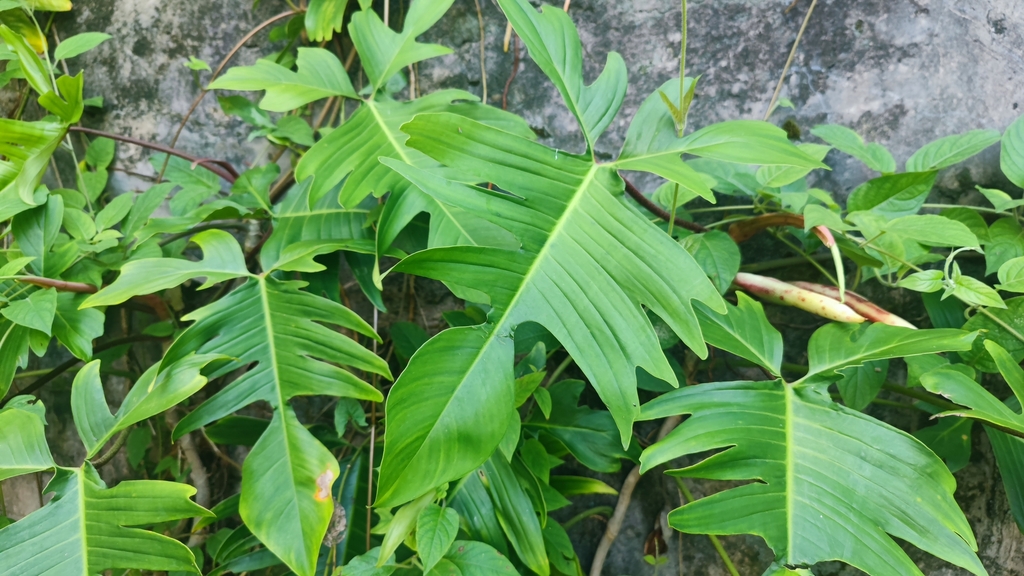
The cataphyll — the modified leaf that sheathes each new growth point before a true leaf emerges — is where some philodendrons make their strangest moves. In Philodendron gloriosum the cataphylls are pink, papery, and persist on the rhizome for months before drying to pale straw. In Philodendron sodiroi and its relatives the cataphylls are greenish and comparatively unremarkable. In Philodendron atabapoense — a long, narrow-bladed species from Venezuela and Brazil — the cataphylls are deep red-wine and semi-persistent, adding color to a stem that might otherwise look bare between nodes.
Whether a cataphyll is deciduous or persistent, and how quickly it breaks down, tells you something about the natural moisture regime the species evolved in. Persistent cataphylls are more common in seasonally dry environments where the papery sheath continues to buffer the developing bud. Quickly-rotting cataphylls tend to flag a problem: if they blacken before the new leaf is half unfurled, check your airflow and substrate moisture. The cataphyll is rotting because conditions are too wet and still.
This is care knowledge that lives in the stem, not the leaf. A grower who photographs only leaves is missing data. The first sign of overwatering in gloriosum is a browning cataphyll base, not a yellowing blade. The first sign that a newly mounted melanochrysum is establishing is a cataphyll that stays green and firm as the new growth pushes. Learn these signals and your error rate drops.
Internode as Aesthetic Unit
Compact internodes are commercially desirable — tighter nodes produce a bushier, more photogenic plant for a ten-centimeter pot — and the nursery trade has selected for them relentlessly. This is worth thinking about critically. In nature, Philodendron billietiae runs long internodes as it climbs, because tighter spacing would shade its own leaves on the way up a rainforest trunk. A nursery billietiae with internodes compressed by high light and frequent pinching looks quite different from the same plant allowed to climb a thick moss pole at the light level it actually prefers.
The orange petiole of billietiae — one of the more startling colors in the genus, a true orange rather than the red-adjacent tones of verrucosum or squamiferum — reads differently at a tight internode versus a relaxed climbing spacing. Tight spacing crowds the petioles and the orange gets lost in a mass of overlapping blades. Give the plant height and airflow and each petiole becomes visible as a discrete structure. The argument for growing some philodendrons tall and loose rather than compact and dense is partly an aesthetic one about the stem.
Growers who mount climbers on wooden boards or bark slabs often report that the plant spaces its own nodes more openly than the same species in a pot — the board's surface texture and the vertical orientation appear to signal the plant that it is ascending, triggering a growth habit closer to wild type. Whether that observation will survive careful controlled experiment is unknown, but the visual outcome is striking: nodes placed at intervals that let the eye rest between leaves, each petiole legible, each point of attachment to the mount visible and deliberate.
The Taxonomy Hiding in Plain Sight
Petiole morphology is not a footnote in philodendron taxonomy — it is frequently diagnostic. The shape of the petiole cross-section, the presence and character of indument, the geniculum (the swollen, flexible joint at the blade end of the petiole that allows the leaf to reorient toward light), and the degree of sheathing at the base have all been used to separate species in the large and contentious Philodendron genus, which currently includes somewhere north of 500 accepted species depending on which revision you consult.
Thomas Croat's decades of taxonomic work on Araceae returned repeatedly to petiole features as distinguishing characters when leaf blade morphology proved too variable. This makes practical sense: blade shape in philodendrons shifts enormously with age, light level, and mounting surface. Juvenile leaves of Philodendron gloriosum look nothing like adult leaves. But the petiole of gloriosum — round, pale, lightly mottled — stays recognizably itself from juvenile to adult. It is a more stable witness.
For collectors trying to authenticate an unlabeled plant or verify a label on a new purchase, petiole examination should be the first move, not the last. Photograph the petiole in cross-section if you can — slice a millimeter off a damaged petiole end if you must. Note the color, the surface, the sheathing length. Then go to the blade. This is the reverse of how most of us were taught to look at aroids, and it is, I'd argue, the correct direction.
Relearning How to Look
The aesthetic case is simple: stems and petioles give aroids a verticality and a rhythm that leaves alone cannot provide. A large Philodendron gloriosum rhizome crossing a board, showing its pale green girth and the staggered pink cataphylls at each node, has compositional weight that a photograph of its leaves never quite captures. A verrucosum climbing a moss pole with three petioles visible at once — each hairy, each a different shade of red-green depending on age — has more visual complexity in that column of growth than in any single leaf.
This is not to dismiss the leaf. The tessellated velvet of Philodendron sodiroi, the silver venation of Philodendron gloriosum, the near-black surface of a well-grown Philodendron melanochrysum in low light — these are real and serious pleasures. But they are surfaces. The stem is structure. It is the grammar of the plant's growth, the physical record of every node it has thrown, every cataphyll it has shed, every petiole it has extended into available light.
Pay attention to the parts that aren't the leaf. Touch the stem. Note the scale, the hair, the color, the internode interval. You are not deviating from the point of the plant — you are getting closer to it.