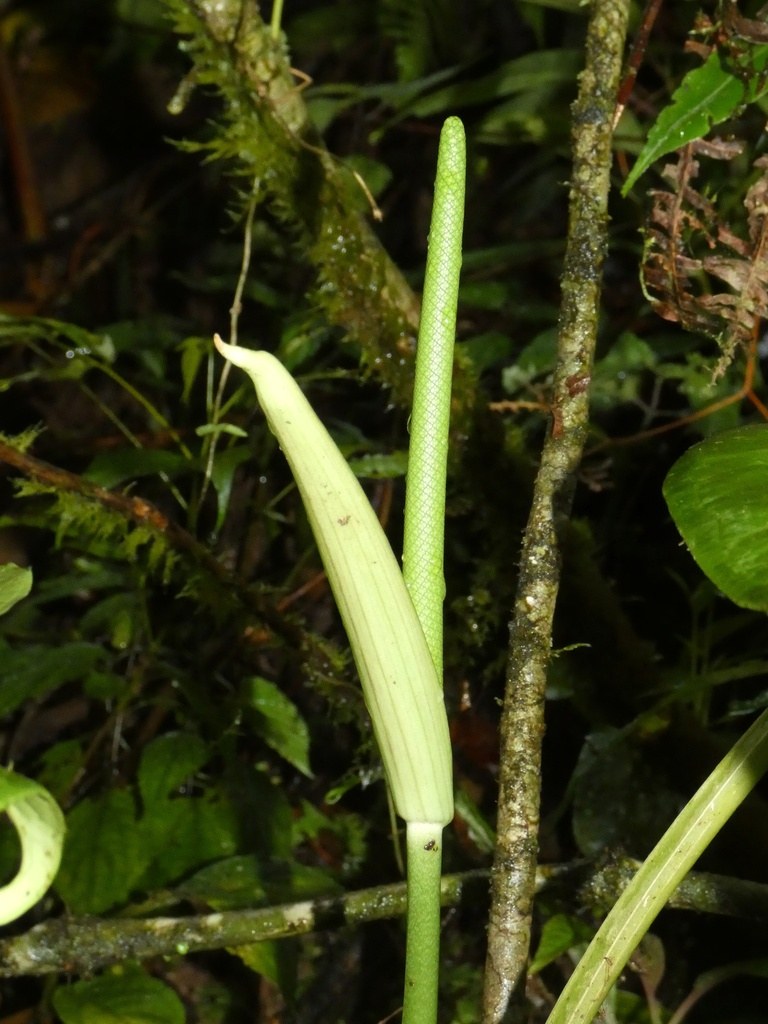
📷 cultivar413 / Wikimedia Commons (CC BY 2.0)
Field Guide · Philodendron
The orange-petioled climber from the Guiana Shield rewards growers who give it a pole, an airy mix, and patience for its seasonal flush.
Described by Tom Croat in 1995 from material collected in French Guiana, billietiae is the benchmark for orange-petioled philodendrons. Mature leaves elongate to 60–90 cm, with rippled margins and a deep emerald blade set against tangerine cataphylls. It climbs slowly until it finds bark or sphagnum, then accelerates. Expect a quiet winter and a hard flush of two or three leaves in late spring.
The benchmarkThe chimeric variegated form throws sectoral cream and yellow across the green blade, sometimes a full half-moon. It grows noticeably slower than the standard plant and reverts under low light. Mature leaves can lose stability if the growth point runs heavily white, so cut back to a node with green tissue. Worth the asking price only if you can give it a bright, humid, vertical run.
Slow burnOften confused with billietiae at the nursery bench, atabapoense has narrower, longer leaves and a wine-purple underside rather than orange petioles. It comes from the Orinoco basin and tolerates slightly cooler nights than its cousin. Hybrids between the two (sold as 'Joepii x atabapoense' and similar) circulate widely. A useful companion plant — same care, different silhouette.
Honest cousinA hybrid often listed with billietiae in its background, grown for the apricot-to-bronze flush on new leaves. It stays compact and self-heading rather than climbing, which makes it a shelf plant where billietiae needs a pole. Color holds best under strong indirect light; in dim rooms it greens out within a week. A reasonable substitute for collectors short on vertical space.
Compact stand-inNot orange-petioled, but grouped here because Joep Moonen — the Dutch naturalist who guided Bert Billiet to the type locality of billietiae — also brought joepii into cultivation from French Guiana. The leaves are bizarrely waisted, with two lateral lobes flanking a long terminal blade. Care matches billietiae exactly. Owning both feels like completing a small chapter of aroid history.
Collector's footnote
Billietiae is a hemiepiphyte. In the wild it germinates on the forest floor, finds a trunk, and climbs into the canopy of lowland forest in French Guiana, Brazil, and Suriname. Once it's on bark, the roots run along the surface in moss and leaf litter, not in soil. Replicate that. A mix of chunky orchid bark, perlite, and a smaller fraction of coco chips or pumice works well — something that drains in seconds and holds onto moisture only at the contact points.
Give it a pole from the start. A damp sphagnum or tree-fern pole, kept wet at the top, will pull the plant upward and trigger larger leaves within two or three growth cycles. Without a pole, billietiae will produce smaller, more spaced-out leaves and the petioles will stay shorter and paler. Aerial roots want to grip something living-feeling; bare moss poles dry out fast and need topping up every few days.
Repot only when the substrate breaks down — usually every 18 to 24 months. The roots are thick and brittle, and the plant resents disturbance. If you must repot during a flush, work fast and keep humidity high for a week afterward.
Bright indirect light, ideally 200–400 µmol/m²/s at the leaf surface, or a meter reading of 800–2,000 foot-candles. Under that, petiole color washes out and internodes stretch. A few hours of gentle morning sun deepens the orange noticeably, but midday glass-filtered sun will scorch the blade within an afternoon. East and lightly shaded south exposures suit it; pure north windows produce a green, leggy plant.
Water when the top third of the pot is dry. The roots want oxygen between drinks, but the moss pole should stay damp. Humidity above 60% keeps new leaves opening cleanly; below 50%, expect deformed pulls and brown leaf tips. A small clip fan running on low — enough to flutter a leaf — prevents the stagnant air that breeds bacterial leaf spot.
Billietiae flushes seasonally rather than constantly. Most plants put out two to four new leaves between late spring and early autumn, then rest. Don't push fertilizer in the rest months; a quarter-strength balanced feed every two weeks during active growth is plenty. Pushing food during dormancy is how growers get salt burn at the petiole base and root rot through the winter.
Treating it like a pothos. Billietiae in a peat-heavy mix, without a pole, in a north corner, watered weekly on a schedule — that plant will limp along for a year and then collapse. It is not a forgiving aroid in the way hederaceum is. Get the substrate and the pole right first; everything else follows.
Chasing color with sun. The orange petiole is mostly genetic. Strong light intensifies it, direct sun bleaches the leaf and burns the cataphyll. If the petioles on a new plant look pale, give it three months in good light before assuming the plant is a dud — color often deepens with maturity and with the next flush, not overnight.
Misidentifying it. Nurseries occasionally ship atabapoense, hybrids, or seed-grown variants labeled as pure billietiae. Check the leaf shape (elongated, gently rippled margin, rounded sinus at the base) and the petiole (terete, orange the full length, not just at the cataphyll). Provenance matters if you plan to breed or sell cuttings; for a windowsill grower, an honest hybrid is often a tougher plant anyway.
The Field Guide from Leaf People.