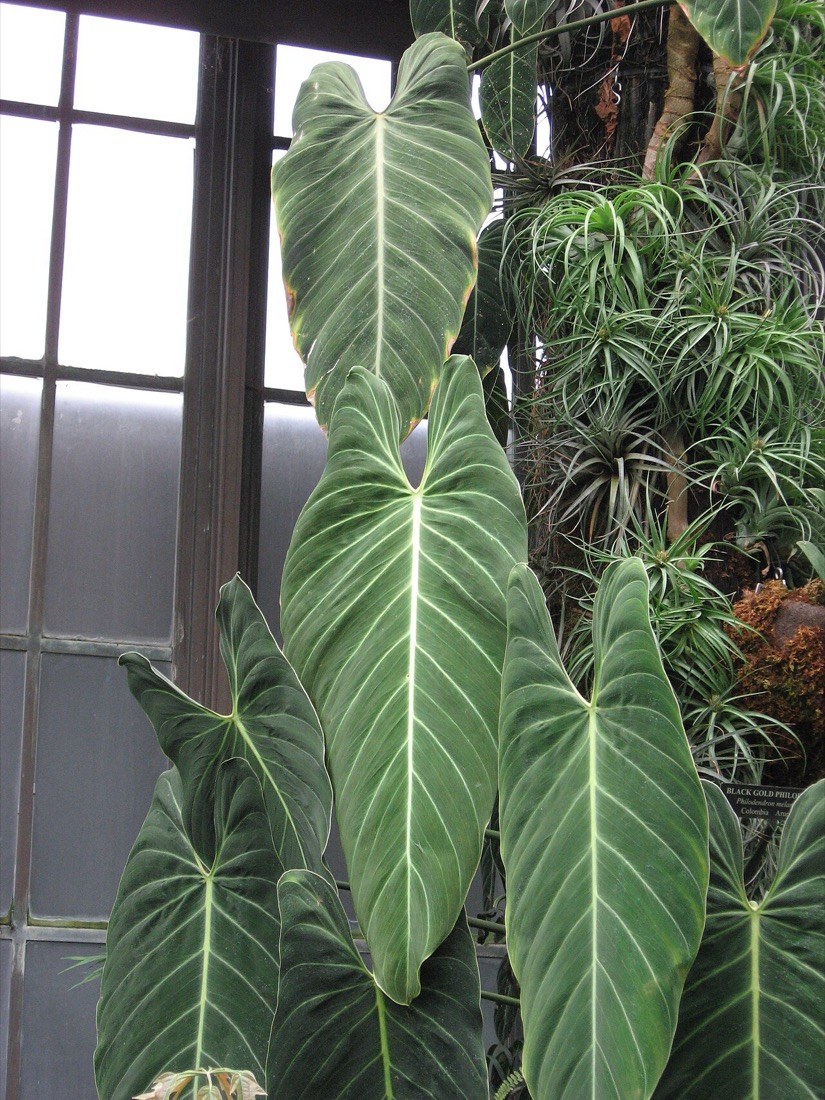
📷 Chhe (talk) / Wikimedia Commons (Public domain)
Field Guide · Philodendron
The black-gold velvet from Colombia rewards patience, a tall pole, and a substrate that breathes — here's how to read it and grow it on.
The species itself: narrow, pendulous juvenile leaves that elongate into dark, gold-flecked velvet straps as the plant climbs. Petioles are terete and roughly as long as the blade. On a damp moss pole with steady humidity, mature leaves push past 60 cm and keep going. Slow at first, then suddenly not.
The benchmarkOften shelved next to melanochrysum and just as velvety, but the petioles give it away — densely bristled, almost furry, with pale green ribs on the underside of the leaf. Cooler-growing and fussier about wet feet. Worth keeping if you can hold humidity above 70% without stagnant air.
Velvet cousinPanamanian, faster than melanochrysum, and capable of enormous coppery new leaves that age to deep matte green. The midrib stays paler and the leaf shape is broader and more ovate. A good choice if you want velvet scale without the long juvenile awkward phase.
Faster growerSean Patrick's hybrid splits the difference: the heart shape and silver veining of gloriosum on a plant that still wants to climb. Leaves are broader and shorter than true melanochrysum and the velvet is a touch lighter. Useful when you want the look in less vertical space.
Compromise pickNot a climber and not a substitute, but if you fell for melanochrysum for the texture, luxurians delivers it on a creeping rhizome. Leaves are huge, heart-shaped, deeply quilted, and matte black-green. Wants a wide, shallow setup and the same airy mix as its climbing relatives.
For the texture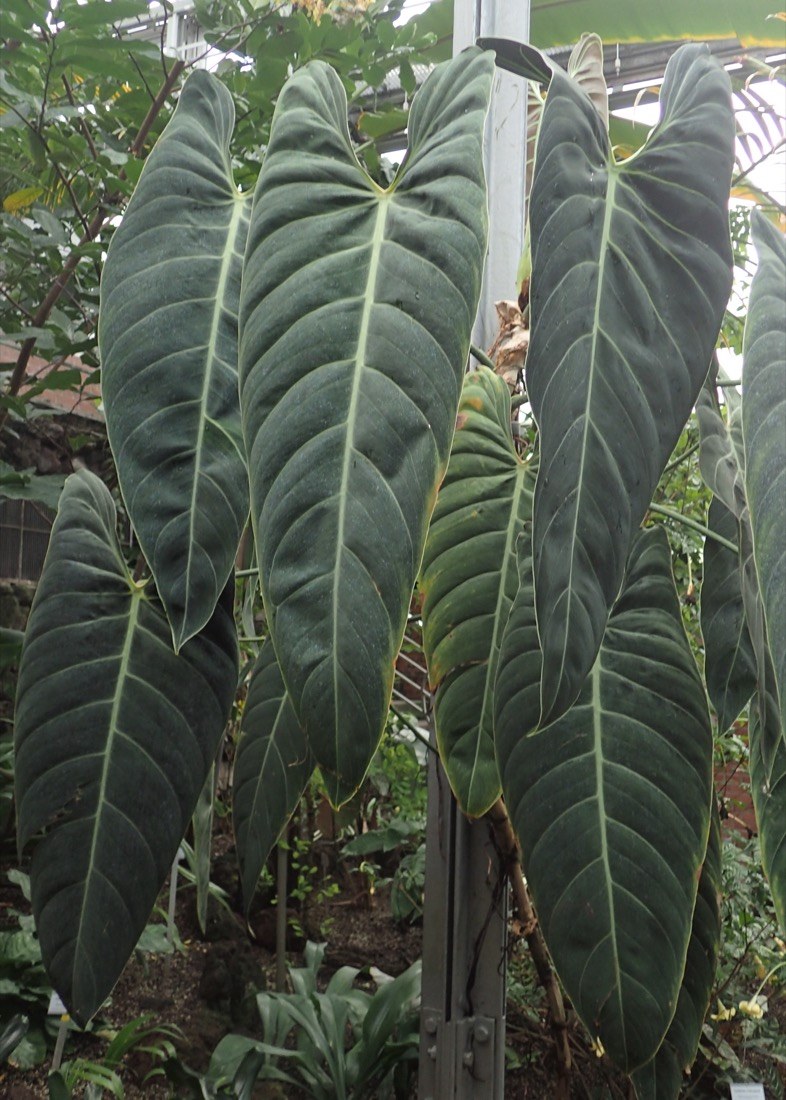
Mislabeling is constant in this group, especially with young plants where everything velvety looks similar. On a true melanochrysum, juvenile leaves are narrow, almost lance-shaped, hanging straight down from a short petiole. The surface is matte black-green with fine gold speckling that catches angled light — the melano (black) and chrysum (gold) of the name are literal. Petioles are smooth and terete, not winged and not bristled. If the petiole is hairy, you're looking at verrucosum. If it's D-shaped in cross-section with silver veining and the plant crawls rather than climbs, that's gloriosum.
The other tell is growth habit. melanochrysum wants to climb. Unmounted, it sulks and throws small, narrow leaves indefinitely. The moment its aerial roots find something to grip — sphagnum, tree fern, cork — internodes shorten, leaves widen, and the blade elongates dramatically. A plant producing 25 cm juvenile leaves on a bamboo stake can produce 70 cm adult leaves on a proper pole within a year. That transition is the whole point of growing this species; without it you have a perfectly fine houseplant and not the thing on the species page.
Use an airy mix. A workable blend is roughly equal parts orchid bark, perlite or pumice, and coco chips, with a handful of charcoal and a smaller fraction of sphagnum to hold some moisture near the roots. The mix should drain within seconds when you water and never feel sodden a day later. melanochrysum has thick, exploratory aerial roots that rot fast in dense peat-heavy soil, and root loss sets the plant back months.
The pole matters more than the pot. A moss pole or tree fern slab tall enough for the plant to grow into for a full year is the minimum — short poles produce short leaves. Keep the pole damp, not dripping; mist it in the morning or top-water it so moisture wicks down. Aerial roots will burrow into it within weeks and the plant starts pulling water and nutrients directly through the pole, which is when leaf size jumps.
Water the substrate when the top third has dried. Tepid water, thoroughly, until it runs out the bottom. Humidity above 60% is when this species looks happy; above 70% it accelerates. Airflow is non-negotiable at those humidity levels — a small clip fan moving air across (not at) the plant prevents the bacterial leaf spotting that velvet philodendrons are prone to.
Bright indirect light, full stop. A few feet back from an east or north window, or under a decent grow light at around 150–250 µmol. Direct sun scorches the velvet surface in a single afternoon and the damage is permanent — those leaves don't recover, they just sit there reminding you. Too little light is the more common error: leaves get progressively smaller and paler, and the plant stalls. If new leaves are shrinking, light is usually the first thing to fix, before substrate or humidity.
Feed lightly and often. A balanced fertilizer at quarter strength every watering, or full strength every third watering, works well during active growth. Flush the pot with plain water monthly to keep salts from building up in the bark mix. In winter, when growth slows, cut feeding in half rather than stopping entirely — the plant is still pulling some nutrition through the pole.
The mistakes that kill or stall melanochrysum are predictable. Keeping it in the nursery pot of dense soil it arrived in. Refusing to give it a real pole because the look doesn't suit the room. Misting the foliage instead of raising ambient humidity, which leaves water sitting in the velvet pile and invites fungal spots. Repotting too often — this species resents root disturbance and will drop a leaf or two every time. And impatience: the gap between a 20 cm juvenile leaf and the first proper adult blade can be six months of apparently nothing happening underground. It is happening. Leave it on the pole, keep the conditions steady, and the leaf you bought the plant for will eventually unfurl.
The Field Guide from Leaf People.