📷 no rights reserved / iNaturalist (CC BY 4.0)
Field Guide · Rhaphidophora
Two plants get confused at every garden center — here is how to read the differences and grow each one well.
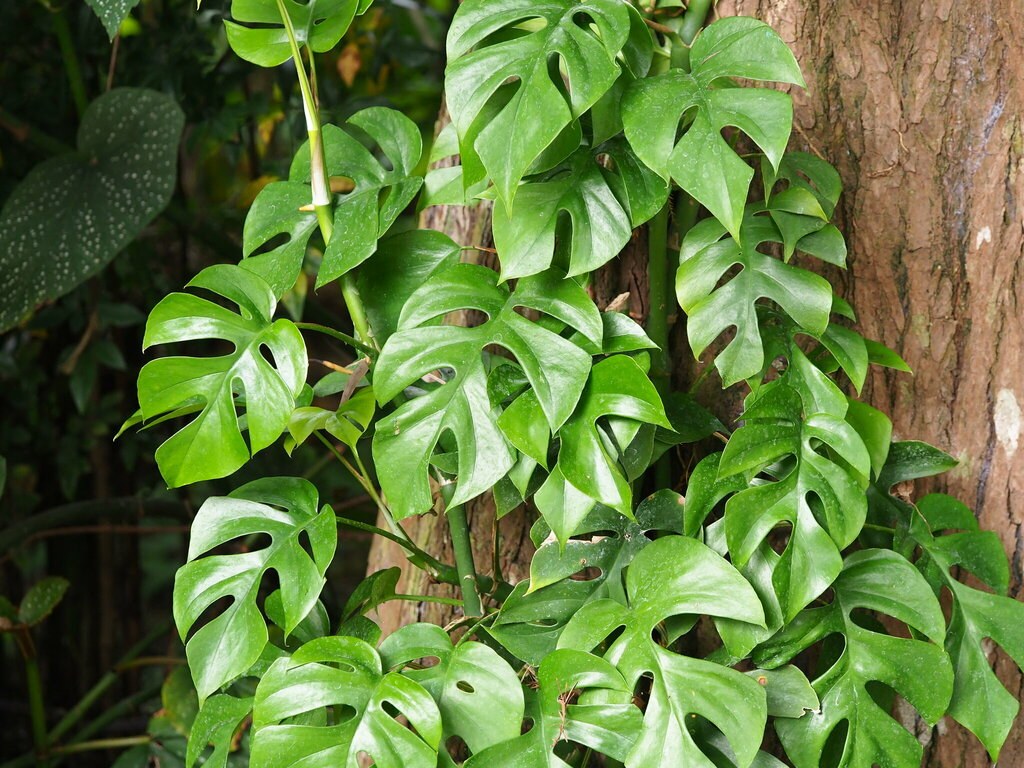
The plant at the center of the confusion. Native to southern Thailand and peninsular Malaysia, it stays small-leaved compared to Monstera deliciosa — mature blades rarely exceed 25 cm in cultivation. Leaves develop side fenestrations early, often by the third or fourth leaf on a healthy climb. Wants a moss pole, chunky aroid mix, and water before the medium goes bone dry.
The lookalikeGrows as an entire ovate leaf as a juvenile, then splits into deep pinnate divisions once it climbs and roots into bark. Found across India, southern China, and Indochina, often on tree trunks in monsoon forest. Wants a real support — without one it sulks and refuses to mature. Vigorous when warm and humid; fine on a sturdy pole indoors.
Best climberA New Guinea shingling species that presses its small, dark green, silver-veined leaves flat against bark or a slab. Stays modest in size and reads more like a textured wall covering than a houseplant. Needs high humidity (70%+), gentle airflow, and a board kept evenly damp. Slow until established, then steady.
For shinglersAn Australian and New Guinean shingler with bright, fleshy, lance-shaped leaves that overlap up a slab. Easier than cryptantha and tolerates lower humidity down to about 60%. Mount on cork or a moss board; it will not behave in a pot for long. Water the mount, not the leaves, and let it dry slightly between soakings.
Easier shinglerA dramatic species from across Southeast Asia and the Pacific that begins life as a tight shingler, then transitions to large pinnate climbing leaves once it hits a trunk. Worth growing for the transformation alone. Needs warmth, a tall support, and patience — the adult form takes years under glass. Tolerant of normal home humidity once established.
For the long game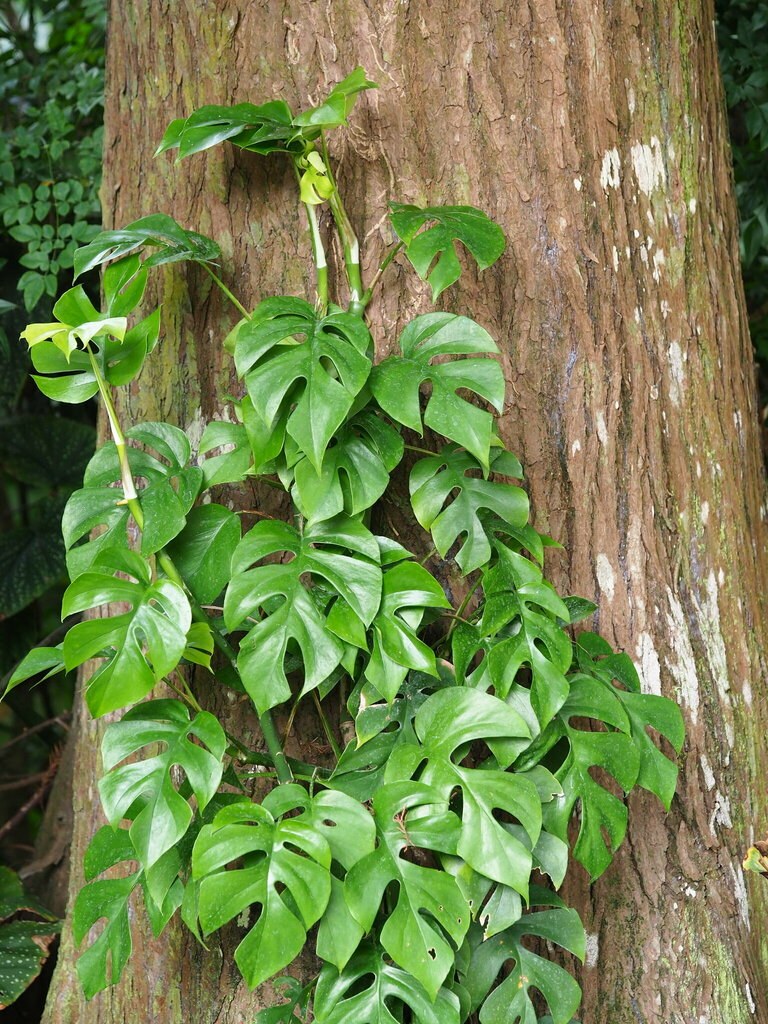
The quickest tell is scale and texture. Rhaphidophora tetrasperma leaves are thin, semi-glossy, and small — a vining stem with 15 cm leaves that already have neat oval fenestrations is almost certainly tetrasperma. Juvenile Monstera deliciosa leaves are thicker, matte, and stiffer in the hand, and they stay entire (no holes, no splits) until the plant is well-rooted and climbing. A deliciosa generally needs to push out leaves in the 30–40 cm range before fenestrations appear at all.
Look at the petiole and the node. Deliciosa has a pronounced geniculum — a flexible joint where the petiole meets the blade — and develops a papery sheath that dries and persists on the stem. Tetrasperma's petiole is smoother, the geniculum subtle, and the sheath is shorter-lived. On the stem itself, tetrasperma internodes are short and wiry with thin aerial roots; deliciosa internodes are thicker, greener, and produce the heavy cord-like aerial roots that eventually anchor a 3 m vine.
Fenestration pattern is the giveaway when both have holes. Tetrasperma cuts inward from the leaf margin in clean, narrow slots — sometimes all the way to the midrib, sometimes not. Deliciosa, once mature, makes broad lobes and interior oval holes near the midrib, and the blade itself becomes asymmetric and much larger. If a vendor is selling a 20 cm fenestrated leaf as "mini monstera deliciosa," it is tetrasperma.
Both are climbing hemiepiphytes, and both improve dramatically with a real support — a moss pole, tree fern slab, or cedar plank — kept damp enough that aerial roots will grip and bury in. Without that, you get smaller leaves, longer internodes, and a plant that never matures. This is the single biggest care difference between growing them well and growing them as a houseplant curiosity.
Substrate should be chunky and fast-draining for both: roughly equal parts coarse orchid bark, perlite or pumice, and a smaller fraction of coco chips or sphagnum to hold a little moisture. Tetrasperma is slightly thirstier and more forgiving of a moister mix; deliciosa wants more air at the root and rots faster in dense, peaty soil. Pot into something with real drainage and water when the top third of the medium has dried.
Light: bright indirect for both, meaning a few feet from an unobstructed east or west window, or filtered south. Tetrasperma will tell you it wants more light by stretching between nodes and producing smaller, less-fenestrated leaves. Deliciosa shows the same complaint but more slowly. Neither wants direct midday sun through glass — the thin tetrasperma blades scorch quickly, and deliciosa bleaches.
Humidity and warmth: tetrasperma is fine at 50–60% and household temperatures down to about 16 °C at night. Deliciosa is similarly tolerant but rewards higher humidity with faster maturation and earlier fenestration. Neither is a terrarium plant once past the small juvenile stage. Steady airflow matters more than chasing a humidity number — stagnant, wet air invites bacterial spotting on both.
Buying a "mini monstera" and expecting it to stay mini. Tetrasperma is small-leaved but vigorous; a happy plant on a pole will put up 2 m of growth a year and need cutting back. If you wanted compact, you wanted the wrong genus — look at Anthurium or smaller Philodendron instead.
Treating either plant as a tabletop trailer. Both will trail, both will look mediocre doing it. Leaves shrink, fenestrations vanish, and you end up with a thin vine of disappointing foliage. Give them something to climb from the day they come home.
Overwatering in a peat-heavy nursery mix. Most plants from big-box growers arrive in dense, water-retentive soil that suits a greenhouse bench, not a living room. Repot into a chunky aroid mix within a few weeks of purchase, and the rot problems people blame on "sensitivity" mostly disappear.
Finally — confusing one for the other at purchase and then giving care advice meant for the other. Tetrasperma rewards a slightly wetter pole and bounces back fast from a mistake. Deliciosa rewards patience and room. Identify what you actually have first, then grow it for what it is.
The Field Guide from Leaf People.