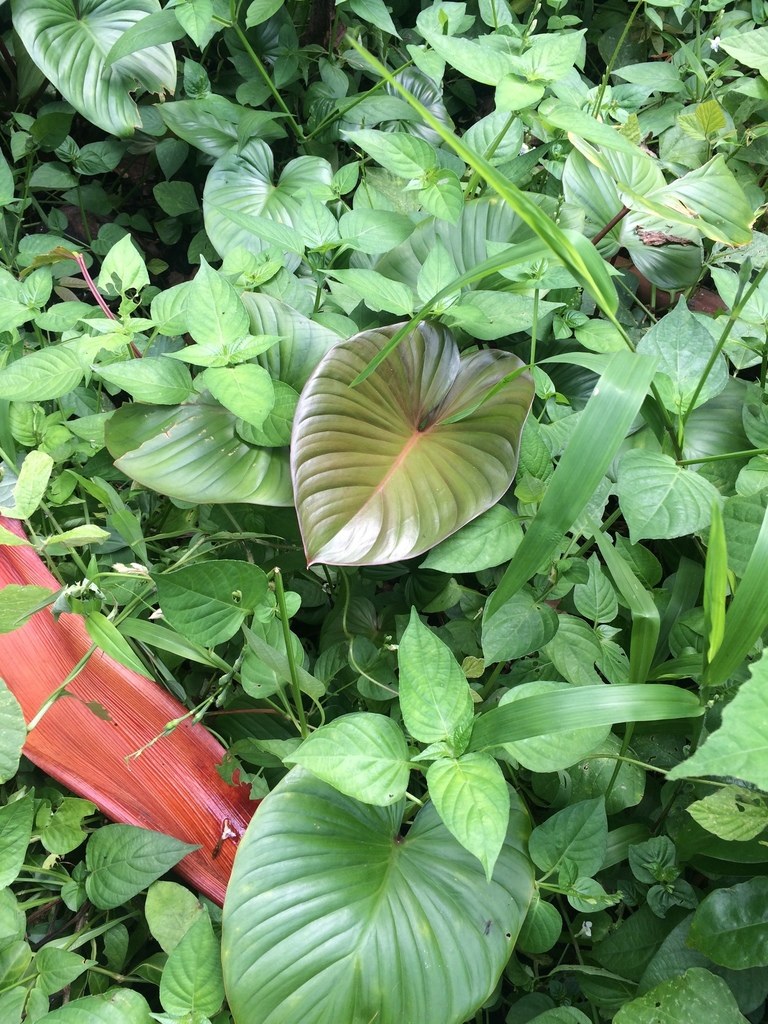
📷 Greg III Espera / iNaturalist (CC BY 4.0)
Field Guide · Homalomena
While the market chases velvet Philodendron, a quieter genus of forest-floor aroids hides anise-scented leaves, gunmetal patterns, and real botanical history.
A Marie Selby Botanical Gardens introduction and the gateway Homalomena for most growers. Broad, slightly quilted blades on short petioles, with the genus's characteristic anise scent when bruised. It tolerates average home humidity better than almost any other aroid of comparable size, which is why it keeps showing up on windowsills that have killed three Anthuriums.
Best starterSometimes sold under H. lindenii affinities, with irregular dark and pale green blotching that genuinely reads as camouflage rather than variegation. Leaves stay under 25 cm and the plant offsets readily, forming a tight clump in a 6-inch pot. Color holds best under bright indirect light; deep shade flattens the pattern to plain green.
Most underratedA workhorse cultivar of the widely distributed H. rubescens complex, with deep green, almost lacquered leaves on burgundy petioles. It handles lower light and brief substrate dry-down better than the fussier velvet species, and mature clumps can throw a dozen leaves at once. The closest thing this genus has to a pothos in temperament, without looking remotely like one.
Most forgivingA Sumatran species with elongated, slightly arrow-shaped leaves dusted in silver over a deep green ground. Less common in the trade than the rubescens types and worth tracking down through specialist aroid sellers. It wants the warmer, wetter end of Homalomena conditions — think 70%+ humidity and a chunky but moisture-retentive mix.
Collector pickA Peninsular Malaysian selection with rounded, near-heart-shaped leaves and a soft satin finish that catches sidelight like brushed metal. Stays small enough for a shelf but builds density quickly once established. One of the better choices for growers who want Homalomena texture without committing to a terrarium build.
Best small space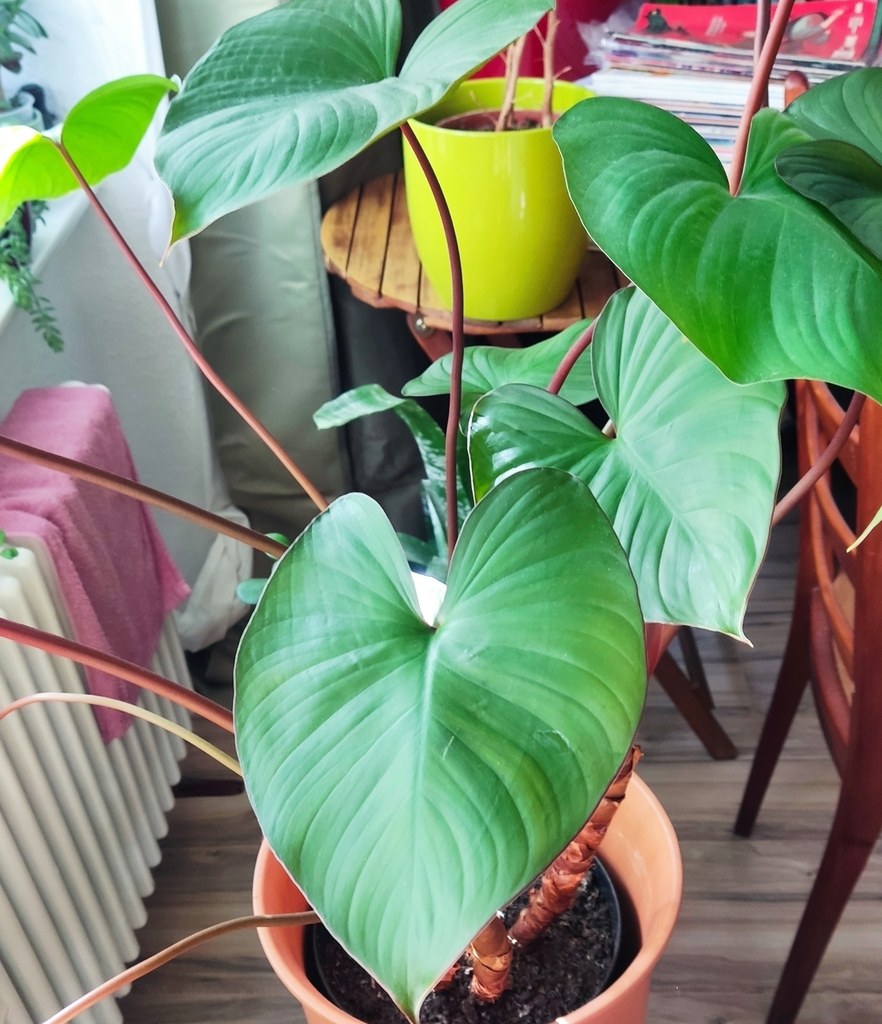
Homalomena sits in the same room as Philodendron and Anthurium — Araceae, similar leaf vocabulary, similar native range across tropical Asia and the Neotropics — but it has never had the same commercial push. Part of that is taxonomy: the genus is messy, with around 140 described species and a long history of misidentification between the Asian and American clades. Part of it is habit. Most Homalomena are terrestrial clumpers, not climbers, so they don't produce the dramatic morphological shift from juvenile to mature leaf that drives Philodendron prices.
What you get instead is a forest-floor plant with a specific personality: thick, often anise- or licorice-scented foliage, dense basal clumping, and a tolerance for the deep shade and consistent moisture of lowland Southeast Asian rainforest. The Selby introductions of the 1980s — most famously 'Selby' itself — put a handful of cultivars into the houseplant trade, where they were marketed as durable office plants and promptly forgotten by serious collectors.
That neglect is the opportunity. Species like H. sumatrana, the silver-leaved Bornean forms, and the small-leaved Peninsular Malaysian selections are still moving through specialist nurseries at prices that would be unthinkable for a comparable Anthurium. If you already keep aroids well, you have most of the skills this genus asks for.
Treat Homalomena as a terrestrial aroid that wants more moisture retention than a climber. A working mix is roughly 40% fine orchid bark, 30% coco chips or coir, 20% perlite or pumice, and 10% worm castings, with a handful of horticultural charcoal. The goal is a substrate that drains freely but holds even moisture between waterings — these are not plants that want to dry out completely. A bone-dry root ball will brown the leaf margins within days.
Water when the top inch is approaching dry, not when the pot is light. Rainwater or filtered water is worth the effort; the genus is moderately sensitive to chloramine and fluoride, and the damage shows as black tip burn that gets blamed on humidity. Speaking of which: 60–75% is the comfort zone for most species, and the silver-leaved Sumatran and Bornean forms genuinely want the upper end. The Selby-era cultivars will tolerate 45–50% if airflow is good.
Roots are fine and fibrous rather than thick and cord-like, so repot into only a slightly larger pot — going up two sizes at once will leave wet, unused substrate that sours fast. Divide mature clumps every two to three years; the plant responds to division with a flush of new growth from the cut rhizome.
Bright indirect light, filtered through a sheer curtain or two feet back from an east window, suits almost every species in cultivation. The patterned cultivars — 'Camouflage', the silver sumatrana, 'Perak Emerald Gem' — hold color best at the brighter end of that range, around 150–250 µmol if you're measuring. Direct midday sun bleaches and crisps the leaves within an afternoon. Deep shade produces stretched petioles and muddy color.
Temperature is straightforward: 65–82°F, with a hard floor around 60°F. Homalomena has no meaningful cold tolerance and will drop leaves at the first chilly draft from a winter window. Keep them off the floor in January.
The mistakes that take these plants out are predictable. First, treating them like a climbing Philodendron and letting the mix dry hard between waterings — they don't recover gracefully. Second, overpotting into a deep nursery container, which leaves the lower substrate permanently saturated and rots the rhizome from below. Third, ignoring the anise smell when you bruise a leaf: that scent is a useful diagnostic, and a sudden sour or fermented note from the substrate means you have anaerobic conditions in the pot and roughly a week to fix it. Fourth, assuming any glossy green clumper labeled Homalomena at a big-box store is correctly identified — a lot of what's sold as Homalomena in the general trade is actually Aglaonema or a misidentified Schismatoglottis, and the care diverges quickly from there.
The Field Guide from Leaf People.