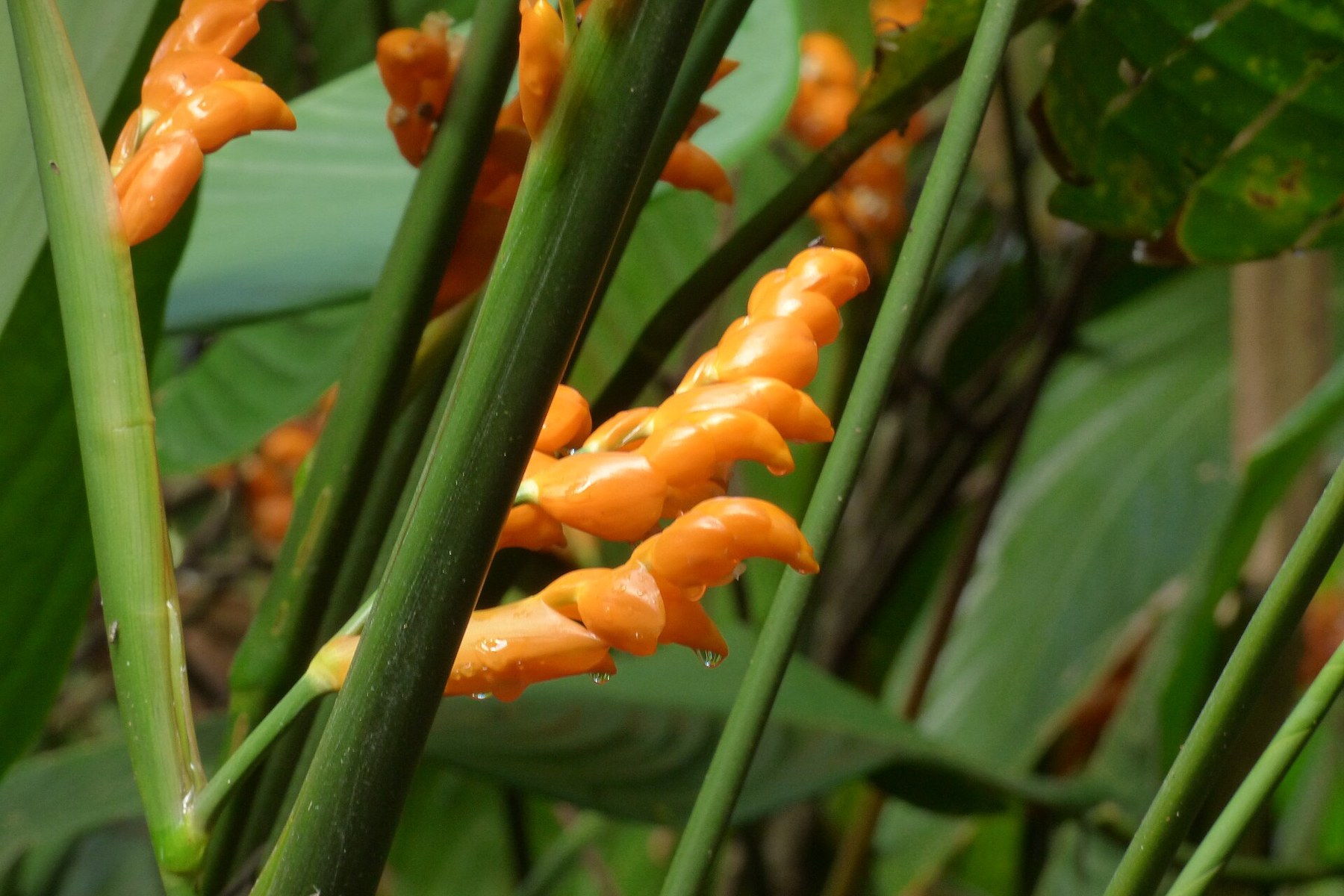
📷 Alejandro Bayer Tamayo from Armenia, Co / Wikimedia Commons (CC BY-SA 2.0)
Field Guide · Stromanthe
The Marantaceae all fold their leaves at dusk, but Stromanthe gives itself away in the petiole, the panicle, and the way it clumps.
The cultivar most people meet first, and still the one worth owning. Lance-shaped leaves stack pink, cream, and deep green on top with magenta undersides that flash when the foliage folds upright at night. Give it warmth above 65°F and steady humidity and it will throw a loose clump two to three feet wide. The variegation is genuinely stable, not a reverting chimera, which separates it from most variegated Goeppertia on the market.
Best overallThe straight species behind 'Triostar', native to lowland Brazilian rainforest from Bahia south. Glossy green lances to about 18 inches with the same wine-red reverse, held on long petioles that fan out from a basal clump. It tolerates lower light than the variegated form and grows noticeably faster. Look for the red bracts and small white flowers in late winter on mature plants — a real panicle, not the cone-like inflorescence of Goeppertia.
Most forgivingLess common in the trade and often mislabeled as a plain S. sanguinea. Leaves are broader and a darker, almost lacquered green, with a slightly shorter petiole and a more upright posture. Habit stays tighter than 'Triostar', which makes it a good pick for collectors short on bench space. Provenance matters here — buy from a grower who can name the source, because the name gets applied loosely.
Collector pickA sport with fine cream speckling instead of the broad sectors of 'Triostar', giving a softer, almost painterly leaf. The undersides keep the same magenta blush, so the nyctinastic fold at dusk still reads as a color change across the clump. It is slower and slightly fussier about humidity than 'Triostar', and the variegation can fade in low light. Worth growing if you already keep the genus well.
For the shelf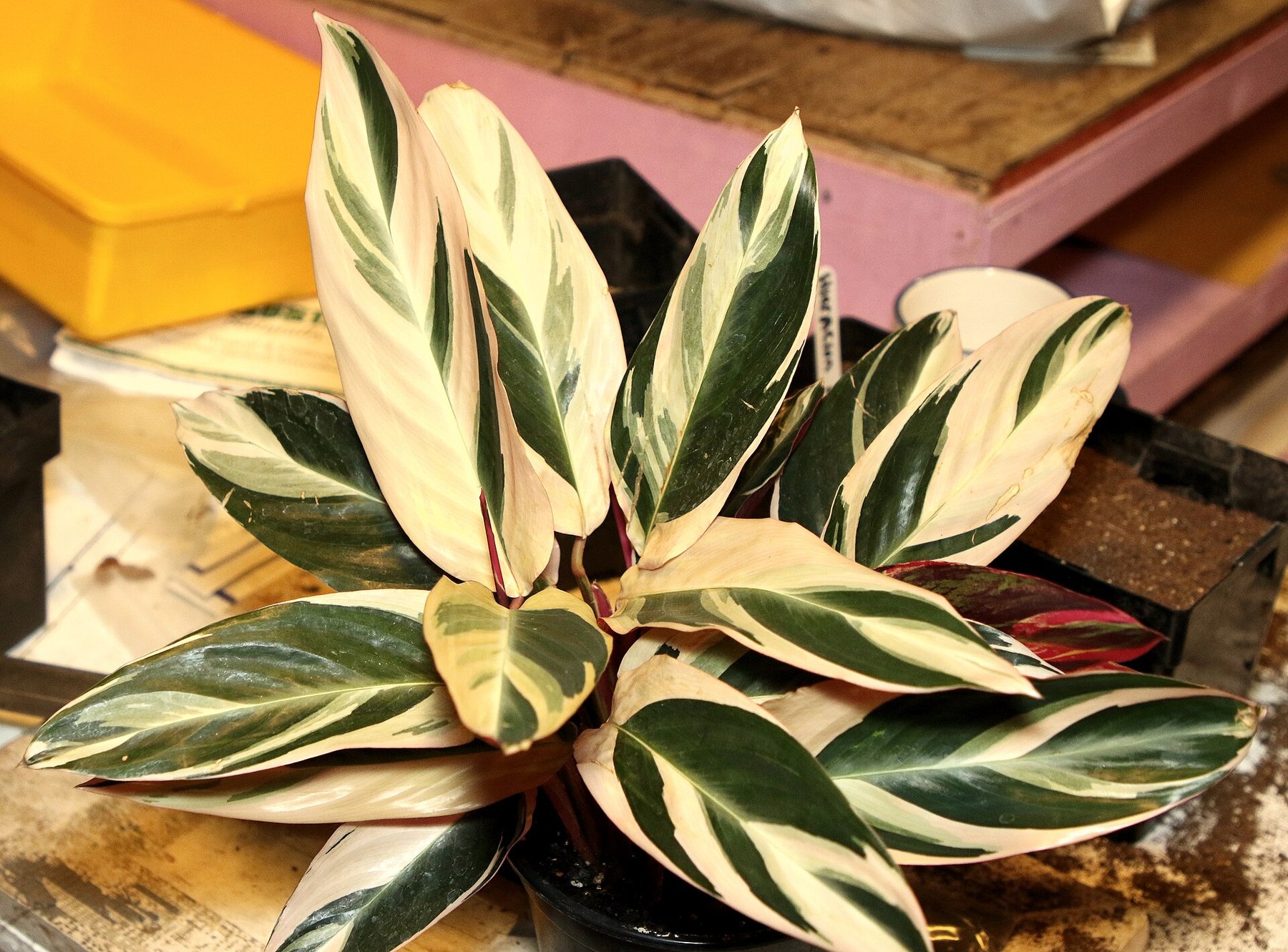
Start with habit. Stromanthe grows from a basal clump with long, distinct petioles that fan outward, so the plant reads as a loose vase of leaves rather than a dense rosette. Goeppertia (which absorbed most of what the trade still calls Calathea — orbifolia, ornata, makoyana, white fusion, and so on) tends to push leaves up on shorter, stiffer petioles in a tighter mound. True Calathea in the modern sense is a smaller genus, mostly larger-leaved species like C. lutea and C. crotalifera with paddle leaves and rattlesnake-tail inflorescences.
Then look at the leaf shape and reverse. Stromanthe leaves are narrow lances, typically two to four times longer than wide, with a smooth glossy upper surface and a saturated magenta or wine underside. Goeppertia leaves are usually broader ovals or rounds, often with elaborate feathered patterning on top, and the undersides are purple but matte and dustier in tone. If the reverse looks like nail polish, you are probably holding a Stromanthe.
Finally, wait for flowers if you can. Stromanthe produces an open, branching panicle of red bracts with small white or pink flowers, held well above the foliage. Goeppertia inflorescences are tight, cone-like or basket-like structures, often sitting low in the clump. The panicle is the cleanest diagnostic feature in the family, and it is the one most often missed because houseplant growers rarely let these plants flower.
Marantaceae roots are fine and shallow, and Stromanthe is no exception. Mix a substrate that holds moisture without going anaerobic: roughly two parts fine orchid bark, two parts coco coir or peat, one part perlite, and a handful of horticultural charcoal. The goal is a medium that stays evenly damp for four or five days after a thorough watering, then begins to dry at the surface. Pure peat compacts and sours; pure bark dries too fast and the leaf edges crisp within a week.
Light should be bright and indirect — think a foot or two back from an east window, or filtered south through a sheer. Stromanthe tolerates lower light than Goeppertia orbifolia but rewards more than people give it; the variegated cultivars in particular need real brightness to hold their pink sectors. Direct midday sun bleaches the upper surface within hours and the damage is permanent on that leaf.
Water with rainwater, distilled, or RO if your tap runs hard or chlorinated. Stromanthe is less dramatic than Goeppertia about fluoride and chloramine — it will not crisp overnight — but cumulative mineral load shows up over months as brown leaf margins and a tired clump. Let the top inch dry, then water until it runs free from the pot. Never let the rootball go bone dry; the lower leaves yellow and abscise, and they do not come back.
Aim for 60% relative humidity or higher. Below 50%, leaf margins brown and the nightly prayer movement gets sluggish. A pebble tray does almost nothing; a small ultrasonic humidifier aimed across the plant, or a grouped collection in a humid room, does a great deal. Pair humidity with moving air — a quiet clip fan on low, twelve hours a day — or you will trade crispy edges for fungal spotting and spider mites underneath the leaves.
Temperature is the quiet killer. Stromanthe comes from warm lowland forest and sulks below 60°F. A cold windowsill in February, or a draft from an exterior door, produces curled leaves and stalled growth that owners often misread as underwatering. Keep it above 65°F at night and well away from heating vents, which dry the air at the leaf surface faster than any room reading suggests.
The most common mistakes are predictable. Overpotting into a too-large container holds water against the fine roots and rots the crown; step up one pot size at a time. Wiping leaves with leaf-shine products clogs stomata and kills the gloss the plant already produces on its own — a damp soft cloth is all you need. And do not chase the magenta underside by giving more light; that color is genetic, and the way to see it is simply to walk past the plant after dark, when the leaves have folded up and the whole clump turns wine red.
The Field Guide from Leaf People.