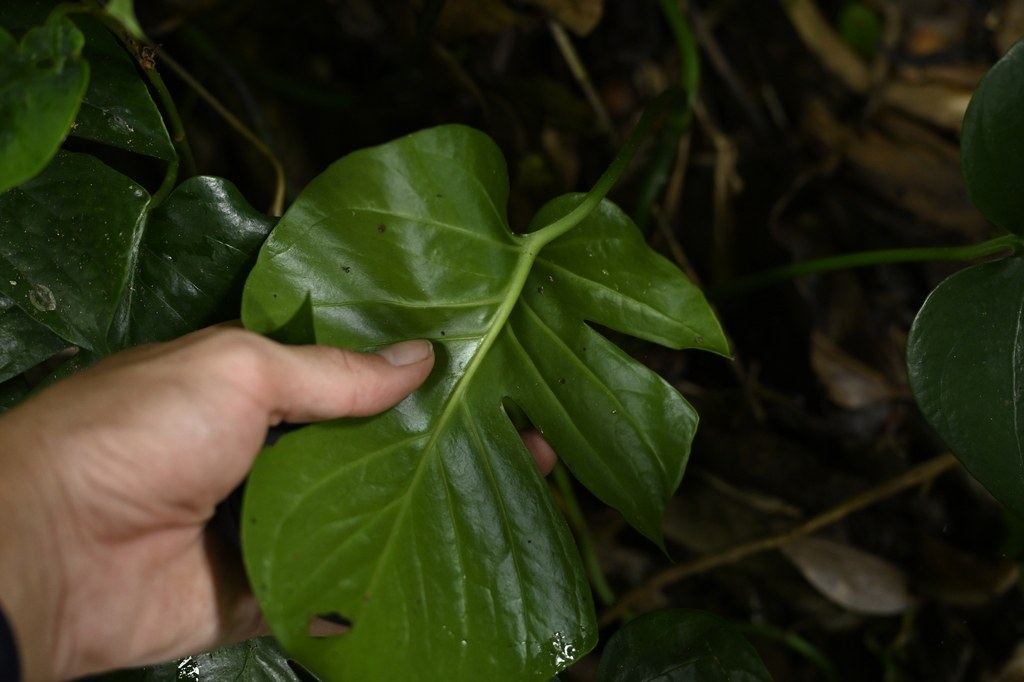
📷 曾昱承 Yu-Cheng Zeng / iNaturalist (CC BY 4.0)
Field Guide · Amydrium
The quiet Southeast Asian shingler that refuses to mature unless you give it something real to climb.
The species most growers actually want, native from Thailand through the Philippines and Indonesia. Juvenile leaves are small, entire, and easily mistaken for a Rhaphidophora; mature leaves go long, leathery, and split into dramatic windows along the midrib. Give it a rough vertical surface and it will reward you within a season or two. Worth the patience.
The benchmarkTrade name for a silver-patterned form of A. medium that holds its pewter dusting on juvenile and sub-adult leaves. The silver fades as leaves enlarge and fenestrate, so most keepers grow it for the shingling stage rather than full maturity. Slower than the green form in my experience, and fussier about light. A handsome wall plant if you can keep humidity steady.
Best silverBigger, broader, and less commonly offered than A. medium, ranging across New Guinea and the Moluccas. Adult leaves can reach impressive sizes but fenestrate less reliably under cultivation; expect entire, glossy, deeply veined blades on a thick stem. A good pick if you have ceiling height and patience. Sometimes mislabeled in trade as Epipremnum or Rhaphidophora.
For big spacesThe outlier — a smaller, terrestrial-leaning species from Borneo and Sumatra that creeps rather than climbs hard. Leaves stay modest and entire, with a quieter matte finish. Useful in a mixed tropical setup or a large terrarium where the showier climbers would outgrow the space. Rare in cultivation and usually pricier than its looks justify.
Collector's pick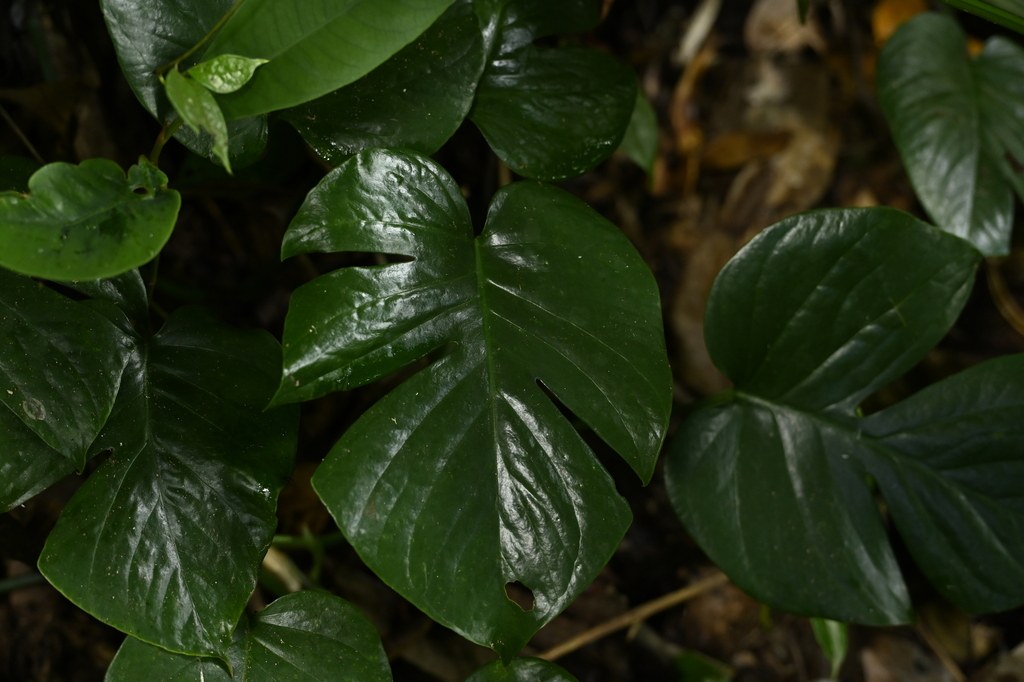
Amydrium are shinglers in juvenile form and climbers as they mature. Like Monstera and Rhaphidophora, they read leaf size and morphology off the surface they're attached to. A plant left to trail in a hanging pot will hold tiny, entire, lanceolate leaves indefinitely — sometimes for years — no matter how good your light is. People then assume the plant is slow or stuck. It isn't. It's just been told, structurally, that it's still a seedling on the forest floor.
Give it something tall, rough, and consistently moist. A sphagnum pole works, but only if you actually keep the moss damp from the top down; a dry pole is just a stake. Tree-fern panels are better where you can get them. Cedar planks wrapped in coir, or a slab of cork bark pinned to the wall behind the pot, both work well because the aerial roots can grip and burrow. The roots need to bond to the surface — once they do, the next leaf is usually a step up in size, and somewhere between leaf eight and leaf fifteen on a well-attached stem you'll see the first perforations open along the midrib.
Height matters too. A 60 cm pole will get you sub-adult leaves at best. Plan for at least 1.2 m of climbable surface if you actually want fenestrated adult foliage on A. medium, and expect the silver form to lag behind the straight species by a year or so.
Bright indirect light, full stop. Amydrium medium tolerates a wider range than people give it credit for — it will hold on in moderate light — but fenestration is a high-energy behavior, and a plant in dim conditions will keep producing entire leaves even on a perfect pole. Aim for 200–400 µmol·m⁻²·s⁻¹ at the canopy, or a meter back from an unobstructed east or shaded south window. Direct midday sun scorches the silver form quickly.
Substrate should drain fast and stay airy: a chunky aroid mix of bark, perlite, and a little charcoal, with maybe 15–20% coir or sphagnum to hold moisture against the roots. Water when the top third of the pot dries; these plants resent wet feet but sulk just as hard if you let the rootball go bone dry. The moss pole, kept damp, takes most of the pressure off the substrate watering schedule.
Humidity is where people overcorrect. Amydrium will grow at 50% ambient — they're not Anthurium luxurians. But fenestration becomes reliable around 65–75%, and the silver form holds its pattern better at the higher end. If your room runs dry in winter, a humidifier near the pole does more than misting ever will. Airflow matters: stagnant high humidity invites bacterial leaf spot, which spreads fast on the shingled juvenile growth.
Buying the silver form expecting silver forever. The pewter dusting is a juvenile trait. As leaves enlarge past roughly 20 cm and start fenestrating, the silver fades to a faint marbling or disappears entirely. If you want the silver look long-term, keep the plant climbing slowly on a shorter surface and prune back the leading growth — you're effectively keeping it in extended adolescence. Many growers run two specimens for this reason: one allowed to mature, one kept juvenile.
Confusing it with Rhaphidophora decursiva or Epipremnum pinnatum. All three pass through similar-looking juvenile stages and all three are sold mislabeled. A. medium's adult leaves fenestrate but generally don't pinnatifid-split all the way to the midrib the way Rhaphidophora decursiva does. Petiole sheath length and the geometry of the holes are your best tells. Buy from a seller who can show you adult foliage from the mother plant.
Treating the pole as decoration. A bamboo stake zip-tied to the stem will not trigger morphological change. The roots need to make contact with a porous, moisture-holding surface and stay there. If your plant has been on a pole for a year with no size increase, check whether the aerials are actually penetrating the surface — if they're sliding off dry sphagnum or wrapping around plastic mesh, rebuild the pole.
Overpotting after a growth spurt. Amydrium push hard once they've locked onto a good surface, and the temptation is to upsize the pot to match. Resist. Root volume isn't the limiting factor; climbing surface is. A tight pot with a tall, damp pole will outperform a generous pot with a short stake every time.
The Field Guide from Leaf People.