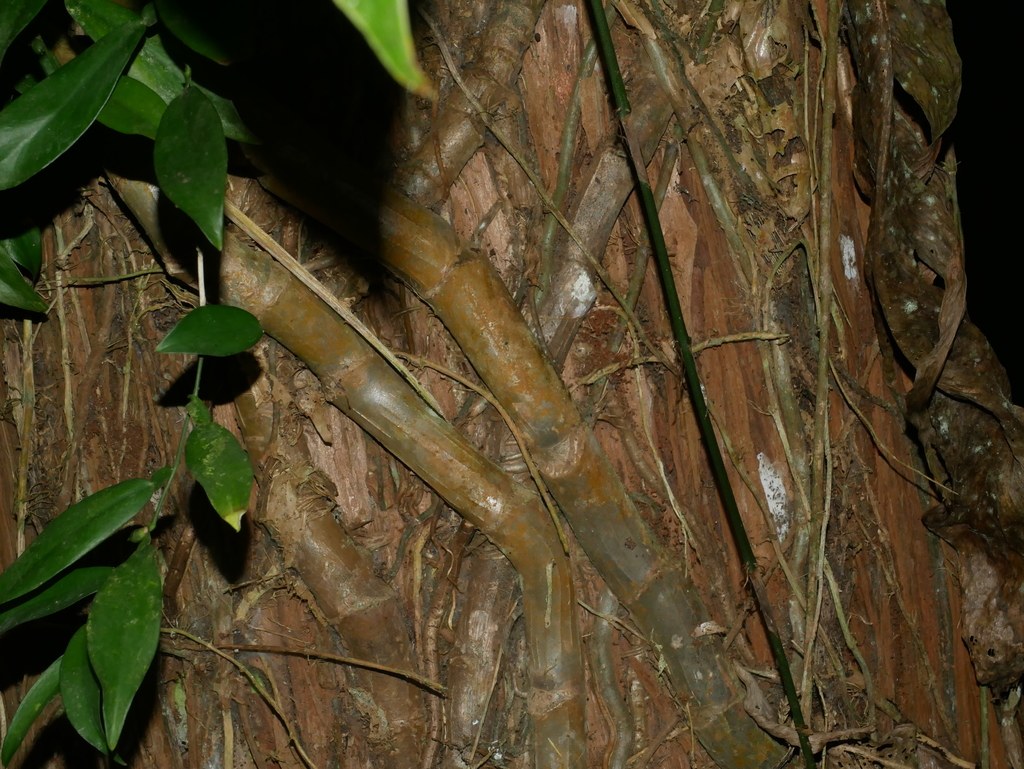
📷 Jacy Chen / iNaturalist (CC BY 4.0)
Field Guide · Epipremnum
The leaves don't split because the plant is old. They split because it finally believes it's climbing a tree.
The plant the genus is built around, ranging across Southeast Asia and the Pacific. Juvenile leaves are narrow, glossy, and undivided; mature foliage on a thick post becomes deeply pinnate with elliptical fenestrations along the midrib. Give it a 6-inch wide moss or cork pole and it will rewrite itself within two years. Don't confuse it with Rhaphidophora decursiva, which it superficially resembles but is unrelated.
The referenceA Philippine selection prized for its metallic, lance-shaped juvenile foliage. Almost everyone grows it as a trailing pot and never sees what it can do. On a damp slab with overhead light, leaves enlarge dramatically and eventually pinnate, losing some of the blue cast in the process. You essentially choose: keep the color or chase the splits.
Cult favoriteSectoral, sometimes half-moon white variegation on the standard pinnatum frame. Slower than the green form and prone to reverting or throwing all-white growth that won't sustain itself. Prune back to a node with balanced variegation when a vine commits to one extreme. Fenestration arrives later here — expect closer to three years on a pole.
Slow burnOften sold as a pothos and treated like a hanging basket plant, but it's the same species and behaves the same way given height. The cream marbling reduces chlorophyll, so growth is measurably slower and light demand is higher. Mature, climbing specimens with fenestrated marbled leaves exist and are worth the patience. Bright indirect, never direct midday sun on the variegation.
UnderestimatedA relatively recent commercial selection that fenestrates earlier and more reliably than typical 'Cebu Blue', with darker blue-green leaves that hold color better as they mature. The fastest route to a split-leaf pinnatum if you don't want to wait two-plus years. Still wants a pole — fenestration on a trailing vine is rare and shallow. A sensible starter if the goal is adult foliage.
Fastest payoff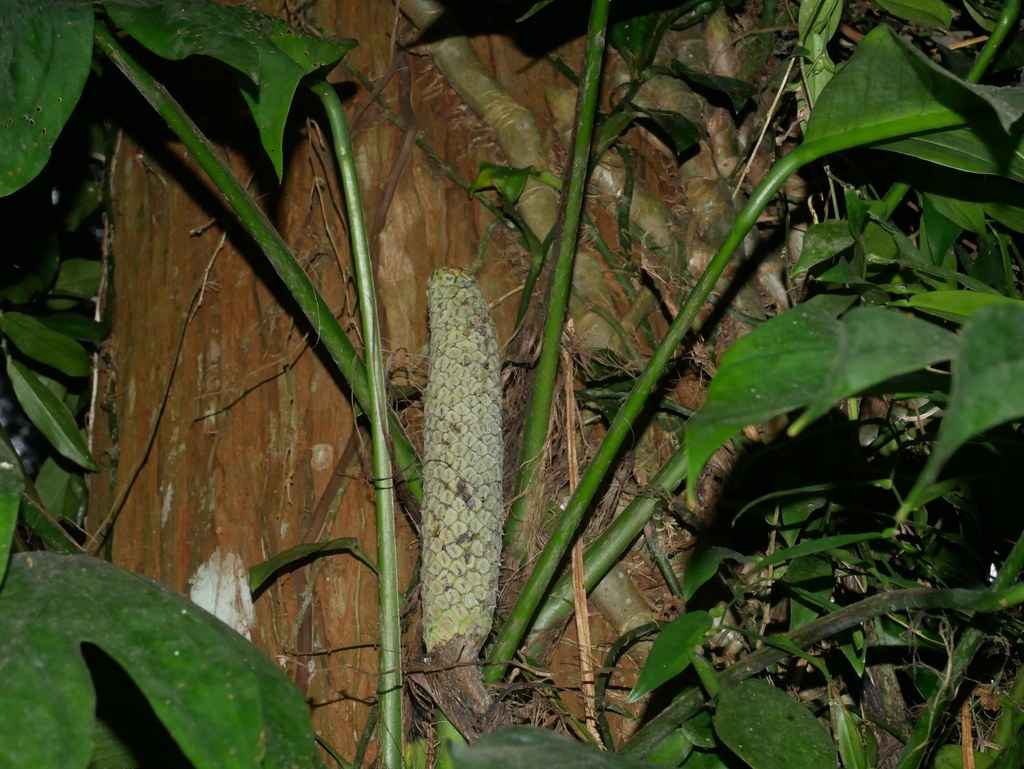
Epipremnum pinnatum is a shingling-then-climbing hemiepiphyte. In the wild it germinates on the forest floor, sends out skototropic stolons toward the darkest vertical shape it can find — usually a tree trunk — and then climbs, pressing its leaves flat against the bark. As it gains height and light, the leaves enlarge, thicken, and eventually pinnate. Fenestration is a response to that vertical journey, not to calendar age.
This is why a ten-year-old hanging basket of 'Marble Queen' still produces 3-inch entire leaves. The plant has been falling, not climbing, its entire life. Hand it a moss pole, a cedar plank, or a slab of cork bark kept genuinely damp, and the same vine will start producing larger, thicker, more adult-looking leaves within a few months. Give it 18 to 36 months of consistent upward growth on a wide enough support and you'll see the first true splits.
Width matters more than people expect. A skinny 2-inch coir pole won't trigger much. The aerial roots need surface area to grip and moisture to drink from. A 6-inch wide moss pole, a wrapped cork round, or a slab against a humid wall all work. Thin bamboo stakes are decorative furniture; they don't change the plant's mind.
Mix airy. A workable blend is roughly equal parts orchid bark, perlite or pumice, and coco chips, with a handful of charcoal. The pot roots want oxygen between waterings; the aerial roots want a damp climbing surface. These are two different watering jobs.
Water the pot when the top inch of mix is dry — typically every 5 to 8 days in a warm room. Separately, mist or soak the pole itself two or three times a week so the aerial roots have something to latch onto and drink from. A dry pole is the single most common reason a pinnatum sits on a support for a year and refuses to mature. The vine has to believe the structure is a living, humid tree.
Humidity above 60% accelerates everything, but it isn't strictly required — pinnatum will mature in a 45% living room if the pole stays damp and the light is strong enough. Airflow matters: stagnant humid air invites bacterial spotting on the new, larger leaves.
Bright indirect is the floor, not the ceiling. For adult foliage to develop, target 200–400 µmol PAR at the leaf, or a few feet from an unobstructed east or north window, or under a decent LED. Variegated cultivars need more light than the straight species to compensate for reduced chlorophyll, but direct afternoon sun bleaches the white sectors.
The most common mistakes, in order: trailing the plant instead of climbing it; using a pole too narrow to grip; letting that pole dry out; cutting the vine back every time it gets long, which resets the maturation clock; and repotting into peat-heavy mixes that suffocate the basal roots. If a vine has started producing larger leaves, don't prune it — let it run.
One more: patience. A plant that has been a basket for five years won't fenestrate in three months on a pole. The first 6 to 12 months on a proper support are usually just larger entire leaves and thicker stems. The splits come after the plant has committed. When they arrive, they arrive in a run — three or four progressively more pinnate leaves in a season — and the plant you thought you owned turns out to be a different one entirely.
The Field Guide from Leaf People.