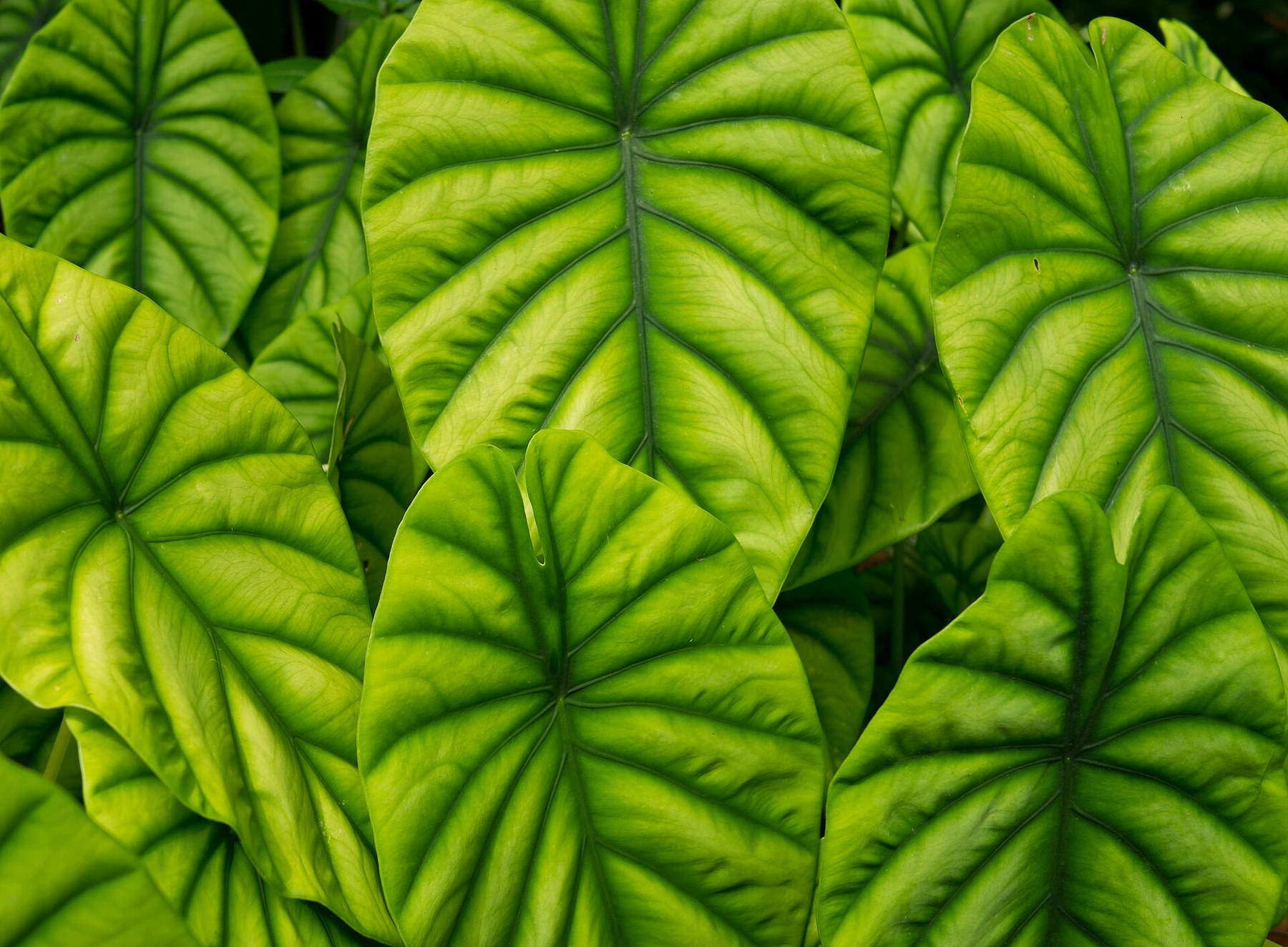
📷 Frank Schulenburg / Wikimedia Commons (CC BY-SA 3.0)
Field Guide · Alocasia
The Borneo copper-leaf is the most photogenic Alocasia you can buy — and the one most likely to collapse in a sulk if you treat it like a houseplant.
The selected form most often sold under the cuprea name, with thick, quilted blades that flash copper to oxblood depending on light angle. Leaves stay compact — 8 to 14 inches — and the plant rarely climbs. Give it warmth, airflow, and a coarse mix and it will push a new leaf every three to four weeks in summer. Stress it and it will drop everything and retreat to a corm.
The iconSlow, small, and tolerant of lower humidity than most jewels — closer to 55 percent will keep it presentable. The matte black blade with silver veins is the opposite aesthetic of cuprea but the same Bornean understory mood. Overwatering kills more Black Velvets than anything else; the rhizome rots before you notice. Use a gritty, fast-draining mix and water only when the medium is nearly dry.
Most forgivingThe so-called Red Mambo, with leaves that emerge bronze and mature to a deep purple-green with magenta veins. Trickier than cuprea — it wants steady warmth above 70°F and resents tap water with high mineral content. Worth chasing if you already keep A. cuprea and A. reginula happy. Don't make it your first jewel.
For the obsessed name dlhA suspected reginula × melo hybrid with stiff, almost succulent leaves in dusty grey-green. The thick cuticle means it forgives missed waterings and lower humidity better than any other jewel on this list. Growth is glacial — expect two or three new leaves a year. A good gateway plant if cuprea has burned you before.
Best for beginnersSabah endemic with deeply puckered, gunmetal leaves that look carved from stone. Wants the same conditions as cuprea but is even less tolerant of soggy roots — its native habitat is ultramafic, sharply drained substrate. Pot it in pumice-heavy mix and water by weight. A specimen plant, not a shelf-filler.
Collector grail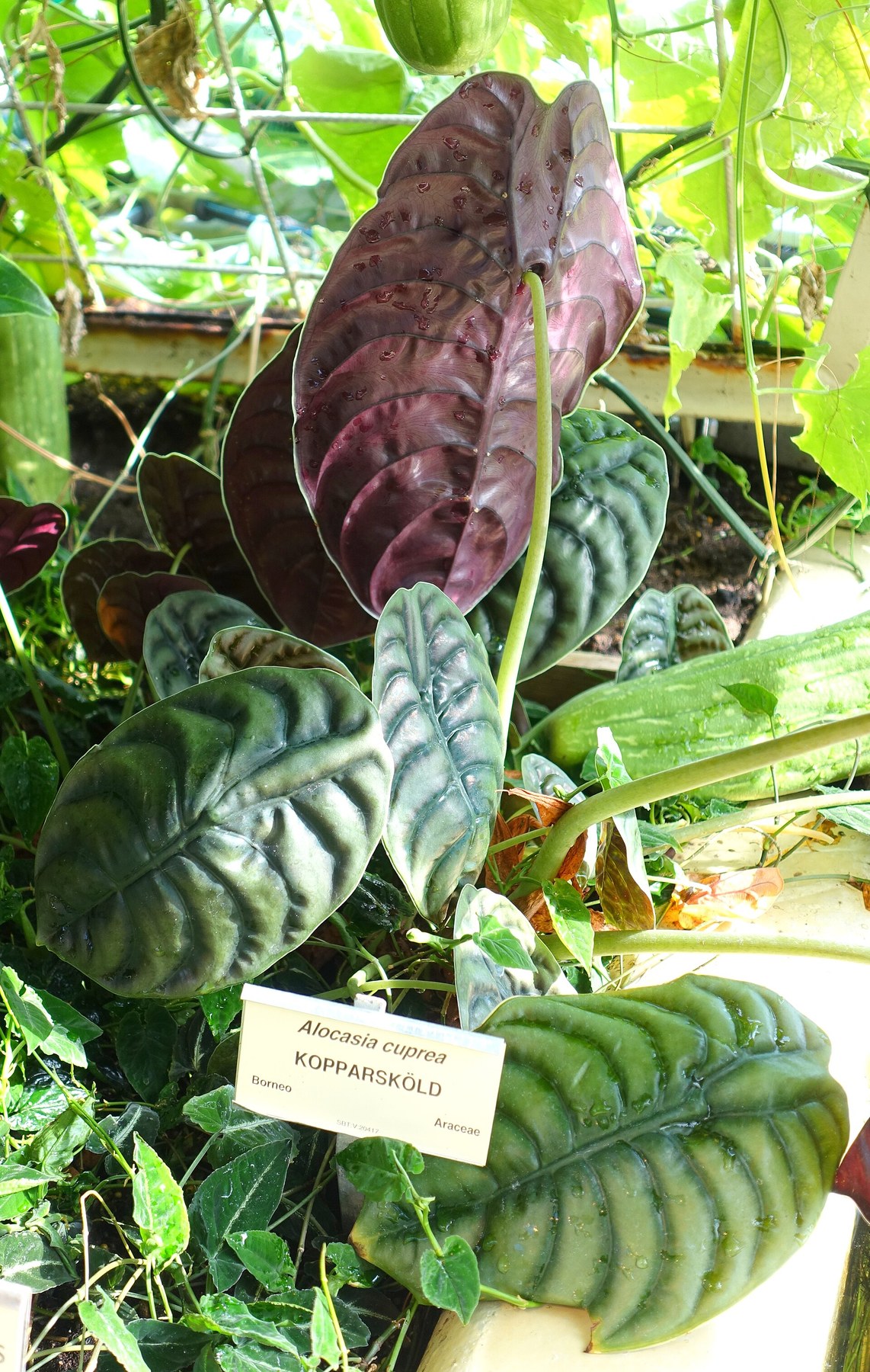
Alocasia cuprea is endemic to the limestone understory of Borneo, where it grows in leaf litter on shaded forest floors with daytime humidity above 80 percent and night temperatures that rarely drop below 68°F. Every problem people have with this plant traces back to one of those three numbers being wrong.
The leaves are the giveaway. That mirror finish is a thin, highly reflective cuticle over thin mesophyll — built for low, diffuse light. Put cuprea in a south window and the blade cooks from the inside; the metallic sheen dulls to a flat bronze, then crisps at the margins. Put it in a dry room and the petioles go limp within days and the newest leaf aborts before it unfurls.
The plant's defense against bad conditions is to drop everything, retreat to its corm, and wait. This is not death — it is sulking. If you unpot a 'dead' cuprea and find a firm, walnut-sized corm, pot it in damp sphagnum, keep it at 75°F, and it will resprout in four to eight weeks. Most growers throw the pot out one week too early.
Forget bagged houseplant soil. Cuprea wants an aroid mix that drains in seconds but holds moisture between particles: roughly two parts coarse orchid bark, one part perlite or pumice, one part coco chips, and a handful of horticultural charcoal. Some growers go further and grow cuprea in pure pon or 100 percent sphagnum — both work if you understand the watering implications.
In a chunky mix, water thoroughly until it runs from the pot, then let the top inch dry before watering again. In sphagnum, squeeze the moss — if water beads at the surface, wait. The killing mistake is watering on a schedule. Alocasias drink hard in active growth and almost nothing in winter; a midwinter pot kept summer-wet will rot at the corm within a month.
Use room-temperature water with low mineral content. Cuprea is sensitive to fluoride and chlorine — leaf tips brown and the metallic finish goes patchy. Rainwater, distilled, or filtered water makes a visible difference within two or three new leaves.
Bright indirect light means an east window, a north window in summer, or two to three feet back from a south or west window behind a sheer. A PAR meter is more useful than guessing; cuprea is happiest between 100 and 200 µmol·m⁻²·s⁻¹. Below that it stretches and the new leaves come out smaller; above it the cuticle dulls.
Humidity should sit at 70 percent or higher. A pebble tray will not get you there. Either group plants in an enclosed cabinet, run a real humidifier sized to the room, or accept that you are growing cuprea in a glass box. Pair the humidity with airflow — a small clip fan moving air gently across the leaves prevents the fungal spotting that high humidity invites. Still, wet air is how you grow mold, not Alocasias.
Temperature wants to stay between 68 and 82°F year-round. A cold draft from a winter window will brown the petioles overnight. If your growing space drops below 65°F in winter, put cuprea on a seedling heat mat under the pot, not next to the leaves.
Repotting in fall. Alocasias root aggressively in warmth and barely at all in cool weather. Repot in spring or early summer; a fall repot often triggers the corm-retreat response.
Treating spider mites as a minor issue. Thin-cuticled jewel Alocasias are spider mite magnets, and an unchecked infestation will strip a cuprea in two weeks. Inspect the leaf undersides weekly with a loupe. At the first stippling, hose the plant down and start a predatory mite program or a systemic — don't wait.
Fertilizing a stressed plant. If cuprea is dropping leaves, the answer is never more food. Cut fertilizer entirely, correct the underlying issue — usually root rot or low humidity — and resume feeding at quarter strength only when a new leaf is actively pushing.
The Field Guide from Leaf People.