📷 Salix / Wikimedia Commons (CC BY-SA 4.0)
Field Guide · Begonia
The palm-leaf Begonia behaves like a cane-stemmed houseguest from the Atlantic Forest, and it slots neatly between your Philodendron shelves.
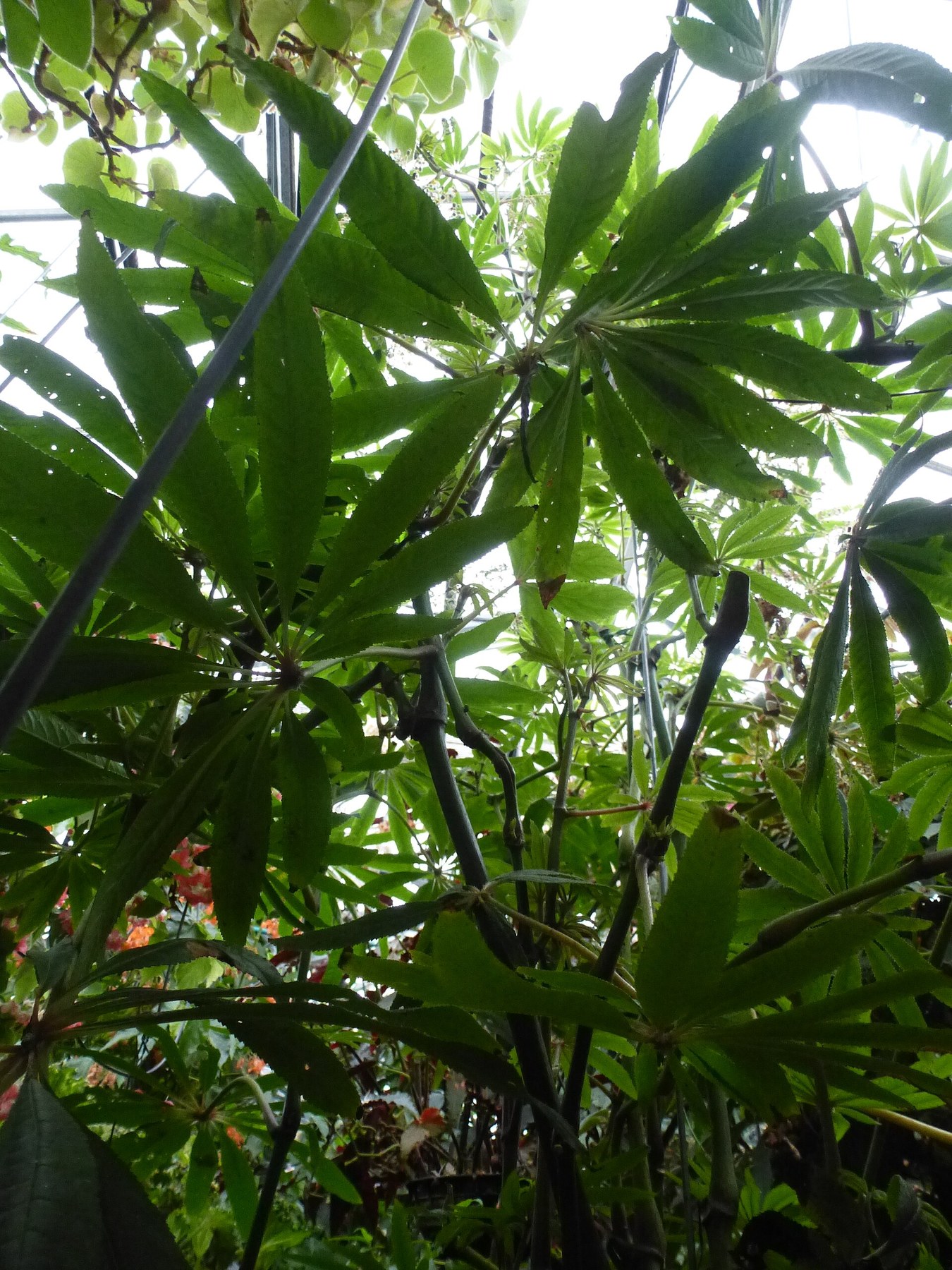
Native to the Brazilian Atlantic Forest, luxurians throws whorled, finger-like leaflets off tall reddish canes — the only Begonia most people mistake for a small palm or a Schefflera. Given a 20–25 cm pot, bright indirect light, and an airy mix, it pushes a flush of new canes every warm season and can clear two meters indoors. Tiny fragrant white flowers appear on mature plants in late winter. It is the gateway Begonia for aroid collectors because it reads architectural, not frilly.
Editor's pickThe silver-spotted angel-wing clone that launched a thousand windowsills, and still earns the slot. Olive leaves with crisp white polka dots and a wine-red reverse, on bamboo-like canes that branch readily if you tip-prune. It is the easiest cane Begonia to keep upright and the most forgiving of household humidity in the 45–55% range. Cuttings root in water in under three weeks, which makes it the trade currency of the genus.
Most forgivingThe sun-changing Begonia: leaves shift from chartreuse to bronze-black depending on light intensity, with a bullate, quilted surface that catches sidelight beautifully. A creeping rhizome means it prefers a wide shallow pot and resents being buried. Less common than maculata but unfussy where humidity sits above 55%. Group it with smaller jewel anthuriums for a textural shelf.
Best textureA small shrub Begonia from southern Brazil with velvety olive leaves bisected by a single chartreuse midrib stripe — the markings read almost identical to a Philodendron gloriosum in miniature. It wants steady humidity (60%+), warmth, and stagnant water nowhere near its crown. Slower than maculata but worth the patience for collectors who already keep velvet aroids happy. Pinch tips early to build a bushy plant rather than a leggy one.
Velvet leafA heritage cane hybrid from the early 1900s, still in cultivation because nothing else gives you 20 cm silver-spotted leaves on a self-supporting plant. Pink flower clusters hang in pendulous trusses for months once a cane matures. Treat it as the workhorse: it tolerates ordinary indoor humidity, takes hard pruning in spring, and roots from any node. The cane Begonia that earns its square footage.
Best value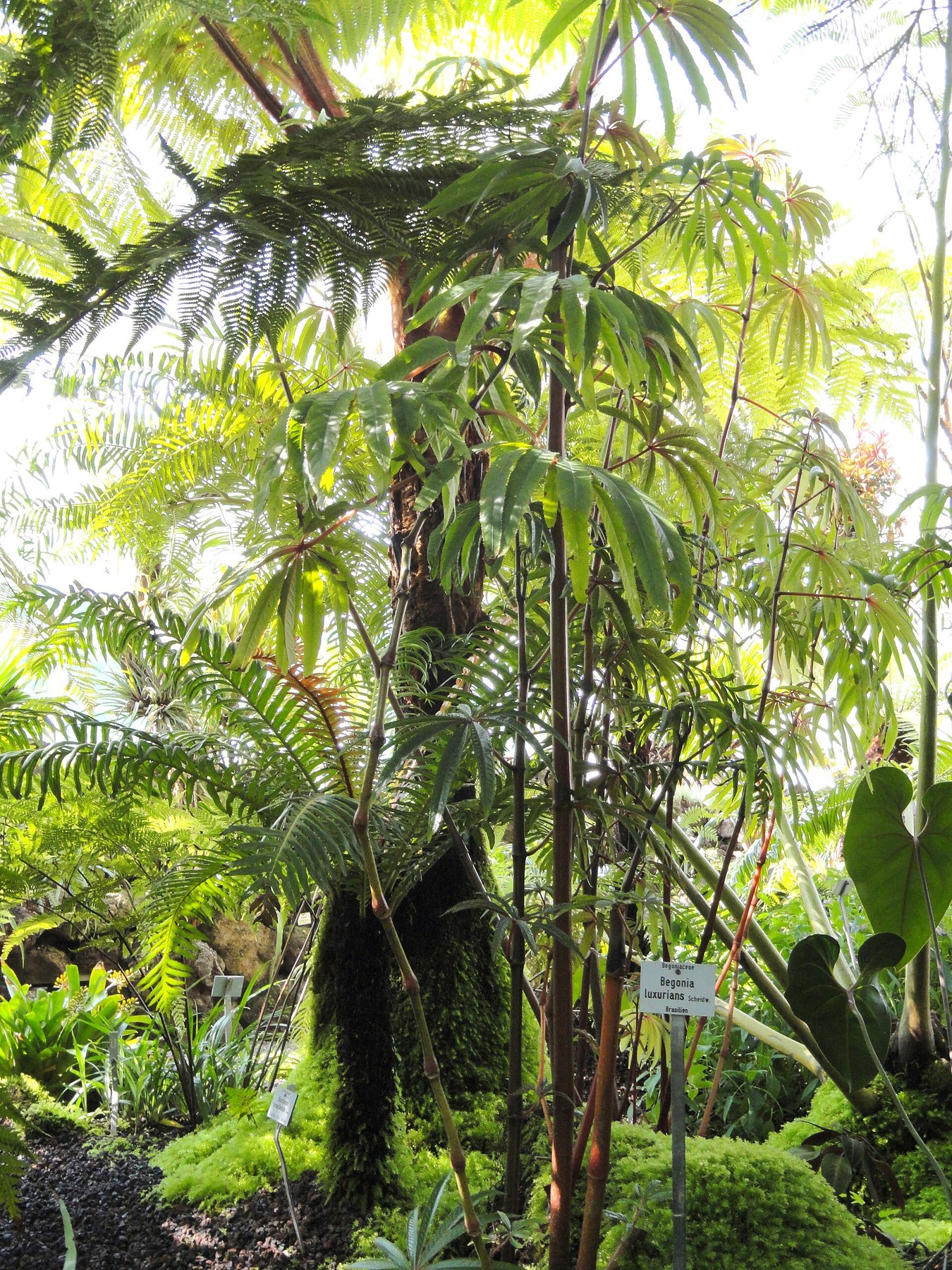
Most Begonias read as a different hobby — frilly, fussy, terrarium-bound. Begonia luxurians reads as an aroid companion. The canes are reddish and upright, the leaves are palmate with seven to seventeen narrow leaflets, and the whole plant carries itself like a young Schefflera or a small Dizygotheca rather than a windowsill flower. It comes from the moist Atlantic Forest of São Paulo and Rio de Janeiro states, where it grows as an understory shrub alongside the same epiphytic anthuriums and philodendrons many collectors already chase.
Practically, that shared origin means shared culture. The light, water, and substrate that suit a Philodendron gloriosum or an Anthurium warocqueanum will keep luxurians pushing new canes. It does not demand a closed case. It does not want sphagnum-only media. It wants what a terrestrial aroid wants, and it returns the favor by adding a vertical, palmate silhouette that nothing in the Araceae family quite duplicates.
Use an airy chunky mix — the same one feeding your terrestrial philodendrons is fine. A working ratio: 40% coarse orchid bark (medium grade), 25% perlite or pumice, 20% coco chips, 15% a peat or coir base for moisture buffer. A handful of horticultural charcoal helps with the inevitable wet weeks. The goal is a mix that drains within seconds of watering and re-wets evenly, never compacts.
Luxurians is a cane Begonia and roots deeper than rhizomatous types, so favor a taller pot over a pan. Terracotta is fine if you water attentively; plastic or glazed ceramic is more forgiving for collectors who travel. Pot up only when roots circle the bottom — going up one size at a time. An over-potted Begonia in damp media is the fastest route to stem rot in the genus.
Bright indirect light is the sweet spot — an east window, or a meter back from a south or west window with a sheer. Direct midday sun bleaches the leaflets and crisps the tips within a week. Too little light and the canes stretch, internodes lengthen, and the palmate look collapses into a leggy mess. If you grow under LEDs, 150–250 µmol at the canopy is plenty.
Water when the top 3–4 cm of mix has dried but the lower root zone is still faintly damp. Luxurians does not want a true dry-down between waterings the way a Hoya does, and it does not want to sit wet either. In an airy chunky mix, that usually means a thorough flush every five to seven days in summer, every ten to fourteen in winter. Use room-temperature water; cold tap water out of a January faucet will spot the new leaves.
Humidity above 50% keeps the leaflets unfurling cleanly. It will survive at 40%, but expect crispy tips and slower growth. A pebble tray does almost nothing; a small clip fan plus a humidifier set to 60% does everything. Airflow matters more than collectors expect — stagnant humid air is what brings powdery mildew, the one disease this genus reliably gets.
Overwatering in a peat-heavy mix. Most rot in this genus is substrate, not schedule. If you are watering on a sensible cadence and still losing canes at the base, the mix is wrong. Repot into something chunkier before you change anything else.
Letting it get leggy, then trying to fix it late. Cane Begonias branch from where you cut. Tip-prune luxurians in early spring, above a node, while the plant is pushing new growth. Cuttings root readily in damp sphagnum or perlite under a humidity dome — do not waste them.
Treating it like a terrarium plant. Luxurians resents stagnant closed cases. It is a shrub, not a jewel Begonia. Open shelf, fan, humidifier — the same setup that keeps a velvet philodendron happy will keep this plant pushing two-meter canes within a couple of seasons.
The Field Guide from Leaf People.