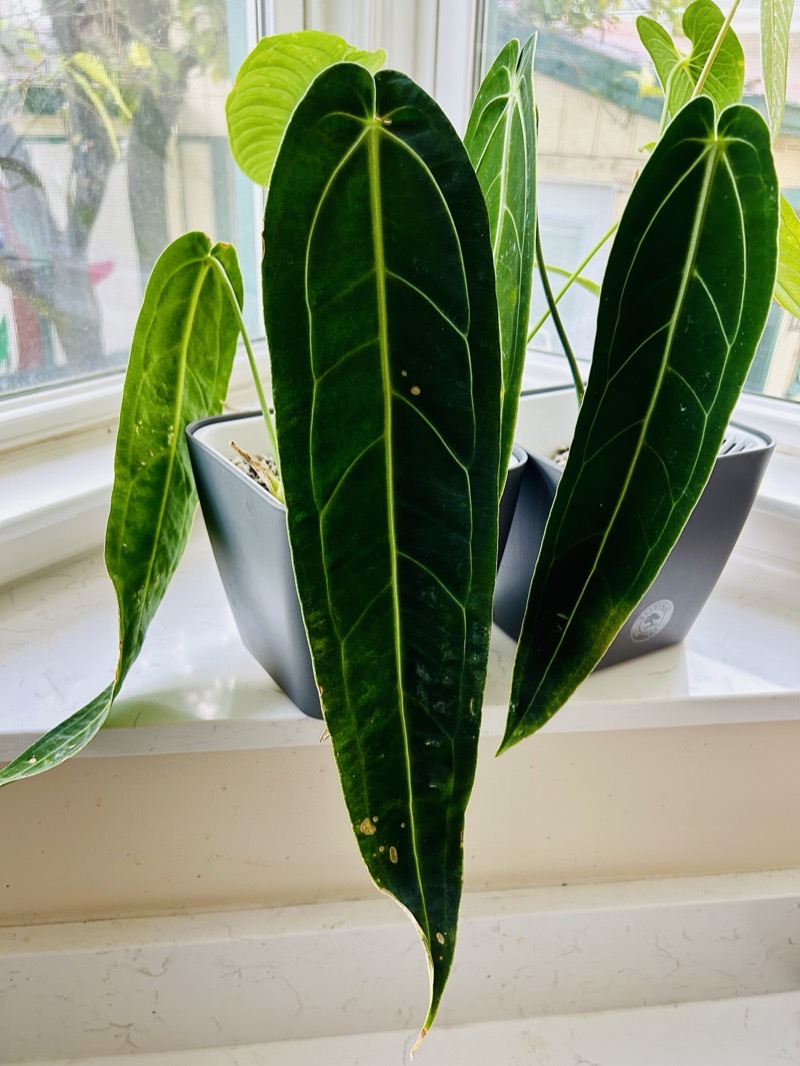
Somewhere in the western cordillera of Colombia, at elevations where the cloud sits in the canopy for most of the morning and the temperature rarely climbs above 20 °C, Anthurium warocqueanum grows as an epiphyte on mossy trunks with its roots wrapped in perpetual, oxygenated moisture. The leaves hang vertically — sometimes past a metre — dark green shading to near-black, the primary and secondary venation silvered as if someone had pressed platinum wire into living tissue. In the forest, all the conditions conspire in its favour. In your growing room in January, they conspire against you.
That tension is the whole story of warocqueanum in cultivation. No other aroid — possibly no other houseplant — commands the price, the patience, and the grief that this species does. Collectors who keep ten-leaf specimens speak with the quiet authority of people who have survived something. Those who have lost one speak with equal authority, only darker. The Queen, as the hobby calls her, has been earning that epithet since Victorian horticulturists first displayed her in Belgian glasshouses, and she has not become more forgiving in the intervening century and a half.
A Plant with a Pedigree
Anthurium warocqueanum was described by the English botanist Thomas Moore in 1878, named in honour of Jean-Jules Warocqué, the Belgian industrialist and plant patron whose greenhouse collections were among the finest in Europe. That original horticultural milieu — wealthy, heated, staffed — is worth keeping in mind. The plant entered cultivation in conditions that approximated its native cloud forest far better than most Victorian parlours could manage, and still it was considered a challenge.
Its taxonomy places it in section Cardiolonchium, alongside the velvets that have come to define a whole collecting subculture: regale, papillilaminum, crystallinum, magnificum. Among these, warocqueanum is distinguished by leaf size and shape — long, strap-like, the base barely cordate, the blade narrowing to a drawn-out tip — and by the contrast between that near-black surface and its pale venation. It is the most elongated of the group, and that length is the source of both its appeal and its fragility in cultivation. Long leaves transpire heavily. Long leaves snap in transit. Long leaves, in low humidity, desiccate from the margins inward in a way that looks like grief made visible.
The species grows across a relatively narrow elevational band in the Colombian departments of Chocó, Antioquia, and Valle del Cauca, always in cloud forest, always in high humidity and low direct light. Populations vary in leaf width, venation density, and the intensity of the silver blushing — variation that collectors have learned to read and debate with the intensity of wine critics parsing vintages.
Every collector who has killed a warocqueanum understands something about the plant that no care guide can fully teach.
Why the Hobby Became Obsessed
The modern warocqueanum craze tracks almost exactly with the expansion of plant trading on social media from around 2017 onward. Instagram gave velvet anthuriums a perfect stage: the leaves photograph like cinema, that dark, light-drinking surface recording beautifully in artificial light. A single image of a mature plant against a white wall — leaves hanging like dark banners, venation catching the light — could accumulate tens of thousands of interactions, and with attention came demand.
At peak pandemic-era plant fever, rooted warocqueanum cuttings were changing hands for several hundred dollars in the United States, and tissue-culture deflasked babies — tiny, fragile, prone to dying in the hands of anyone who did not understand their specific acclimation needs — were moving at prices that now seem absurd. The market has corrected. A healthy rooted plant is far more accessible than it was in 2021. But accessibility has not made the species easier to grow, and the hobby's attrition rate for warocqueanum remains quietly high. People buy them because the price dropped. They lose them because the care requirements did not.
What the obsession revealed, more than anything, is that warocqueanum is not simply a beautiful plant people want to own. It is a problem people want to solve. The forums and growing groups devoted to it are full of data: vapour-pressure deficit measurements, substrate moisture curves, leaf temperature readings. Growing a mature, happy warocqueanum is a legitimately difficult horticultural achievement, and the hobby treats it as such.
Reading the Leaf
Experienced collectors assess warocqueanum health leaf by leaf, almost as a clinician reads a chart. The surface of a well-grown leaf is uniformly dark — a true velvet, the adaxial trichomes catching light at the same angle across the whole blade. Pale patches or greyish zones where the velvet looks flattened usually mean thrips, and thrips on warocqueanum are disproportionately damaging because the feeding scars persist in every subsequent leaf, scaled up. A plant that has been through a bad thrips infestation can take six to eight leaves to grow out the cosmetic damage, assuming you have arrested the infestation in the meantime.
Marginal browning — the crispy edges that are every grower's first warocqueanum nightmare — typically indicates one of three things: vapour-pressure deficit too high (ambient humidity below about 70% combined with warm, moving air), root system too compromised to supply water at the rate the long leaf transpires, or both. The two causes compound each other. A plant with root rot cannot uptake moisture even when humidity is adequate, and a plant in low humidity cannot recover from root damage the way a well-buffered specimen might. The margin is the canary.
New-leaf emergence is the plant's most precarious phase. The spathe, or rather the cataphyll wrapping the unfurling leaf, protects the blade during emergence, but warocqueanum's leaves are long enough that the tip often extends beyond that protection before the blade has hardened. If the ambient humidity drops during this window — a cold night, a heater cycling on — the tip desiccates and the damage is permanent, encoded in that leaf for its entire lifespan, which on a healthy plant can be a year or more.
The Substrate Question
More warocqueanum have been killed by substrate than by almost any other single factor. The plant's natural root environment is the surface of a mossy trunk or a pocket of accumulated debris in a fork — never wet soil, never anything that holds moisture against the root surface for extended periods. The roots need moisture in the air around them as much as in direct contact; they need oxygen; they need to drain fully between inputs.
The medium that comes closest to replicating this in a container is a matter of genuine debate, but the consensus among serious growers leans toward something in the 50–60% chunky orchid bark range, combined with perlite for drainage and structure, with additions of either long-fibre sphagnum, LECA, or biochar depending on the grower's preference for moisture retention versus gas exchange. The specific recipe matters less than the principle: after watering, the medium should retain some moisture for 24–36 hours and then approach dryness. If it is still wet at 72 hours, the mix is too dense.
Terracotta pots are popular with experienced growers precisely because they wick moisture away from the root zone and provide a visual and tactile cue — the pot feels cool and looks dark when wet, warm and pale when dry. Plastic pots with multiple side drainage holes work similarly in principle. What does not work, reliably, is any attempt to grow warocqueanum in anything approaching a standard peat-based potting mix. The obituaries in growing groups almost always include the words 'I had it in regular potting soil.'
Humidity, Airflow, and the False Security of a Closed Cabinet
The instinct, when faced with a plant from a cloud forest, is to seal it in: a glass cabinet, a humidity tent, a terrarium. The instinct is not entirely wrong — warocqueanum does need sustained humidity in the 70–85% range — but the execution kills as many plants as the dry air it is trying to exclude. Still, saturated air around a plant whose roots cannot dry promotes the fungal pathogens, particularly Phytophthora and Pythium, that rot roots and collapse petioles within days. Pythium, in particular, can take a warocqueanum from 'slightly droopy' to 'unrecoverable' in under a week.
The correction is airflow. High humidity with good airflow is the cloud forest model: the moisture is there, but the air is moving, the surface of the leaf and the medium are not stagnant. In practice this means a small fan running continuously in any enclosed growing space, pointed to circulate air without blasting the plant directly. The combination of 75% humidity and gentle air movement is more beneficial, and less dangerous, than 90% humidity in dead still air.
Growers who have cracked the warocqueanum code tend to describe their setups in terms of airflow before humidity. A greenhouse tent with a USB fan and a humidifier on a controller is a common solution. So is a dedicated IKEA glass cabinet modified with a fan and venting. The specific enclosure matters far less than understanding what you are managing: not just moisture, but the dynamic relationship between moisture, temperature, and air movement that the cloud forest provides by default and that cultivation has to engineer deliberately.
What a Mature Plant Actually Looks Like
Most collectors encounter warocqueanum as a juvenile: a four- or five-leaf plant with blades in the 30–45 cm range, already beautiful, already unmistakably itself, but nowhere near its potential. A mature specimen — a plant that has been in stable conditions for two or three years, that has developed a robust root system and calibrated its growth rhythm to its environment — produces leaves that can exceed 120 cm in length and 25 cm in width, hanging almost perfectly vertically on petioles that are themselves 40–50 cm long.
The venation on a mature leaf is significantly more pronounced than on juvenile foliage. The primary veins are raised and cream to silver; the secondary venation between them, less obvious on young leaves, becomes a fine reticulate network that catches raking light. There are documented collector plants in the US and Europe with leaves approaching 150 cm. These are not outliers so much as demonstrations of what the species does when it is not being interrupted — by repotting trauma, pest damage, low humidity, or any of the other indignities cultivation imposes.
Reaching that scale requires not doing things as much as doing them. Warocqueanum responds poorly to frequent repotting; it prefers to be slightly root-bound and dislikes the disturbance. It resents fertiliser at high concentration — a quarter-strength balanced liquid feed every two to three weeks during active growth is roughly the ceiling before salt burn appears at the leaf margins. The growers with the largest plants are often those who have learned to resist the interventionist impulse, who water when the medium is nearly dry and otherwise leave the plant alone to do what it has been doing, in various forms, since before Belgium was a country.
The Heartbreak and Why We Keep Going
Every collector who has killed a warocqueanum — and this is a large and unsentimental club — goes through a recognisable sequence: diagnosis (root rot, usually), recrimination (the substrate, the cabinet, the missed watering cycle), and then, almost inevitably, the decision to try again. This is not sentiment. It is something closer to the competitive instinct. The plant presented a problem; the problem was not solved; the problem remains.
The second attempt is almost always more informed than the first. The grower who lost one to Pythium in a closed cabinet buys a fan. The grower who lost one to crispy margins in a dry room builds a humidity tent. The accumulated knowledge of the warocqueanum growing community is, in large part, a catalogue of expensive failures turned into actionable understanding. The species has been, in this sense, an unlikely educator — pushing the hobby toward better substrate practices, better humidity management, better pest monitoring, and a more honest reckoning with what it actually means to provide appropriate conditions rather than approximate ones.
None of which makes it easy. A healthy, mature warocqueanum is still a genuine achievement, still something that stops visitors mid-sentence when they see it hanging its great dark blades in a warm, misty corner. The Queen has always demanded conditions fit for a queen. That this is difficult, in a spare bedroom in Ohio or a flat in Glasgow, is precisely the point. If she were easy, she would be something else entirely.
A Note on Forms and Fakes
The market for warocqueanum has generated, predictably, a fringe of misidentified plants. Juvenile Anthurium regale — similarly velvety, similarly dark, but with a broader, more cordate blade and less pronounced elongation — has been sold as warocqueanum often enough that the error is worth naming. Regale is a magnificent plant in its own right and deserves to be sold honestly. The distinction at juvenile size is not always obvious, but the petiole cross-section and the degree of leaf elongation relative to width are reliable early markers.
More problematic are the named forms and clones that proliferate without documentation. 'Dark form,' 'wide form,' and 'narrow form' are descriptors that circulate freely and mean different things in different sellers' hands. Where a vendor is selling a specific vegetative clone with a documented lineage, that is meaningful. Where 'dark form' means 'this batch of seedlings looked a bit darker than average,' the label is doing marketing work rather than botanical work. Buying from growers who can describe the specific plant's history — not just its current appearance — remains the most reliable way to get what you pay for.
None of this diminishes the species. Anthurium warocqueanum is exactly what its reputation suggests: long, dark, silver-veined, specific in its requirements, devastating when it grows well, and genuinely difficult to keep alive at anything near its potential. Knowing what you are getting into, in precise rather than vague terms, is the only honest preparation. The cloud forest does not simplify for anyone.