The Cordillera del Cóndor runs along the Ecuador-Peru border like a blade left in wet ground. It is not a comfortable place. The range sits at roughly 1,000 to 2,700 meters, blanketed in the kind of cloud forest that condenses moisture from nothing, where mosses grow on mosses and the canopy rarely dries between November and May. It was, until 1998, also the site of an active territorial conflict — the Cenepa War's unresolved eastern front — which meant that serious botanical collection essentially stopped there for decades while the rest of the aroid world moved on. When collectors began seeing photographs of an Anthurium from that corridor in the early 2020s, most assumed the images were manipulated. The leaves were too regular in their corrugation, the velvet too deep, the silver venation too evenly spaced to be real.
They were real. And what followed that revelation has become one of the more instructive episodes in the recent history of collector culture — not because the plant is the rarest thing anyone has ever grown, but because it forced a reckoning with a word that gets used loosely in almost every sales listing and forum thread: locality.
The Plant Itself
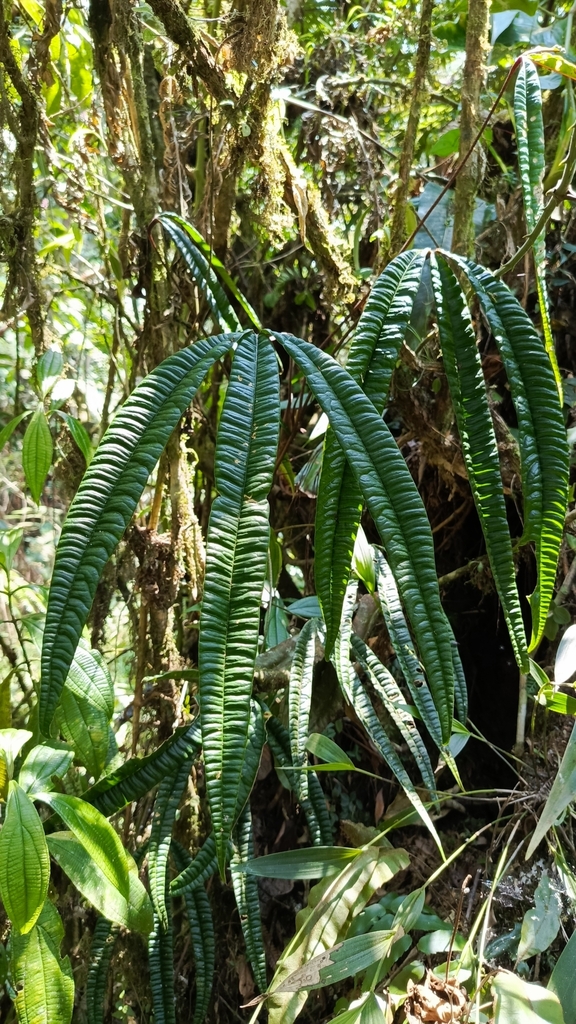
The anthurium in question belongs to the velvet-leaf section Cardiolonchium, a grouping that includes Anthurium crystallinum, A. magnificum, A. forgetii, and the notorious A. dressleri from Panama's Darién. Velvet anthuriums as a group are defined by trichomes on the adaxial leaf surface that scatter light in ways that feel tactile even in photographs. But within that section, there is enormous variation in bullation — the puckering between veins that gives the best specimens their quilted, almost upholstered quality. The Cóndor material shows bullation so pronounced that the sinuses between primary veins cast real shadow in side-raking light. This is not cosmetic. It reflects the mechanics of a leaf designed to shed lateral water sheeting off upper montane cloud.
The petioles are D-shaped in cross-section with a pronounced adaxial sulcus, running approximately 60 to 80 percent of total leaf length on mature specimens. The blade on a fully grown plant reaches 55 to 70 centimeters, occasionally more, with a sinus depth that leaves the basal lobes clearly separated. Primary venation is impressed above and prominently raised below, silver-white against the deep matte green. Secondary veins connect in a nearly perpendicular pattern to the primaries, giving the venation map an almost architectural regularity. None of this is unique in isolation. What is unusual is seeing all of it expressed together at a leaf size that makes the whole structure feel architectural rather than merely decorative.
Taxonomically, the plant has not been formally described as a new species, and careful growers tend to resist naming it until publication arrives. In the trade it circulates under several locality tags — 'Cóndor Cloud,' 'Ecuador 1800m,' and at least one vendor's proprietary label that tells you nothing useful about origin. That ambiguity matters, and we will get to why.
Locality is not a story you tell about a plant. It is a set of biological instructions the plant carries whether you know them or not.
How It Came Out of the Forest
Botanical access to the Cóndor corridor opened incrementally after the 1998 Brasília Presidential Act demarcated the final border segment. Ecuadorian environmental agencies established the Reserva Biológica El Quimi in 2006, and limited research expeditions began entering the zone with permits from the Ministerio del Ambiente. The first photographs of this specific anthurium appearing in hobbyist circles are traceable to shared field images from one of those expeditions, forwarded informally and then posted without much context. Within weeks the speculation began.
The path from forest floor to a collector's grow tent in, say, the Netherlands or Ohio involves several links: a permitted collector or researcher, a tissue-culture lab or an offset from a single mother plant, an importer, a broker, and then the secondary market where cuttings and seedlings change hands again. At each link, locality information can be preserved, compressed, or lost entirely. By the time a listing reads 'Anthurium sp. velvet, Ecuador locality,' that tag might mean a documented GPS coordinate and collection permit number, or it might mean someone's seller told them it was Ecuadorian and they chose to believe it. Both are common. They are not equivalent.
What Locality Actually Encodes
The collector community tends to discuss locality as if it were primarily about authenticity — a provenance story that separates a 'true' plant from a nursery-propagated approximation. That framing is not wrong, but it undersells what elevation and latitude actually encode in a plant's physiology. An anthurium collected at 1,800 meters in the Cóndor has grown in conditions where nighttime temperatures regularly fall to 14 or 15 degrees Celsius and daytime highs rarely exceed 24. It is adapted to high ambient humidity — often 85 to 95 percent — but also to consistent airflow from orographic cloud movement. Its stomata, its cuticle thickness, its response to temperature differentials: these are shaped by a specific climate, not just a specific aesthetic.
This matters practically. A lowland-collected or greenhouse-propagated clone of the same putative species, grown warm and still for several generations, will behave differently. It may push leaves faster but show less bullation. It may tolerate 28-degree grow-tent temperatures that would cause a high-elevation clone to sulk or stall. Neither is superior in the abstract. But they are not interchangeable, and treating them as such leads to the frustrated posts that appear in every velvet anthurium forum: 'my Cóndor plant is barely growing, what am I doing wrong.' Sometimes the answer is that the plant is not actually from the Cóndor, and its care requirements are being calibrated to a story rather than to the actual organism.
This is not an argument against buying plants without flawless documentation. Most of what circulates in the hobby lacks it, and many beautiful, healthy collections have been built on plants whose provenance is 'I bought it at a show in 2019.' The argument is that locality information, when it does exist, should be treated as data and passed forward faithfully — not because it makes a plant more valuable in a listing, but because it makes it more legible to everyone who grows it next.
The Tissue Culture Question
Several European labs began producing in vitro propagules of Cóndor-type material within two years of the plant's circulation. This accelerated availability, which is unambiguously good for the hobby. Plants that were trading as single cuttings for prices that made serious growers wince became accessible to people who simply wanted to grow a beautiful anthurium without spending rent money. Tissue culture democratizes. That is its legitimate function.
The complication is that TC production typically starts from a single mother plant or a small clonal pool. If the original accession was well-documented — a specific clone, collection number, elevation — that information can be carried through to the lab's stock records and eventually to the buyer. Frequently it is not, because nobody along the chain thought it would matter or because the original seller did not provide it. The result is a wave of plants that are genetically linked to Cóndor material but carry no usable locality data, circulating alongside plants whose sellers have invented or extrapolated locality tags to match market demand. Sorting these streams requires either direct relationships with collectors who were involved in early acquisitions, or a resigned acceptance that you are growing a beautiful plant with an uncertain biography.
There is a third option, which a small number of serious collectors have pursued: sourcing from researchers who maintain documented accession records and are willing to share them with buyers who will preserve the chain. This is slow, expensive, and requires building trust across language barriers and legal frameworks. It is also how botanical gardens have always operated, and it produces the only kind of locality claim worth believing.
Growing the Cóndor Material
Assuming you have a plant with credible high-elevation provenance, or simply a plant sold as Cóndor-type that you want to give its best chance: begin with temperature. The comfortable range for this material is 17 to 24 degrees Celsius. It will tolerate brief excursions above that — a summer afternoon at 27 is not a death sentence — but sustained warmth above 25 compresses internodes, softens bullation, and slows the root activity that drives leaf production. If you are in a hot climate, a wine cooler-style grow cabinet with a small fan is not absurd. It is the single most impactful investment for high-elevation anthuriums.
Substrate should be sharply draining and heavily amended. A base of orchid bark at a medium grade, cut with perlite at roughly 40 percent by volume, with added horticultural charcoal and dried sphagnum for moisture retention without compaction, gives roots the air-to-moisture ratio that montane conditions provide naturally. This plant is not sitting in perpetually wet forest duff; it is growing in a substrate that drains within minutes of a rain event and then breathes. Let the top third of the medium dry before watering. Fertilize at half-strength, with a balanced formula, during active growth. Do not push nitrogen to accelerate growth — it softens tissue and invites pathogen pressure.
Humidity above 70 percent is comfortable; above 80 percent is better, paired with airflow sufficient to prevent standing moisture on the leaf surface. A small oscillating fan on a timer accomplishes both. If you are seeing bacterial leaf spot — the translucent, water-soaked margins that advance quickly in still air — increase circulation before adjusting chemistry.
The Ethics of the Tag
There is a version of locality culture that is purely commercial — a tag that adds 30 percent to a price with no obligation attached. This version is easy to spot and not worth much attention. More interesting is the genuine tension that locality enthusiasm creates within a hobby that depends on propagation and distribution to survive. If every collector demands documented provenance before purchase, the hobby contracts to a tiny pool of plants with impeccable paper trails and leaves everything else without a market. If nobody cares about provenance, the information degrades permanently and with it any ability to understand how specific populations differ and why.
The more useful frame is reciprocal responsibility. Sellers who have real locality data should record it, pass it on, and resist the temptation to apply a Cóndor tag to material they cannot actually verify. Buyers who receive documented plants should maintain those records and share them when propagules are passed forward. Hobbyist databases — the kind that several aroid societies have begun building — can provide infrastructure for this without requiring anyone to become a taxonomist. None of this demands perfection. It demands only that people treat locality information as something worth preserving rather than something worth exploiting.
What the Cóndor Plant Is Actually Teaching Us
Anthurium collecting in the 2020s has become sophisticated enough that most serious growers can distinguish a true crystallinum from a crystallinum × magnificum hybrid by leaf shape and petiole cross-section alone. That level of botanical literacy took decades to develop in the orchid world and is arriving faster in aroids, partly because information moves faster and partly because the plants themselves are extraordinary enough to reward close attention. The Cóndor material accelerated that literacy because it arrived with questions attached rather than answers.
Nobody handed collectors a name, a care sheet, and a price. They received photographs from an unfamiliar range, plants with unusual physiology, and the ongoing uncertainty of classification. That uncertainty forced engagement with real botany — with what a D-shaped petiole means, with why elevation shapes bullation, with how to read a collection permit. The plant became, almost accidentally, a lesson in what it means to actually know a species rather than own one.
Locality is not a story you tell about a plant. It is a set of biological instructions the plant carries whether you know them or not. The Cordillera del Cóndor is 2,900 kilometers from most of the grow tents where this anthurium now lives. That distance is real, and the plant remembers it. The most honest thing a collector can do is try to remember it too.