There is a particular quality of darkness that collectors chase: not the flat matte of a spray-painted surface, but the deep, light-eating blackness of a true Anthurium leaf that holds a faint sheen when the angle is right — like obsidian that has remembered it was once something alive. Set it against a white grow tent wall and the contrast is almost violent. The leaf seems to pull the light out of the room and keep it.
This is not a new desire, but the market around it is new, and the market is, as markets tend to be, largely dishonest. In the last five years, near-black anthuriums have become the most photographed, most flipped, and most misnamed genus in the hobby. Collectors pay four-figure sums for tissue culture liners. Vendors coin epithets like 'black velvet' and 'midnight' for plants that green out the moment humidity drops below 70 percent. What follows is an attempt to cut through that: what darkness actually is in an anthurium, which species and selections can reliably produce it, and what it genuinely costs to keep a leaf that dark alive.
What Makes a Leaf Black
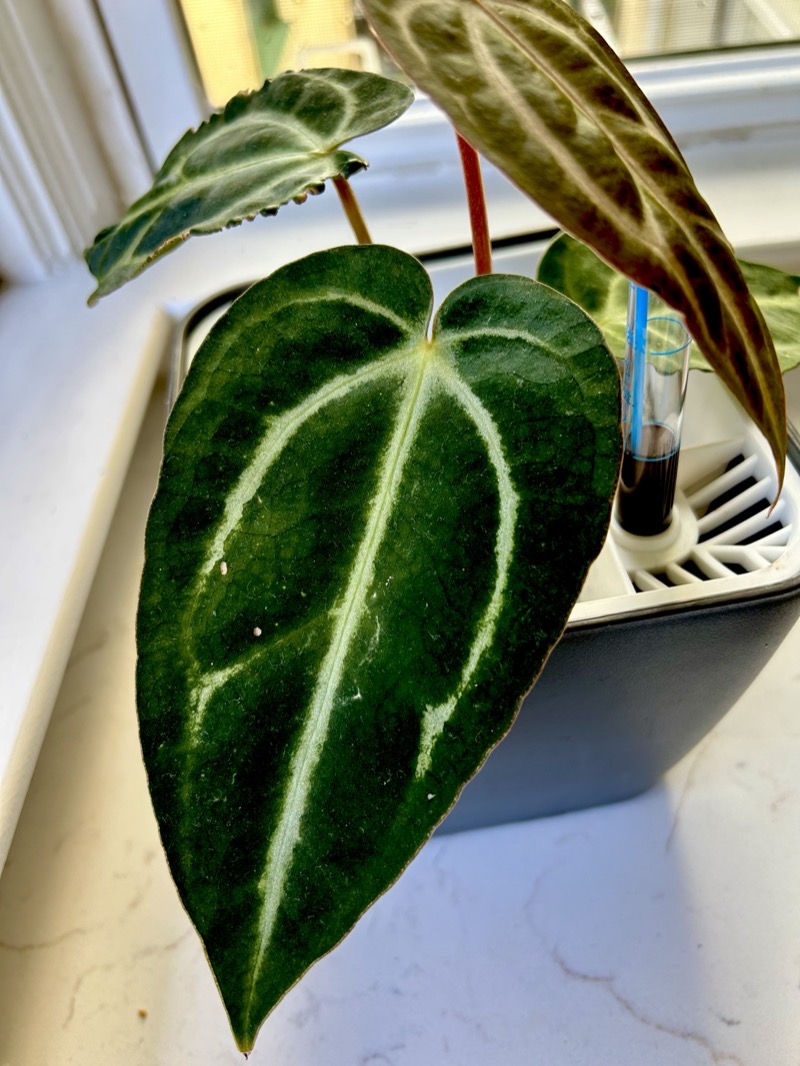
Anthurium leaves do not contain black pigment. The darkness comes from an unusually high concentration of anthocyanins layered beneath the leaf surface, combined with a structural arrangement of the upper epidermis that scatters very little light before it reaches those pigment cells. The result is additive: a deep red-violet that, with enough pigment density, reads to the human eye as near-black. Tilt the leaf toward a strong light source and you might catch a burgundy or purple undertone. This is not a flaw; it is proof the mechanism is working.
Not all anthuriums capable of this darkness produce it consistently. Anthocyanin expression in aroids is environmentally modulated. High light intensity, cooler night temperatures, and certain nutrient stresses all upregulate the pigment pathway. This is why a plant can look genuinely black in a highland terrarium running 58°F nights and read as dark green three months later in a collector's warm, dim living room. The darkness is physiologically expensive. The plant produces it as a photodamage response and will dial it back the moment conditions no longer require it.
This is the first thing vendors don't tell you: blackness in an anthurium is partly a performance, and the conditions required to sustain that performance are specific and demanding. A plant can be genuinely capable of near-black coloration and still look disappointingly olive on your shelf. The question isn't just whether the genetics are there. It's whether you can create the environment to express them.
The real thing doesn't green out when you move it to your living room. If it does, you never had the real thing.
The Species That Actually Deliver
The species with the most documented, reliable capacity for near-black coloration are a short list. Anthurium crystallomanum — not to be confused with crystallinum, its more famous cousin — produces heavily pigmented, somewhat bullate leaves with a velvet surface and a dark center that can approach true black under high light and cool nights. Anthurium papillilaminum, a Panamanian endemic with an almost iridescent upper surface, runs very dark under similar conditions. Anthurium regale juveniles often push near-black as new leaves harden, though mature foliage on well-fed plants tends to a rich, dark green.
Anthurium wendlingeri is occasionally cited for its dark, strap-like leaves, though the darkness is more about depth of green than true pigmentation. The species worth knowing best, if darkness is the goal, is probably Anthurium warocqueanum — the queen anthurium — in its more pigmented forms. A well-grown warocqueanum in a cool, bright highland setup can hold leaves that are unmistakably dark for their full lifespan. The species is also large enough that a single leaf makes a statement a smaller plant can't.
Then there is the category of hybrids and selected clones, where provenance becomes genuinely important. There are warocqueanum clones in circulation that have been selected over multiple generations for pigment intensity. There are crosses — warocqueanum x papillilaminum among them — that combine the velvet surface texture of one parent with the pigment capacity of the other. These exist, they are real, and some of them are extraordinary. They are also frequently counterfeited by vendors attaching the same names to unrelated seedlings.
The Naming Problem
The anthurium market has a provenance problem that is, at this point, structural. Plants travel from collectors in Colombia, Ecuador, and Panama into tissue culture labs, then into mass production, then onto auction platforms and Instagram storefronts — and at each step, the name may or may not follow the actual plant. A vendor who receives fifty unlabeled liners from a TC lab and believes them to be papillilaminum will sell them as papillilaminum. He may be wrong. He may not know he's wrong. He may not particularly care.
The result is a market in which the same morphological space — dark, velvety, impressively veined — is occupied by correctly identified species, misidentified species, unnamed hybrids sold under species names, and named hybrids sold under invented cultivar epithets that have no formal registration. When a vendor lists something as 'Black Velvet Anthurium,' that name tells you almost nothing beyond 'this plant looks dark right now in this photograph under these conditions.' It is not a cultivar name in any meaningful horticultural sense. It is a marketing decision.
This matters beyond collector pride. If you pay a significant sum for what you believe to be a selected warocqueanum clone with documented pigment performance, you have a right to know whether that claim is accurate. Most of the time, there is no way to verify it. No genetic testing. No grower's records. No chain of custody. You are trusting a seller whose incentive structure does not reward honesty about plant identity.
What the Real Thing Costs
A verified, well-established Anthurium warocqueanum in a dark, selected clone — one with photos documenting pigment performance across multiple leaf cycles — will run anywhere from three hundred to well over a thousand dollars depending on the seller, the market moment, and the size of the plant. A single leaf cutting of a reputable papillilaminum with known provenance is rarely available for under two hundred. These prices are not irrational given what is actually on offer: a slow-growing, environmentally exacting plant with a documented history of producing something genuinely rare.
The plants that sell for forty dollars on a big auction platform under the name 'near-black velvet anthurium' are almost certainly not these plants. They may be attractive. They may even be dark. But they have no documented history, no verified identity, and no guarantee of what they will look like in six months in your conditions. Some of them are beautiful mysteries. Some of them are fast-grown andraeanum hybrids from a cut-flower operation that happened to photograph darkly.
The honest answer is that most collectors cannot afford the verified thing and will buy the affordable mystery instead. This is not a moral failing. The hobby runs on affordable mysteries. But going in with clear expectations — that you are acquiring potential, not a guarantee — is the difference between a satisfying experiment and an expensive disappointment.
The Conditions Darkness Requires
Growing a near-black anthurium to its full pigment potential is not a passive exercise. The core requirements are: bright indirect light (more than most indoor spaces provide without supplemental lighting — 150 to 250 PPFD at the leaf surface is a reasonable target), high humidity consistently above 70 percent, meaningful temperature differentials between day and night, and an airy substrate that holds moisture without excluding oxygen. None of these conditions are unusual among serious aroid growers. All of them are difficult to maintain simultaneously in a home environment.
The temperature differential deserves specific attention because it is the condition most often skipped. Many highland anthuriums, including warocqueanum and papillilaminum, come from elevations where nights drop to the low 60s Fahrenheit. Running a grow space at a constant 75°F produces healthy plants that are unlikely to reach their maximum pigment expression. Running nights at 60°F in a sealed terrarium is a significant logistical commitment — it usually means a dedicated space with active cooling, which is not a weekend project.
Substrate matters, too, in a specific way. Dense, water-retentive mixes suppress the mild drought stress that can also trigger anthocyanin upregulation. A chunky mix — coarse bark, perlite, a small amount of sphagnum, nothing compacted — keeps roots oxygenated and allows controlled dry-down between waterings. Feed lightly and consistently; nitrogen excess pushes vegetative growth at the expense of pigment.
The Ethics of the Chase
It is worth asking, occasionally, what drives the desire for the darkest possible leaf. Some of it is straightforwardly aesthetic — the near-black anthurium is a genuinely striking object, and there is nothing wrong with wanting a striking object. Some of it is status, which in the collector world is legible and not particularly shameful: to grow the difficult thing well is a real achievement, and the rarest, most demanding plants carry that difficulty as a signal.
But some of the desire is market-manufactured, and that part deserves more skepticism. The cycling of 'the next black thing' through the hobby — a new cultivar name, a new auction frenzy, a new set of photographs making the rounds on Instagram — follows a pattern that benefits sellers more reliably than it benefits plants or growers. The plant at the center of this machinery is often pulled from habitat range, cloned at industrial scale, and distributed before its long-term care requirements are well understood by the buyers receiving it.
The collectors who seem to get the most from the darkest anthuriums are those who slow down: who research the species before buying, who build the environment before acquiring the plant, who are willing to say 'I don't have the setup for this yet' and mean it. The near-black leaf is not a trick you unlock with money. It is a result you grow into, incrementally, over years of learning what your space can actually do.
What Darkness Actually Costs
The price of a truly dark anthurium — the real accounting — is not the purchase price. It is the infrastructure: the lighting equipment, the humidifier with a controller, the cooling unit, the hours of maintenance, the years of learning. It is also the plants you lose while learning, the species you misgrow before you understand them, the expensive mistakes that are simply tuition.
Against that expenditure, what you get is this: a leaf that, under the right conditions, does something that very few living things do. It absorbs almost all the light that touches it and gives back almost nothing. It sits in a grow tent and looks like it is made of a different substance than other leaves — denser, older, more serious. Whether that is worth what it costs is a question only the person writing the check can answer.
What it is not worth is the performance of having it. A plant that greened out six weeks after you moved it from the vendor's optimized setup to your apartment is not a dark anthurium. It is a dark anthurium photograph, which is a different thing entirely, and considerably cheaper.