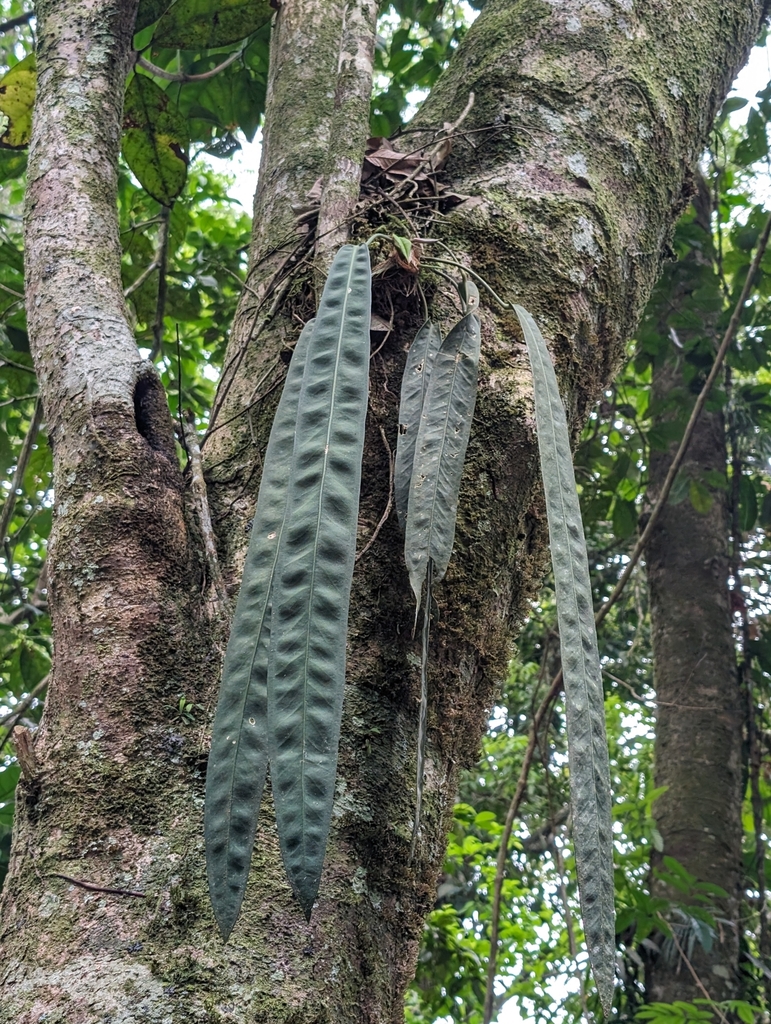
Somewhere in a cloud forest above Chiriquí, a mature Anthurium wendlingeri hangs from a mossy branch with its leaves trailing a meter below the point of attachment — strap-shaped, dark green, heavily quilted, swaying in the updraft. The spadix below it corkscrews like a telephone cord left in the sun. Nothing about it looks like the red-spathed florist anthuriums sold in airport gift shops. It looks, if anything, like a plant from a different genus entirely, one that evolved specifically to make growers nervous.
That nervousness is not entirely unfounded. The pendant strap-leaf anthuriums — a loose collector shorthand for wendlingeri, decorosum, pendulifolium, and their kin — carry a reputation for sulking, yellowing, and slowly collapsing the moment humidity drops below a threshold most houses never reach. That reputation is partly deserved and partly the residue of bad early advice. What follows is an attempt to separate the real requirements from the mythology, and to make a case that these plants, properly sited, are among the most singular things you can grow.
What We Mean by Pendant
The term 'pendant anthurium' is not a formal taxonomic grouping. It describes a growth habit: leaves that hang downward from the petiole attachment rather than extending outward or upward. In nature, this makes excellent sense. These plants grow as epiphytes in mid- to upper-canopy positions, roots anchoring into bark fissures and accumulated organic debris, leaves dangling free where they intercept filtered light without competing for horizontal space. The pendant habit is an architectural solution to a specific ecological problem, not an aesthetic accident.
Anthurium wendlingeri is the species most collectors encounter first. Native to Costa Rica and western Panama, it produces strap leaves that can reach 120–150 cm on a well-grown adult, with pronounced quilting between the lateral veins — that corrugated texture collectors call 'bullation.' The spathe is small and greenish, almost incidental. The spadix is the thing: it spirals in tight corkscrewing coils, sometimes completing two or three full rotations. No other commonly cultivated anthurium does this.
Anthurium pendulifolium offers a narrower leaf — closer to a ribbon than a strap — and tends to run a little longer relative to width. Anthurium decorosum, less often seen in collections, produces similarly pendant foliage but with slightly more pronounced venation and a petiole that can show faint reddish pigmentation when the plant is grown in brighter light. All three are from the section Porphyrochitonium, a grouping defined partly by this elongated, downward-hanging leaf form.
A mature wendlingeri spadix corkscrews like a telephone cord — nothing about it belongs in an airport gift shop.
The Cloud Forest Problem
The difficulty with pendant anthuriums is not really about misting. It is about understanding where these plants live and what that environment actually does. Cloud forests in the Chiriquí Highlands or on the Caribbean slopes of Costa Rica's Cordillera Central maintain relative humidity in the 80–95% range for most of the day, not because anyone is spraying them with a bottle every four hours, but because cloud immersion, slow-draining mist, and minimal vapor pressure deficit keep the air perpetually damp.
When growers say 'mist or die,' they are describing a symptom — leaf edge browning, tip dieback, eventual defoliation — that comes from a specific cause: low absolute humidity combined with high vapor pressure deficit. A leaf browning at the margins is losing water through transpiration faster than the root system can replace it, partly because the air is too dry and partly, often, because the roots themselves are compromised. Misting addresses neither of these root causes. It wets the leaf surface briefly and may even create conditions for fungal spotting if airflow is poor.
The actual solution is enclosure or a dedicated high-humidity cabinet — a grow tent with a humidifier running, an IKEA greenhouse cabinet with a small ultrasonic unit, or a purpose-built growing chamber. Target 75% relative humidity as a floor, not a ceiling. Above that threshold, pendant anthuriums stop throwing tantrums and start growing with the steadiness of any well-adapted epiphyte.
Roots Before Leaves
Every care problem with these plants traces back to roots. In nature, wendlingeri anchors into loose, well-aerated organic matter — decomposed bark, moss, accumulated detritus — that drains quickly after rain but holds enough moisture to prevent complete desiccation between showers. The roots are fine and numerous, adapted to a substrate that breathes. Pack them into a heavy peat mix in a poorly draining plastic pot and they suffocate and rot within months.
The best substrate approach for pendant anthuriums is extremely chunky: 40–50% coarse orchid bark (medium grade, not fine), 20–25% perlite or pumice, and the remainder a mix of long-fiber sphagnum and fine horticultural charcoal. Some growers eliminate the sphagnum entirely in favor of more perlite and report good results; the key is that the mix should be almost dry to the touch within two to three days of watering in a humid enclosure. Wet roots in stagnant media is a faster path to losing a wendlingeri than any drop in humidity.
Pot choice matters too. Unglazed terracotta or net pots encourage lateral root development and gas exchange. If you use a plastic nursery pot, size down aggressively — pendant anthuriums in containers two sizes too large almost always rot before they grow into the space. A 10 cm pot for a plant with four or five leaves is not unusual.
Light Without Burning
In their natural habitat, pendant anthuriums typically grow in positions that receive high ambient light — bright sky visible — but almost no direct sun. The canopy above them filters and scatters. They are not deep-shade plants; the quilted texture of wendlingeri's leaf surface is partly an adaptation to capture diffuse light efficiently from multiple angles.
In cultivation, this translates to bright indirect light or a very gentle grow light with a low daily light integral — somewhere in the 12–18 mol/m²/day range, which is considerably less than what you might give a Monstera or a fast-growing philodendron. Under LED panels, position the plant far enough from the fixture that you can hold your hand under the light for thirty seconds without warmth. Leaves bleaching from green to yellowish-green before any browning appears are telling you the light is too intense; dark green leaves with very slow new growth suggest you can move the light closer or add duration.
New leaves on wendlingeri emerge rolled and slightly reddish, unfurling over the course of a week or two into full adult shape. Watching a new leaf reach its full length — sometimes adding 30 cm to what was already a long plant — remains one of the reliable rewards of growing these species, even for collectors who have done it many times.
The Other Pendant Species Worth Knowing
Anthurium wendlingeri gets most of the collector attention, partly because it was among the first of the pendant strapleavers to circulate widely in hobbyist trades, and partly because the corkscrew spadix is genuinely dramatic. But the group is larger than one species, and some of its members deserve more notice.
Anthurium vittarifolium is the extreme case: leaves on a mature plant can exceed 2 meters, making it effectively unworkable outside a very large enclosure or a greenhouse. Its care requirements track closely with wendlingeri, but the sheer scale demands planning before acquisition. Growers who have pushed it to maturity in home setups tend to either dedicate an entire cabinet to a single specimen or suspend it from a wall-mounted bracket in a humid room with no ceiling clearance to spare.
For collectors with less vertical space, Anthurium fruffiae — a species that circulates under several informal names depending on the seller — offers pendant leaves in the 60–80 cm range at maturity, with a slightly more tolerant attitude toward humidity variance than strict cloud forest species. It is not a beginner plant, but it is a more practical one. The foliage shows the same characteristic quilting, and the petiole cross-section — D-shaped, as in many section Porphyrochitonium members — is a useful identifier when provenance is uncertain.
The Misting Myth and Where It Came From
The misting advice that follows pendant anthuriums through forums and social media threads almost certainly originated with growers who were dealing with the right problem and the wrong solution. A plant browning at the leaf tips in a dry living room is obviously experiencing moisture stress. The instinct to spray it with water is intuitive and nearly universal, and in the short term it can appear to help — or at least to delay the damage visibly.
What misting actually does, in a dry environment with moderate air movement, is provide about fifteen minutes of elevated surface humidity before the water evaporates and conditions return to baseline. For a plant that needs sustained 80% relative humidity, fifteen minutes is not a meaningful improvement. For a plant in an already-humid enclosure where the primary issue is vapor pressure deficit, misting is redundant. The only scenario where misting genuinely helps is in a semi-enclosed space with slow air exchange, where the cumulative effect of repeated applications can raise ambient humidity measurably — essentially an imprecise version of running a humidifier.
The myth persists because the pendant anthuriums do respond to high humidity, visibly and quickly. When a struggling wendlingeri is moved into a proper enclosure, it often puts out two or three new leaves in rapid succession, as if catching up. Growers attribute this to whatever intervention they made last — including, sometimes, misting — rather than to the enclosure's sustained humidity. This is not a criticism; it's how empirical observation works without controls. The practical correction is simple: stop optimizing your misting schedule and start building a better enclosure.
Why Grow Them
There is a case to be made that pendant anthuriums are not worth the infrastructure. They need enclosures, they need careful substrates, they are slow to reach their most impressive forms, and a mature vittarifolium makes genuine demands on available space. If you want a dramatic foliage plant with manageable requirements, a Philodendron gloriosum or a well-grown Anthurium crystallinum will give you a lot of satisfaction with less engineering.
But the pendant species offer something those plants do not: a form that has no equivalent anywhere else in cultivation. The combination of extreme leaf length, heavy bullation, fine corkscrew spadix, and epiphytic habit produces a plant that looks, in a properly set-up enclosure, exactly like a fragment of cloud forest transplanted indoors. Other plants are beautiful. These plants are strange and specific, and that specificity is the reason serious collectors return to them.
What they ask of you is not constant intervention — not hourly misting, not anxious monitoring. What they ask is a correctly built environment and then patience. Once the enclosure is running and the substrate is right and the light is calibrated, wendlingeri and its relatives mostly take care of themselves. The reputation for difficulty is real, but it refers to the setup cost, not to the ongoing maintenance. Get the conditions right once, and the plant will reward you by being, mostly, a plant — growing slowly, steadily, beautifully, in a direction no other genus bothers to go.