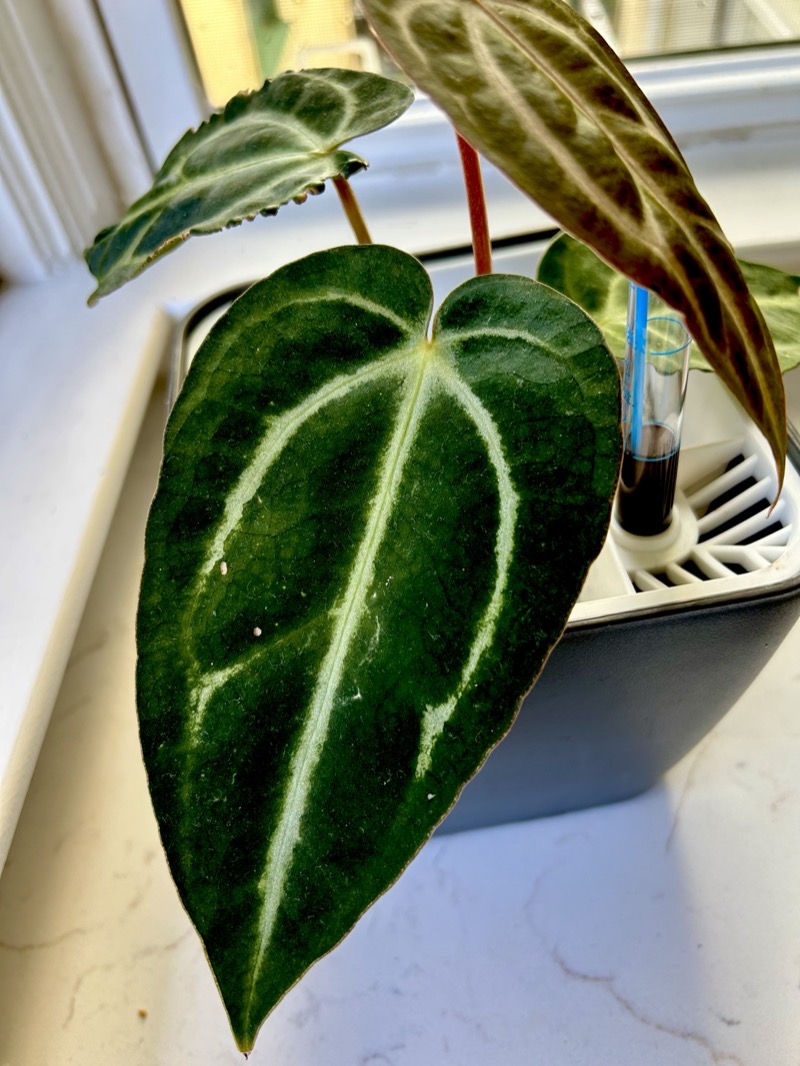
The leaf arrives in a photo flattened against a white tile, lit from above with a ring light. It is almost perfectly black — not dark green, not burgundy, not the deep olive of a backlit Anthurium crystallinum. Black, or close enough that the difference requires a spectrophotometer to settle. The petiole is pale, almost ghostly against it. Someone in a Facebook group types 'HOLY' and the rest of the comment is emoji. The post is shared four hundred times before noon.
That image is doing a specific kind of work. It is selling scarcity and suggesting a lineage without quite stating one. The plant is listed two days later at $1,400 for a single node. This is the world that breeders of so-called 'black' anthuriums have built over the past decade — partly through genuine horticultural ingenuity, partly through controlled information, and partly through the same mechanics that make a sneaker limited: release small, hint at genealogy, let the market do the math.
What Makes a Leaf Dark
The darkness in these plants is primarily anthocyanin — the same class of pigments that turns red cabbage red and autumn maples scarlet. In anthuriums, high anthocyanin expression in adaxial epidermal cells can mask the underlying chlorophyll green, producing leaves that appear nearly black under overhead light and deep purple-red when backlit. The intensity of that expression is partly genetic, partly environmental: lower light, cooler nights, and certain nutrient regimes can all deepen the color after a plant is in your hands.
Anthurium watermaliense is the species most collectors point to as the dark-leaf ancestor. Described from material collected in Colombia and later distributed through Belgian horticulture in the early twentieth century, it carries reliably near-black coloring on mature foliage with a subtle velvet texture — nothing like the theatrical sheen of the Instagram-optimized hybrids, but honest and stable. Anthurium papillilaminum, the Darién velvet anthurium, brings its own darkness and a pronounced velvety indumentum. These two species, crossed and back-crossed against each other and against broader-leafed velvets like Anthurium crystallinum and Anthurium magnificum, form the genetic substrate of most of the cultivars chasing blackness today.
The complication is that 'black' is photographic as much as botanical. A deeply saturated purple-green leaf, photographed on a white background under a 5600K LED, renders darker in JPEG than it appears in person. Breeders know this. The honest ones acknowledge it. A leaf that photographs as black is not the same as a leaf that is black — and the best breeders will tell you so, quietly.
A leaf that photographs as black is not the same as a leaf that is black — and the best breeders will tell you so, quietly.
The Cultivar Question
'Dark Mama' is not a registered cultivar. There is no herbarium voucher, no International Aroid Society registration, no published description with a type specimen. It is a trade name — applied, depending on who you ask, to a specific hybrid line developed by a handful of Southeast Asian growers in the late 2010s, or to any sufficiently dark velvet anthurium that a seller wants to move at a premium. This ambiguity is not accidental.
In the orchid world, cultivar names carry legal and taxonomic weight. A registered orchid grex has a documented parentage filed with the Royal Horticultural Society. Anthurium breeders operate under no equivalent system. A name like 'Dark Mama' or 'Black Velvet' or 'Midnight' can be applied to any seedling a grower decides deserves it. When you buy a 'Dark Mama' from one vendor and a 'Dark Mama' from another, you may be buying plants with entirely different parentage, different mature habits, different eventual leaf color. You are buying a vibe, validated by a name.
Some collectors have started pushing back on this. Growers in the Netherlands and the United States have begun documenting their crosses with parent records and consistent selection criteria before assigning cultivar names, attempting to build something closer to accountability. It is slow work against a fast market.
The Southeast Asian Breeding Engine
The geography of this trade matters. Thailand, Indonesia, and the Philippines have produced the majority of the most coveted dark-leaf anthurium hybrids over the past decade, for reasons that are partly climatic and partly economic. Equatorial humidity and temperatures allow year-round outdoor or semi-outdoor growing, which compresses generation times. A breeder in Chiang Mai or Bandung can produce and evaluate seedlings at a pace that a grower in a Wisconsin basement greenhouse simply cannot match.
Labor costs are lower, which matters when you are running thousands of seedlings to select a handful worth naming. And the export market — primarily the United States, the European Union, and Australia — values these plants at prices that make selective breeding economically rational in a way it rarely is for temperate horticulture. A single named cutting from a proven dark-leaf line can fund months of additional crossing work.
The result is a genuine arms race. Breeders watch each other's social media, try to deduce parentage from leaf shape and petiole color and the angle at which a sinus opens. When a new plant appears that is visibly darker or wider or more velvety than the current standard, the effort to acquire or approximate it begins immediately. Generation times of eight to eighteen months mean the field moves slowly by technology standards but fast by plant standards, and the lead a single breeder holds can evaporate within two or three crossing cycles.
Economics of Engineered Rarity
The pricing structure for these plants follows a logic that has more in common with limited-edition prints than with conventional horticulture. A named, documented cutting from the original breeder commands the highest price — sometimes four figures for a single node. Second-generation material from a reputable reseller drops to several hundred dollars. Unlicensed 'inspired by' seedlings from unverified parentage fill out the bottom of the market at fifty to two hundred dollars, often carrying the same cultivar name without authorization.
This structure depends on information asymmetry. The buyer of a $1,200 node is betting that the name attached to it reflects genuine parentage, stable phenotype, and a leaf that will actually mature dark. There is rarely a way to verify this at the point of sale. Leaves photographed in juvenile form — when anthocyanin expression is often highest — can look spectacular and then green out significantly on mature foliage. Breeders who select for stable darkness across leaf stages are doing harder, slower, more expensive work than those selecting for a single photogenic juvenile flush.
A few US-based growers have begun building reputations on phenotypic honesty: posting photos of mature leaves alongside juveniles, being explicit about which crosses were used, acknowledging when a seedling run yielded mostly mediocre results. This approach sacrifices short-term margin for long-term credibility. It is not yet the norm.
Growing Them, Actually
Strip the economics away and you have a plant that is, by anthurium standards, reasonably manageable. Dark velvet hybrids generally want what their parent species want: temperatures between 65 and 82°F, humidity above 70 percent, bright indirect light rather than direct sun (which bleaches the dark pigmentation and scorches velvet), and a substrate that drains aggressively. A mix of orchid bark, perlite, and a small fraction of coco coir — or a commercially available chunky aroid mix — will serve better than any peat-heavy medium.
The velvet texture that makes these plants photogenic is a liability in low airflow. The trichomes that create the velvety surface trap moisture and debris, and without good air circulation, fungal issues establish quickly. A small fan running on a timer is not optional. Watering should be thorough but infrequent enough that the top inch or two of substrate dries before the next application. These are not plants that want to sit in moisture.
One thing breeders and collectors consistently report: the darkest coloration on mature leaves tends to come from plants kept in slightly lower light than you might expect, with cool nights in the 65–68°F range. Warm, bright, wet conditions push growth but can dilute the anthocyanin expression. Patience and a slightly austere environment often produce better phenotype than aggressive fertilization and maximum warmth.
What Gets Lost in the Chase
There is something worth examining in what this market selects for. The plants being bred toward ever-darker foliage are optimized for a single visual trait captured in a single photograph. Other characteristics — root vigor, resistance to bacterial blight, the quality of velvet texture, the structural integrity of the petiole, the fragrance of the spathe, the reliability of the coloring across multiple leaf cycles — receive less attention because they are harder to sell in a post.
Anthurium watermaliense, the honest ancestral dark-leaf species, will never command a four-figure price. It lacks the theatrical breadth of a magnificum cross, the exaggerated sinus geometry of a crystallinum hybrid. It is simply dark, reliably, on every mature leaf, in a range of conditions, without coaxing. Collectors who have grown it for years describe a quiet satisfaction that is different from the adrenaline of securing a hyped cutting. That distinction — between a plant that performs reliably and a plant that performs for a camera — is worth keeping in mind when a ring-lit black leaf appears in your feed at 11pm and the auction ends in four hours.
None of this is an argument against hybrids or against the genuine craft that serious breeders bring to this work. Some of the plants being developed right now are genuinely remarkable — wider, darker, more velvety than anything in the wild, with stable expression across leaf cycles. The craft is real. The question is whether the market infrastructure around it is honest enough to support it long-term, or whether a wave of buyer disillusionment — too many 'Dark Mama' cuttings that greened out, too many unlisted parentage surprises — eventually deflates the whole category.
The Next Leaf
Somewhere right now, in a growing space in Thailand or the Netherlands or a spare room in Oregon, a seedling is pushing its first mature leaf and it is darker than the last batch. The breeder is taking photos. The light is set up carefully. The tile behind the leaf is white.
That image will move through the collector community like a current, and the conversation that follows — about parentage, about price, about whether this one is real — will be the same conversation that has been happening for a decade, getting louder as the leaves get darker. The arms race does not have an obvious terminal point. There is always a blacker black to chase, always a cross not yet made, always another grower willing to spend two years finding out what happens when you push the parentage one generation further.
What persists, underneath all of it, is the plant itself: a genus of some thousand species evolved across the neotropics over millions of years, doing what plants do, producing pigment for reasons that have nothing to do with ring lights or auction timers. The collector who remembers that — who looks at a dark leaf and thinks first about trichome density and anthocyanin stability and second about the price — is the one most likely to still be growing these things in twenty years, when the hype around whatever cultivar is currently burning through the groups has long since cooled.