The cutting arrives in a padded envelope from a seller in Medellín, labeled Anthurium warocqueanum × papillilaminum, F2. The leaf is maybe eight centimeters long, heart-shaped, the surface a matte charcoal-green that absorbs light rather than reflecting it. The veins are silver-white, slightly impressed. It looks, at this juvenile stage, like a dozen other things you've grown or seen in photos. You put it in a terracotta pot with a mix of orchid bark, perlite, and long-fiber sphagnum. You wait.
Six months later the leaves are twenty-five centimeters and the velvet pile has deepened to something close to black in low light. Someone in a forum asks what it is. You type the name from the label, then pause before posting. Because if you've been doing this long enough, you already know: the name might be exactly right, or it might mean almost nothing at all.
What We Mean When We Say 'Velvet'
The velvet texture that defines this loose group of anthuriums comes from trichomes — microscopic hair-like epidermal cells that scatter light rather than letting it bounce cleanly off the leaf surface. The effect ranges from a fine suede in something like Anthurium crystallinum to the almost optical-illusion depth of A. regale or A. luxurians, where the leaf surface looks three-dimensional under good light. This is not a single trait shared by a single clade. Velvet texture has evolved independently across several anthurium sections, which is part of why lumping these plants together as a category is botanically meaningless even if it's commercially useful.
The species collectors most commonly chase — warocqueanum, crystallinum, magnificum, papillilaminum, regale, dressleri, luxurians, wendlingeri — are spread across the sections Cardiolonchium, Belolonchium, and others, depending on which taxonomic treatment you follow. They share an aesthetic. They do not share a lineage. That matters when you're trying to figure out what you're actually growing, because convergent evolution means that 'big dark velvety leaves with pale veins' describes an adaptive strategy, not a species.
Growers new to the group often start with A. crystallinum and assume they've learned a template. They haven't. Crystallinum's rounded, heart-shaped blade, silvery primary veins, and pale, almost powdery underside are distinctive — but only once you've seen enough of them to know what 'typical' looks like. Even then, the species has significant geographic variation across its range in Colombia, Panama, and Ecuador, and plants from different provenances can look strikingly unlike each other as adults.
A plant sold as warocqueanum in 2019 might have been any tall-leafed velvet anthurium that someone, somewhere, decided was close enough.
The Taxonomy Keeps Moving
Anthurium is one of the largest genera in the Araceae family, with somewhere between 800 and 1,000 accepted species depending on the source and the year. Thomas Croat at the Missouri Botanical Garden has described hundreds of them, and revisions continue. The problem for collectors is that herbarium specimens — the dried, pressed type material against which new collections are compared — often represent a single moment in a plant's life: one leaf, one inflorescence, collected from one altitude on one day. Living plants are not static. A juvenile warocqueanum and a juvenile dressleri can be nearly indistinguishable from a pressed sheet.
Synonymy compounds the confusion. Anthurium magnificum, for instance, has had multiple synonyms over its taxonomic history, and plants sold under that name in the hobby come from populations across Colombia at different elevations, with measurable variation in leaf shape, petiole length, and vein patterning. Is the plant with the more rounded blade and the broader, paler veins from a Nariño population the same species as the narrower-leafed plant from Antioquia sold under the same name? Botanically, possibly. Horticulturally, they behave differently and look different at maturity.
Then there is the question of what happens when a species gets popular before it's been rigorously documented in cultivation. Anthurium dressleri from Panama — narrow, pendant, deeply velvety leaves, famously slow — was barely in circulation before plants with that label began multiplying through the trade. Some of them are almost certainly genuine. Others are almost certainly not. Without a confirmed type plant as a reference, the name becomes aspirational.
How Hybridization Obscures Everything
If taxonomy alone weren't enough to complicate identification, hybridization finishes the job. Velvet anthuriums cross readily when grown in proximity, and many of the most striking plants in collector hands are hybrids — sometimes intentional, sometimes not. A crystallinum grown near a magnificum in a greenhouse will occasionally produce seeds that are neither, and those seedlings, if they look good, will be sold. The label might say the dominant parent, or it might say the hybrid cross accurately, or it might say nothing useful at all.
The challenge is that first-generation hybrids between closely related velvets often look more like idealized versions of the parents than the parents themselves. An A. crystallinum × magnificum cross can produce plants with the crystalline vein color of the former and the broader, more imposing blade of the latter. These plants are real, they're beautiful, and they're genuinely collectible. But they will never key out to a species, because they aren't one. When those plants get propagated by stem cutting and sold two or three times through different hands, the label 'crystallinum' or 'magnificum' often quietly replaces whatever hybrid notation existed.
Tissue culture has accelerated this problem by making it economically viable to produce thousands of copies of a single clone. If the mother plant was misidentified, or if it was a hybrid sold as a species, every TC copy carries that misidentification at scale. A plant sold as warocqueanum in 2019 might have been any tall-leafed velvet anthurium that someone, somewhere, decided was close enough.
Juvenile Foliage as a Diagnostic Dead End
Most of the velvet anthuriums in the hobby are sold — and identified — as juveniles. This is economically rational: juvenile plants are easier to ship, produce faster, and are accessible to more buyers. It is diagnostically terrible. The traits that distinguish species from each other — mature leaf dimensions, petiole cross-section, sinus depth, spathe color, spadix morphology — are largely absent or undeveloped in small plants.
Consider the petiole. In adult A. warocqueanum, the petiole is long, slender, and terete — roughly cylindrical, sometimes slightly flattened adaxially. In A. magnificum, the petiole is shorter relative to blade size and distinctly 4-winged, the wings sometimes quite pronounced. This is a reliable diagnostic character. In a seedling with a ten-centimeter blade, the wings on a magnificum may be barely perceptible, and an inexperienced eye — or a photo taken at the wrong angle — will miss them entirely. The plant gets labeled wrong. It gets bought. It gets re-sold.
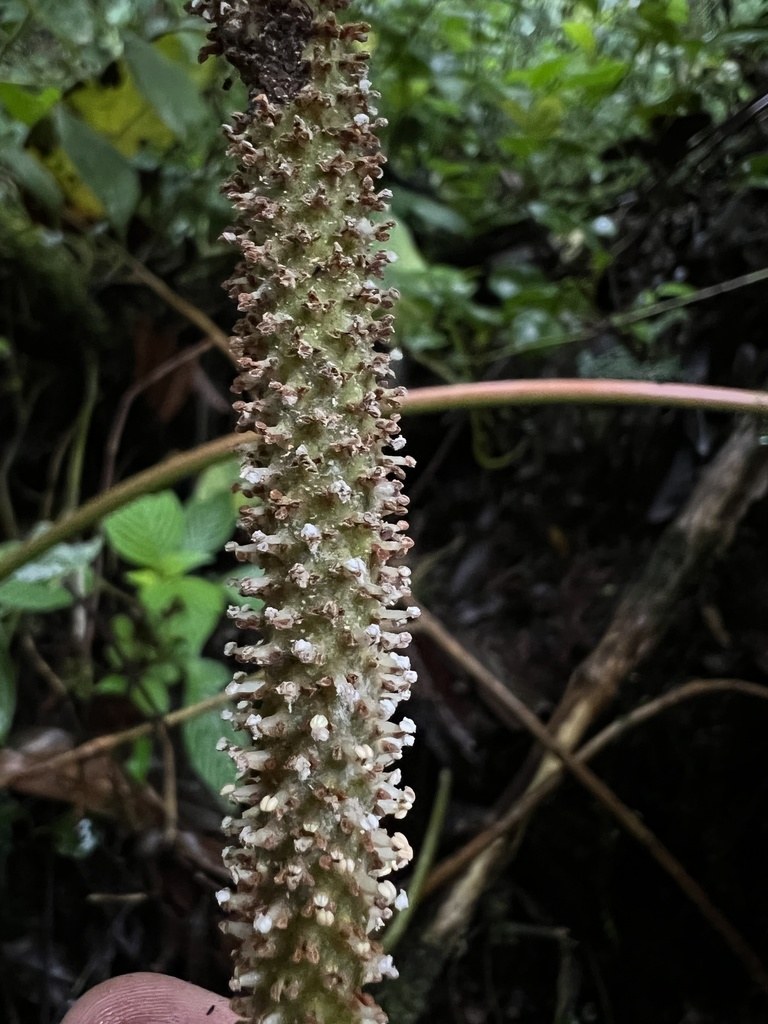
Inflorescence structure is even more reliable than leaf characters for identification, but most collectors never see their plants flower, or don't photograph the spathe and spadix when they do. A velvet anthurium that has flowered and fruited in your care, with good reference photos of the inflorescence, is genuinely identifiable in a way that a leafy cutting never quite is.
What Provenance Actually Tells You
Collectors sometimes treat provenance — knowing the geographic origin or collection source of a plant — as a near-guarantee of correct identification. It isn't, but it's the closest thing available for most specimens. A plant with a documented chain of custody back to a botanical garden accession, or to a collector who received it from a researcher in the field, has a real advantage over a plant that appeared on Etsy from a seller who bought it at a Florida nursery in 2021.
The Missouri Botanical Garden, the Marie Selby Botanical Gardens, and a handful of serious private growers in Colombia, Ecuador, and Panama do maintain correctly identified reference collections. Plants that can be traced to those sources — or to botanists like Arden Dearden or Eduardo Gonçalves who work with the genus seriously — have a credible basis for their names. Most plants in the hobby cannot be traced there. That's not a scandal; it's just the reality of how a plant genus with hundreds of species becomes a global horticultural commodity in a decade.
Geographic data does help in narrowing things down. A. dressleri is a Panamanian species; if your plant is said to have come from a Colombian source, that's worth noting. A. regale has a relatively narrow native range in Peru. These data points don't prove identity, but they can falsify a label — which is sometimes the most useful thing you can do.
Living With Uncertainty in the Collection
There's a practical response to all of this, and it's not despair. Experienced collectors increasingly label plants with what they know for certain and flag what they don't. A tag that reads 'Anthurium cf. magnificum (Colombian source, Antioquia, 2022)' is more honest and more useful than one that reads 'A. magnificum' with no further information. The 'cf.' notation — from the Latin confer, meaning 'compare with' — signals that the identification is provisional, that the plant resembles the named species but has not been confirmed.
Growing a plant to maturity is still the most reliable tool available to collectors without access to molecular analysis. A plant that was ambiguous at fifteen centimeters will often resolve itself at sixty. The D-shaped or 4-winged petiole becomes obvious. The sinus opens or stays closed. The inflorescence appears. Patience is not a romantic virtue here; it's a diagnostic one.
None of this means the plants are less worth growing. A dark velvet anthurium whose name you're uncertain of is still a remarkable object — a leaf that evolved in cloud forest at 1,200 meters, in filtered light and near-constant moisture, to do something leaves rarely do: look like velvet. The uncertainty about what, exactly, it is doesn't change what it does in a terrarium in January, when the light is thin and the leaf is absorbing every photon it can find.
Why This Matters Beyond Labeling
Getting the names right is not just a hobby obsession. It has real implications for conservation. Many velvet anthuriums have restricted native ranges, and collection pressure — both legal and illegal — on wild populations is real. When a species gets popular in the hobby under a wrong name, demand can displace onto the actual species in the wild without anyone quite intending it. A collector who believes their dressleri is correctly labeled has no particular reason to question whether the 'new true dressleri' being offered on a rare plant forum in 2024 was wild-collected.
Conversely, correct identification supports the work of legitimate botanical institutions. When collectors can accurately record what they're growing, that data — crowdsourced across thousands of private collections — has genuine value for researchers tracking distribution, phenology, and variation. The Aroid Society of America and regional affiliates have made progress in connecting serious hobbyists with botanists who can verify identifications from detailed photos and measurements. That infrastructure is worth using.
The velvet anthurium hobby is young enough that its foundational labels are still being set. The plants being accurately identified and documented now will become the reference clones for the next decade of the trade. It's worth slowing down, measuring the petiole, photographing the underside, noting the source — and writing 'cf.' when that's the honest answer. The plants will still be beautiful. The names will mean more.