Somewhere in a collector's grow room, a basket hangs from an s-hook at ceiling height, and out of it spills two meters of thin green rope studded with narrow, lance-shaped leaves. Each leaf is maybe six centimeters long, dark matte green toward the midrib, fading at the margins into a creamy yellow-white that sometimes blushes pink when the light catches it right. The plant has been there long enough that the oldest trailing stems have woody bases. Nobody photographs it for the algorithm. It just grows, and cascades, and occasionally erupts in clusters of tiny burgundy-centered flowers that smell faintly of sweet grass in the evening.
That plant is almost certainly Hoya wayetii — or it is called Hoya wayetii, which is not quite the same thing. The variegated form has been circulating in the hobby under several names, sometimes correctly, sometimes not. Sorting out what you actually have, how to grow it well, and why you should bother in the first place is the sort of quiet project that suits this species. It rewards patience more than attention.
The Name Problem, Briefly
Hoya wayetii was described from Philippine material and sits within a cluster of closely related, narrow-leaved, trailing hoyas that includes H. kentiana and H. gracilis. The confusion between wayetii and kentiana in the hobby is old and stubborn. Both are slender trailers with similarly shaped leaves; both produce small, star-shaped flowers with a dark red corona. The differences are real but require close comparison: kentiana tends toward slightly broader leaves and a more pronouncedly undulate margin; wayetii is typically narrower, with a flatter leaf profile and a somewhat deeper green. In practice, much of what is sold as one is actually the other, and vendors who have been trading cuttings for years may not know which they started with.
The variegated form adds another layer. 'Wayetii Variegata' — the name most commonly used in trade — is genuine in the sense that it represents a stable chimeral variegation that reproduces reliably from stem cuttings. Whether the underlying species is taxonomically wayetii or kentiana or something adjacent is a question most collectors have quietly set aside. The plant you buy labeled Hoya wayetii variegata is probably that plant, and it will probably look like what you expect. That is as good as the hobby gets with this group right now.
What matters practically is that you know what you are selecting for. The best-variegated cuttings show strong marginal cream with a clean boundary between the colored and green tissue. Avoid cuttings where the variegation is a muddy, central blotch — that pattern tends to be unstable and produces mostly green growth once the plant settles. Margin variegation in this species is the form with staying power.
The variegated wayetii doesn't announce itself. It accrues — leaf by leaf, stem by stem, until the basket is genuinely beautiful.
What the Leaves Do in Light
The pink-blushing that makes wayetii variegata photographs so striking is a stress response, specifically a response to high light intensity and cooler overnight temperatures. The cream portions of the leaf — lacking chlorophyll to buffer incoming radiation — accumulate anthocyanins as a kind of photochemical sunscreen. This is not damage; it is the plant doing what it evolved to do in exposed, seasonally variable conditions. Push the light up, let nights drop to 16 or 17 degrees Celsius, and new growth will emerge nearly entirely pink before it hardens to cream.
Managing for this effect is straightforward if you have a bright south or west window or a well-positioned grow light. The trap is overdoing it. Leaves that sit in direct midday sun through glass will scorch at the margins — the white tissue has essentially no protection beyond the anthocyanin it can produce, and that has limits. Bright indirect light for most of the day, with a couple of hours of gentle direct sun in the morning, is the configuration that produces pink new growth without burning established leaves.
The all-green wayetii is less demanding on this front and will tolerate lower light with less consequence, which partly explains why it has always been the more common form in collections. The variegated plant grows more slowly and is more sensitive to sudden changes in light level. Move it gradually if you are repositioning it after purchase.
Substrate and Roots: Where People Go Wrong
Hoyas as a group are often described as preferring to be rootbound, which is true in a limited sense but gets misapplied constantly. What they actually want is a substrate that drains almost immediately and an air-to-water ratio that stays favorable even at the center of the pot. Wayetii has fine, fibrous roots that rot quickly in anything that holds moisture against them for more than a day or two.
A reliable mix for the variegated form: roughly equal parts perlite, coarse orchid bark (8–12mm), and a small amount of coco coir or peat for water retention. Some growers in drier climates add a handful of sphagnum to the surface layer to slow surface evaporation without waterlogging the root zone. In humid grow tents, pure perlite-and-bark without any coir works well and eliminates rot risk almost entirely. The point is drainage. There is no substrate too airy for this plant; there are many that are too dense.
Pot choice matters too. Terracotta breathes and dries faster — useful in high-humidity environments. Hanging baskets in a breathable fiber or open-slatted plastic dry faster than solid plastic pots and suit the trailing habit. If you are growing in a sealed environment with persistent high humidity and little airflow, lean toward terracotta or fiber, not glazed ceramic.
The Cascade as Design Principle
There is a category of hoya collector who grows everything staked, trained up a moss pole or trellis, coaxing the plant into a vertical structure. That approach suits H. latifolia or a large H. macrophylla, where the architectural leaf is the point. Wayetii is not that plant. It is a pendulous trailing species, and fighting that habit produces a cramped, tangled mess. Let it hang.
A basket suspended at or above head height gives the stems room to extend without touching anything, which matters because hoya stems that rest against a surface will put out short aerial roots and occasionally attach — not harmful, but it breaks the clean fall of the cascade and produces kinking at the contact points. In a living room context, ceiling hooks rated for at least three kilograms are worth the investment before the basket fills out. A mature specimen in a 20-centimeter basket with two full growing seasons behind it is heavier than it looks.
The visual payoff of a mature cascade is genuine. Stems of 1.5 to 2 meters, evenly furnished with leaves all along their length, moving slightly in the airflow from a nearby fan — it is one of the few houseplant effects that reads as genuinely lush rather than merely large. The variegated form earns its space more directly than a bulkier specimen because the leaf pattern provides interest at close range that a solid-green plant only achieves when flowering.
Flowers: When, and Whether to Expect Them
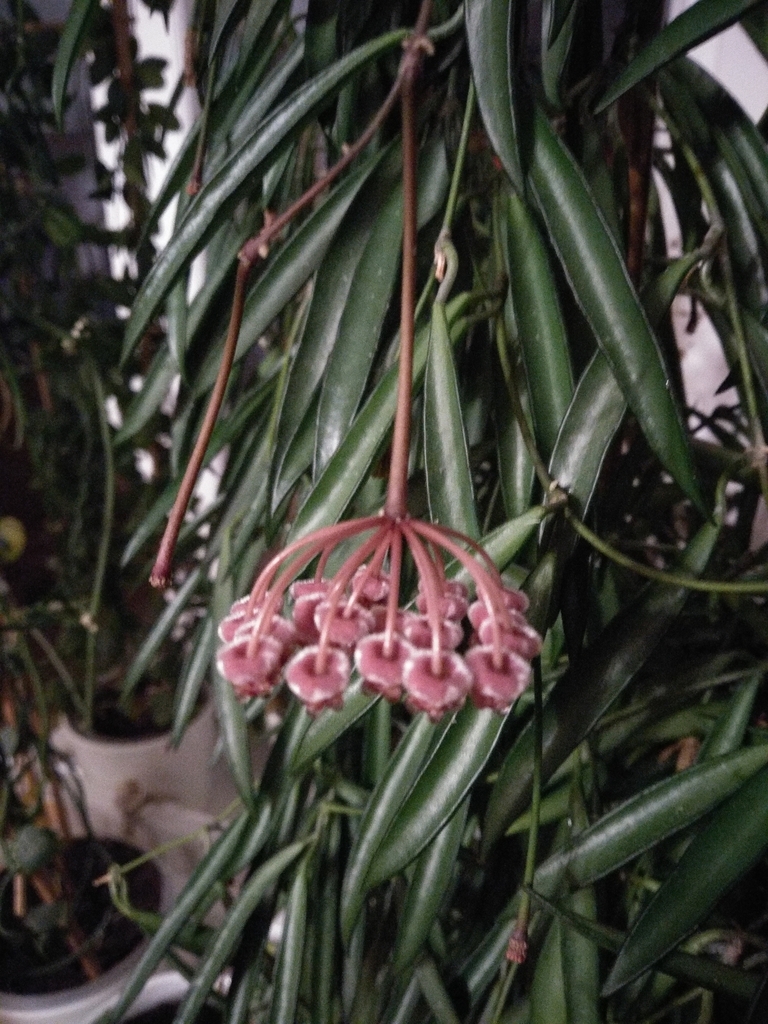
Hoya wayetii flowers reliably in cultivation, but it needs maturity and the right conditions. The flowers emerge from persistent peduncles — woody spurs that extend from the stem at leaf axils — and the plant will reuse these peduncles repeatedly over years. This is the standard instruction everyone gives hoya growers: do not remove old peduncles. It applies here and it is worth saying clearly because new growers often trim what looks like dead woody stubs after a first flowering, then wonder why the plant doesn't bloom again for a long time.
The flowers themselves are small and clustered in umbels of eight to fifteen blooms. In wayetii, the corolla is typically a pale greenish-cream and the corona is a deeper burgundy-red — the contrast is subtle but pretty at close range. Fragrance is mild and sweeter in the evening than during the day, in the same family of scent as H. carnosa but quieter. The variegated form blooms somewhat less freely than the green type under identical conditions, which is consistent across chimeral hoya variegations generally — the reduced chlorophyll affects photosynthetic output and the plant has less energy to put toward reproduction.
To encourage flowering: let the plant experience a distinct dry period in late autumn, reduce watering to roughly once every two to three weeks, and allow night temperatures to drop if possible. Resume normal watering in late winter. This mimics the seasonality of its native range in the Philippines, where a pronounced dry season precedes the flush of new growth and flowering in spring.
Propagation and the Economics of the Variegated Form
Wayetii variegata propagates easily from stem cuttings, which is one reason its price has dropped steadily over the past several years. Single-node cuttings with one leaf root in water or moist sphagnum within three to four weeks at room temperature. Two-node cuttings with two leaves establish faster and branch more readily once potted. The only real failure mode is selecting a cutting with very high variegation — leaves that are more than 70 percent cream — which may have insufficient chlorophyll to sustain itself through rooting. Cuttings with balanced green-and-cream leaves propagate most reliably.
The all-green wayetii is widely available and inexpensive. The variegated form has come down from the high prices it commanded five years ago but still trades at a premium, particularly for cuttings showing strong marginal patterning and pink blush in new growth. What the price drop reflects is not a decline in the plant's quality but simply the efficiency of the hobby's propagation network — good collectors share, sellers compete, and stable variegates become accessible over time. This is how it should work.
If you are buying, prioritize a cutting from a plant you can see in person or in a seller's own photographs showing mature, rooted growth rather than freshly cut stems. The variegation pattern in this species is consistent once established, so a cutting from a well-patterned parent should produce a well-patterned plant. Ask whether the cutting has been rooted already; an unrooted cutting is not a red flag, but you should price in the failure risk accordingly.
The Pleasure of Accumulation
The hoyas that become central to a collection are rarely the ones that demanded the most. They are the ones that stayed, that grew steadily through the years when you were distracted by something flashier, that were still there when the rare anthurium sulked and dropped its leaves and the velvet philodendron stalled for a whole winter. Wayetii variegata is that kind of plant.
It does not ask for a humidifier dialed to 85 percent or a climate-controlled cabinet or daily misting. It wants a bright window, a fast-draining basket, and not too much water. It will reward you in inverse proportion to the attention you pay it — the classic hoya bargain. Give it a season and it will be twice the size. Give it three seasons and it will be genuinely impressive: a long, swaying curtain of cream-edged leaves with the occasional cluster of burgundy-coronaed flowers appearing at a peduncle you forgot about.
There is a kind of collector who grows only the rarest, the newest, the most expensive — and there is nothing wrong with that. But the collectors whose grow rooms are actually beautiful tend to have a wayetii hanging somewhere in them. Not because it is the rarest thing in the room. Because it cascades, and because it just keeps going.