Somewhere in your collection, possibly winding around a trellis you thought was too large, there is a Hoya lacunosa. If you don't have one yet, someone in your local plant group does, and they've been quietly trimming it back for months, setting the cuttings aside in small propagation vessels because the thing simply does not stop. It trails, it climbs, it puts out clusters of tiny pale flowers that smell like cinnamon and vanilla at dusk, and it does all of this at a pace that feels almost rude compared to the slow, deliberate pace of the rare aroids most of us more usually obsess over.
This is a species native to a broad arc of Southeast Asia — Borneo, Sumatra, Peninsular Malaysia, parts of Thailand — where it grows as a lithophyte and an epiphyte, threading itself through rocky outcrops and up the bark of forest trees. It is not delicate. It is not demanding. What it is, quietly and without ceremony, is one of the most rewarding hoyas in cultivation, wrapped inside one of the most thoroughly confused nomenclatural situations the hobby has managed to produce.
What the Leaves Are Actually Doing
The standard Hoya lacunosa bears small, ovate to elliptic leaves, typically between three and six centimeters long, with a texture that ranges from glossy to faintly waxy depending on light exposure and humidity. The leaf surface is not flat — the Latin epithet lacunosa refers to the pitted or lacunose texture, the shallow depressions pressed into the lamina that give the plant its name and its character. Under bright indirect light, those pits catch shadow and give the foliage a subtly three-dimensional quality that photographs better than you'd expect for a plant this common.
Some cultivated forms show heavier speckling — small, pale flecks distributed across the darker green surface — while others are nearly unmarked. This variation is part of why the naming situation became possible in the first place. When a species has natural phenotypic range, and when that species is being propagated and sold by dozens of vendors operating without close botanical oversight, the temptation to name and market the variation as something distinct becomes difficult to resist. A specklier form gets a name. A darker-stemmed form gets another. Neither is necessarily a different taxon, and neither difference is necessarily stable across growing conditions.
Petioles are short, sometimes flushed with red in high light, and the stems are slender but surprisingly wiry — they'll hold their shape on a trellis or frame without the collapse you get from heavier-leafed hoyas grown too fast. This is a vine that rewards structure. Give it something to grip and it will move purposefully rather than just sprawling.
Two names, one plant, and years of collector money spent on the distinction — the 'Black Dragon' versus 'Royal Hawaiian' circus has no real ending.
The Flower, Which Is the Whole Point
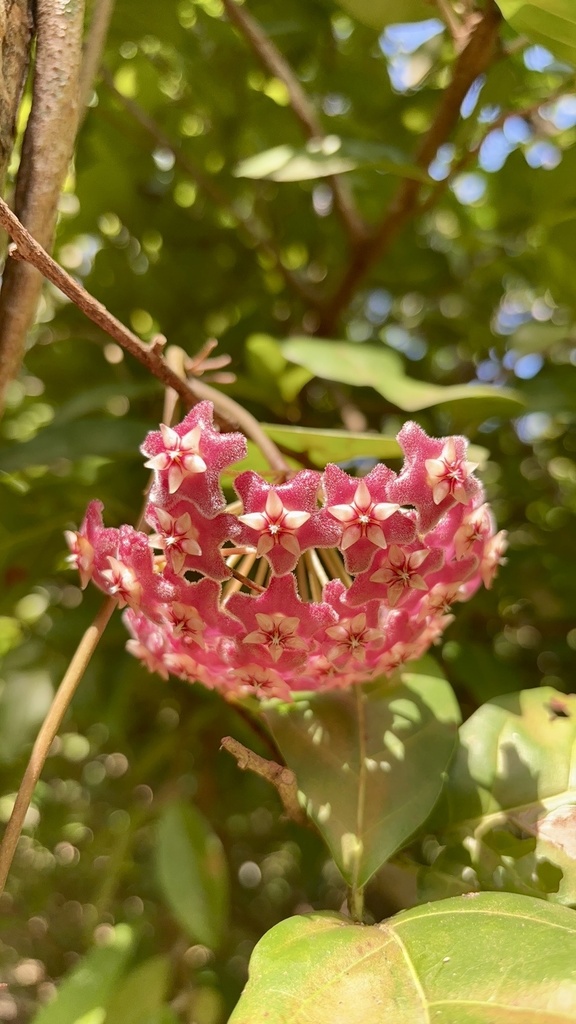
The inflorescences are umbels of ten to thirty individual flowers, each flower a five-pointed star barely ten to fourteen millimeters across, white to cream with a pink or reddish corona at the center. They are small enough that a first-time viewer might walk past them, but the scent stops everyone. Sweet and spiced — cinnamon is the most common comparison, though there's a faint creaminess underneath that pulls it toward the dessert end of the spectrum. The scent intensifies in the evening and in overnight darkness, which suggests pollinator activity that peaks after dusk in the species' native range.
Flowers emerge from peduncles that persist after the blooms drop. This matters practically: H. lacunosa is a hoya, which means it reblooms from those same peduncles. Cut them off and you remove next season's flowering points. This is a lesson learned once, usually the hard way. Mark the peduncles if you need to — a small piece of wire or a gentle tie — and work around them when you're trimming the plant back.
Bloom frequency in cultivation is high by hoya standards. Given adequate light — bright indirect, or a few hours of gentle morning sun — a well-established plant will bloom in cycles throughout the warmer months, sometimes into early winter if the light is supplemented. This is not a once-a-year event you schedule around. It happens, and then it happens again.
'Black Dragon' Enters the Room
At some point in the last fifteen or so years, cuttings began circulating under the name 'Black Dragon' — a Hoya lacunosa selection distinguished, depending on which vendor you asked, by darker stems, more pronounced leaf speckling, deeper green foliage, or some combination of all three. The name has real commercial appeal. 'Black Dragon' sounds specific. It sounds like something a collector should want. It moved units.
The trouble is that the traits used to distinguish it from standard lacunosa are environmentally labile. Stems darken with higher light exposure. Speckling intensifies or fades depending on conditions. Growers who received 'Black Dragon' cuttings and grew them under different light regimes than their source plant found, sometimes within a season, that the distinguishing characteristics had shifted. What had arrived looking distinctive began to look like any other lacunosa. This is a pattern that recurs across hoya marketing — a phenotypically variable species, a culturally appealing name, and a claim of distinctiveness that dissolves under scrutiny.
This is not to say there are no genuine lacunosa selections worth tracking. There are forms with meaningfully different leaf morphology. There are splash forms — leaves with pale or silvery variegation — that are genuinely distinct and reasonably stable. 'Black Dragon', as it circulates in the hobby, is not reliably one of them. You may receive something indistinguishable from the species. You may receive something that looks different for one growing season and then converges. What you will almost certainly not receive is a fixed, stable cultivar with consistent distinguishing characters.
'Royal Hawaiian' Arrives With the Same Luggage
The 'Royal Hawaiian' name came into circulation through a different channel — associated initially with material that had passed through Hawaiian horticultural networks, which have historically moved significant hoya volume into the mainland US market. The marketing story was similar: darker, more dramatic, possibly a distinct selection. The actual plant, in most cases, was Hoya lacunosa.
Side-by-side comparisons conducted by collectors who obtained both names from different vendors have, with notable consistency, produced plants that are visually interchangeable once grown under the same conditions. The 'Royal Hawaiian' versus 'Black Dragon' distinction has functioned primarily as a naming distinction rather than a botanical one — two labels applied to the same underlying genetic material, or to material indistinguishable within the range of the species' natural variation.
There is a particular frustration in this for the serious collector. You pay a premium for a named selection. You grow it carefully. And then you stand in front of your shelves and realize you cannot tell which pot is which, because the plants have converged on the same expression under the same conditions. The lesson is not unique to lacunosa — it applies across any phenotypically variable hoya sold under cultivar names — but lacunosa is where many collectors first learn it, because it's common enough that the redundancy eventually becomes impossible to ignore.
Growing It Well, Which Requires Minimal Heroics
Hoya lacunosa is epiphytic in origin and prefers what that implies: a substrate with meaningful air porosity, fast drainage, and the capacity to dry reasonably between waterings without becoming hydrophobic. A chunky coir-perlite mix works. So does a bark-based mix with added perlite or pumice. The goal is roots that breathe between cycles rather than sitting in sustained moisture. Root rot is possible — it just takes deliberate neglect to achieve.
Light requirements are moderate to high for a hoya. Bright indirect light produces good leaf color and reliable bloom cycles. A few hours of direct morning sun, the kind that comes through an east-facing window, will push the plant into its best expression — stems that hold color, foliage that sits firm, flower clusters that appear at a rate that starts to feel almost embarrassing. Avoid the deep shade that causes etiolation and stops blooming.
Humidity in the forty-to-sixty percent range suits it in most indoor environments. It will survive lower humidity better than most of the aroids in the same collection, which is part of why it so often ends up as the plant someone buys to fill a corner while the humidifier is running for the anthuriums. This is not a slight. It is a practical advantage.
Fertilize lightly during active growth — a balanced liquid feed at half strength every two to three weeks, or a slow-release product worked into the top layer of the substrate. Heavy feeding produces lush growth but does not reliably improve bloom frequency. The plant blooms when it's happy with light and consistency, not when it's been pushed with nutrients.
The Splash Forms, Which Are Actually Worth the Attention
Set aside the 'Black Dragon' question for a moment and consider the genuinely interesting lacunosa variations: the splash forms, in which the leaves carry pale silvery or creamy markings distributed across the lamina in patterns that range from fine speckling to broad, irregular blotches. These forms are not phantoms. They're real, they're visually distinct from the type, and the variegation is reasonably stable across growing conditions.
The mechanism is different from the environmentally-induced variation that confounds the cultivar naming situation. Splash patterning in hoyas is typically the result of differences in leaf anatomy — air spaces beneath the epidermis that scatter light differently — rather than a response to growing conditions. This means the pattern is present regardless of how much light you're running or how dark your stems happen to be this season. A splash lacunosa looks like a splash lacunosa in a grow tent and on a windowsill.
These forms move through the hobby under various names, and the naming situation is not entirely clean here either, but the underlying distinctiveness is at least real. If you are going to pay a premium for a lacunosa selection, the splash forms are where that money has a reasonable chance of buying something you can't replicate by growing standard material under different conditions.
Why It Stays in the Collection
The reason Hoya lacunosa survives the naming circus, the redundant cultivar situation, and the general chaos of how hoyas move through the hobby is simple: it is genuinely excellent. Not in the carefully hedged way that people describe plants they feel obligated to like, but in the practical sense that it does what it's supposed to do without requiring much in return.
It blooms reliably. It grows quickly enough to feel rewarding without becoming a crisis of management. The scent is real and good and specific — not a vague pleasantness but an actual identifiable character that fills a room at the right time of evening. The flowers are small, but small things done precisely are not a lesser category of thing.
The cultivar chaos that surrounds it is a hobby problem, not a plant problem. Hoya lacunosa was growing on rock faces in Sabah before anyone thought to name a selection 'Black Dragon', and it will be growing there long after that name stops moving product. For the collector who can see past the marketing, it remains exactly what it has always been: a fast-moving, free-flowering, cinnamon-scented vine that rewards almost any reasonable care with more growth and more bloom than you were expecting.
Buy it under whatever name it arrives. Grow it in a chunky, airy mix, in good light, with something to climb. Mark the peduncles. Let it bloom.