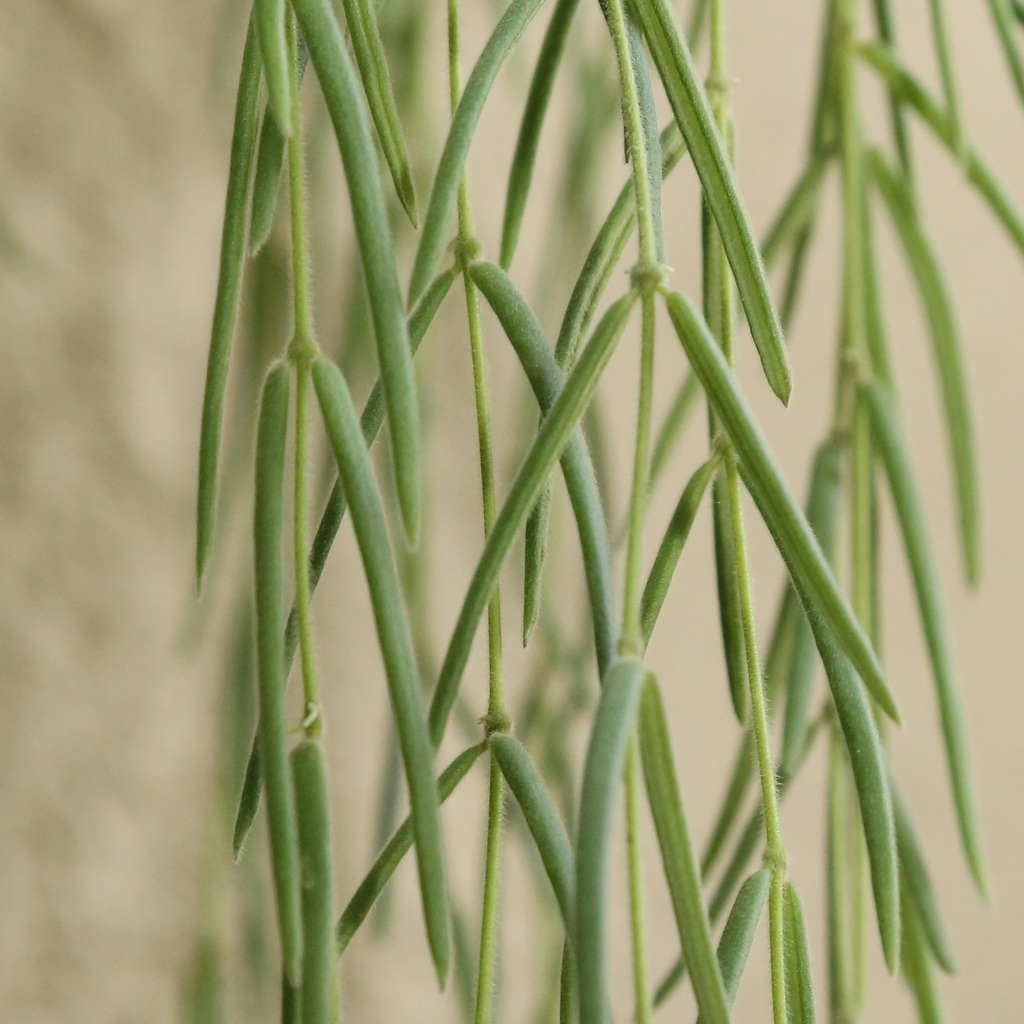
There is a plant that looks, from across a room, less like a hoya and more like a curtain of pine needles left hanging in midair. The leaves are soft, almost furry, cylindrical rather than flat, and they dangle in long pendulous chains from whatever anchor point you've given the plant — a hook, a shelf edge, a length of wire. From close range you can see the fine white hairs coating each leaf, the slight groove running along the inner face, the way the whole cascade trembles if you walk past too quickly. It is, without question, one of the odder things you can grow indoors, and it comes from a place that most houseplant collectors never think about when they imagine the origins of their plants.
Hoya linearis is native to the eastern Himalayan foothills — parts of northern India, Nepal, Bhutan, and into Yunnan province in China. It grows at elevations between roughly 1,500 and 2,500 metres, rooted in cliff faces, mossy rocky ledges, and the branches of montane forest trees. Up there the air is cool and reliably humid from monsoon mist, the light is bright but rarely fierce, and the temperatures at night can drop into the low teens Celsius for months at a time. That ecological profile is almost the precise opposite of the conditions most growers associate with hoyas — the baking, well-lit, drought-tolerant, warm-loving genus that can handle weeks without water and thrives on a sunny windowsill. Linearis will not tolerate any of that. It is a hoya that requires you to unlearn hoya.
Why the Leaves Are What They Are
The cylindrical, needle-like leaves of H. linearis are not an aesthetic accident. Terete or near-terete leaf forms appear independently across multiple plant lineages as an adaptation to specific moisture regimes — in some cases, desert conditions, but in the case of linearis, the challenge is more nuanced. Montane environments with high fog and mist but also periodic dry spells and intense UV at altitude seem to favor a reduced leaf surface area that limits desiccation without sacrificing photosynthetic capacity. The fine hairs — the trichomes that give the plant its characteristic fuzzy texture — likely serve a dual function: reflecting excess light and trapping a thin boundary layer of moist air against the leaf surface during drier periods.
What this means practically is that the leaf anatomy of linearis is not built for the kind of stomatal water-loss management that allows flat-leaved hoyas like H. kerrii or H. obovata to sit in a hot west window and simply wait out the dry spells. The hairy needle leaves are optimized for a subtler environment. They look tough because they look succulent-adjacent, but they are not. Push them into strong, warm, direct sun and the tips go yellow-brown within weeks. The fuzz does not protect against sustained heat; it is a montane adaptation, not a desert one.
The stems behave accordingly. They are slender, wiry, and extremely long — a mature plant can produce chains exceeding a metre and a half — and they branch with modest enthusiasm, meaning the plant tends toward a cascading rather than a bushy habit. Collectors who want the full effect train it from a hanging basket or mount it on a piece of cork bark oriented vertically, letting gravity do the display work. Trying to make it mound or climb a moss pole is asking it to grow in a direction it has never evolved to go.
Hoya linearis looks like a curtain of pine needles left hanging in midair — and it comes from a place that will rearrange everything you think you know about the genus.
The Conditions It Actually Needs
Temperature is where most growers first go wrong with linearis. It is comfortable between about 10°C and 24°C (50–75°F). Above 27°C for extended periods, particularly combined with low humidity and strong light, the plant begins to sulk visibly: leaves pucker, tips die back, new growth stalls. Below 10°C it can tolerate brief dips but sustained cold causes damage. What it wants, and what is difficult to give in most northern-hemisphere homes, is the cool, stable band in the middle — roughly the temperature of a basement or a north-facing room in summer. A cool greenhouse is ideal. A west-facing bedroom in July with no airflow is close to worst case.
Humidity should sit above 60%, ideally 70–80%. This is not unusual for serious collectors running humidifiers or growing in enclosed setups, but it bears saying that linearis will not reward the collector who treats humidity as optional the way H. australis or H. carnosa might. The hairy leaves trap moisture in the wild; in a dry heated interior, that adaptation doesn't help much, and the plant slowly declines. Bright indirect light — a north or east window with good reflected sky light, or 10–12 inches under a quality LED panel at moderate intensity — suits it far better than the high-light positioning that works for most of its genus-mates.
Airflow matters too, and this is where the plant's cliff-face origin becomes relevant again. In nature it hangs on exposed rocky surfaces with constant gentle air movement. Stagnant, humid air without circulation is a recipe for botrytis on those fuzzy leaves. The solution is simple: a small fan on a low setting, directed near rather than at the plant, running during daylight hours. It is one of the few care variables that costs almost nothing to implement and makes a measurable difference.
Substrate and Water — the Counterintuitive Part
Most hoyas want to dry out substantially between waterings. Linearis does not — and this is probably the single most important thing to internalize. In cool, misty montane forest, the substrate the plant roots into (moss, cliff-face mineral grit, decomposing bark) stays lightly moist most of the time without ever being waterlogged. The roots are adapted to perpetual light moisture, not boom-and-bust hydration cycles. Let linearis go as dry as you would let a H. kerrii go, and the needle leaves will start to wrinkle, then brown at the tips, then drop. By the time you see the wrinkling, you have probably already lost two or three weeks of growth.
The substrate needs to walk a narrow line: moisture-retentive enough to stay damp between waterings, but still sufficiently airy that roots never sit in stagnant wet. A mix of fine-grade orchid bark, perlite, and a meaningful proportion of sphagnum moss — something in the range of 3:2:2 by volume — works well for most growers. Some collectors add a portion of fine pumice or akadama for mineral content and structure. The key is that the mix should feel just-barely-moist when you check it with a finger an inch or two down, and you should water again before it dries out completely. In a cool room in winter, that might mean watering every five or six days. In a warm summer, every three.
Fertilize lightly and infrequently. A half-strength balanced liquid feed once a month during the growing season is plenty. Linearis is not a fast grower even under good conditions; overfeeding produces soft, weak growth that is more susceptible to rot and pest pressure.
Flowering, and Why It's Worth the Wait
The flowers of H. linearis are white, small, and clustered in pendant umbels of roughly 10–15 individual blooms. Each flower has the characteristic waxy hoya corona, white with a faint pink or mauve center, and the fragrance is notable — sweetly lemon-scented, strongest in the evening and early morning, strong enough to carry several feet in a still room. The inflorescence hangs down from a peduncle that emerges from a leaf axil, and unlike many hoyas, linearis does not reliably reuse the same peduncle the following season, which means pruning back old flower stems doesn't cost you next year's blooms the way it would with H. bella or H. multiflora.
Getting the plant to bloom requires patience and a couple of specific triggers. A temperature drop in autumn — allowing nights to cool to 12–15°C for four to six weeks — combined with slightly reduced watering seems to initiate bud set. Growers who keep their plants in uniformly warm conditions year-round often report healthy growth but few or no flowers. A cool windowsill placement from September through November, with the plant allowed to dry just slightly more between waterings, mimics the seasonal shift in the Himalayan foothills well enough to trigger flowering in late winter or early spring. The blooms last two to three weeks and leave the room smelling like a lemon verbena in a light rain.
Propagation and the Problem of Scale
Hoya linearis propagates readily from stem cuttings, which is lucky because established plants are slow to produce thick, branching growth. A cutting of four to six leaf-bearing nodes, placed in damp sphagnum or a mix of perlite and sphagnum under high humidity, typically roots within three to five weeks at 20–22°C. Bottom heat via a seedling mat helps. Once rooted, the cutting can be transferred to the substrate mix described above and treated as a mature plant — with the important caveat that young plants are more sensitive to temperature extremes and dry air than older ones.
The challenge is that because the plant grows in long, undivided chains rather than in a bushy mass, propagating it for trade or to build up a personal collection requires taking cuttings that set the parent plant back visibly. A chain severed halfway loses half its aesthetic impact, and the remaining stub may take a season to branch and recover its form. This is partly why linearis moves through the collector market more slowly than, say, a fast-vining H. macrophylla: the good-sized, well-developed specimens represent genuine time investment.
Where It Fits in a Collection
Linearis occupies an unusual position in a hoya collection. It is not rare in the strict sense — tissue culture has made it widely available, and it shows up in specialty nurseries and online sales with some regularity. But it is demanding enough in its care requirements that well-grown specimens with full, long cascades are genuinely uncommon. The people who grow it well tend to be the ones who already run cool, humid setups for other montane plants: miniature orchids, selaginellas, cool-growing begonias, perhaps some of the higher-altitude ferns. If your collection lives in a warm bright room and coasts on benign neglect, linearis will be a source of quiet frustration.
If, on the other hand, you have a spare bedroom that runs cool, a humidifier you run consistently, and a genuine interest in plants that require you to understand their origins rather than just their watering schedules, linearis will reward you with something that nothing else in the genus quite replicates: that improbable curtain of soft, needle-like leaves, trembling slightly in the airflow from a small fan, smelling faintly of lemon on a February morning when almost nothing else is alive.