Around the second week of February, they appear on the impulse-buy racks near the checkout: a single heart-shaped leaf, fat and waxy as a poker chip, potted in a thimble of soil and wrapped in pink cellophane. The tag calls it a sweetheart plant. It costs four dollars. It will, in most cases, sit on a windowsill for somewhere between eight months and three years, never producing another leaf, never vining, never doing anything except slowly and stubbornly refusing to die — which is the only honest thing about it.
The leaf belongs to Hoya kerrii, a species native to Southeast Asia, from Thailand and Laos down through peninsular Malaysia. Kerrii is a legitimate and rewarding Hoya, capable of producing vines three meters long, clusters of pale yellow flowers with a burgundy corona, and, yes, those improbable heart-shaped leaves in pairs all the way up the stem. The Valentine's version, though, is not that plant. It is a single leaf-cutting taken without a node — a botanical dead end dressed up in seasonal marketing. Understanding why requires knowing something about how Hoya actually grows.
What a Node Does and Why Its Absence Is Fatal
Every vascular plant grows from meristematic tissue — cells capable of dividing and differentiating into new structures. In a vining Hoya, that tissue is concentrated at the node, the point on the stem where a leaf attaches and where an axillary bud sits waiting for the right signal. The internode, the stem section between nodes, carries no such tissue. Neither does the leaf blade itself, or the petiole that connects it to the stem. When a grower takes a single-leaf cutting from Hoya kerrii and pots it, they are potting a structure with no meristematic capacity. It will callous. It will root, after a fashion — enough adventitious roots to absorb water and keep the leaf turgid for years. But it cannot initiate a shoot. The leaf will not be followed by another leaf. The vine will never come.
This is not a quirk of kerrii specifically. It applies across the genus and across most aroids and succulents. A Monstera deliciosa leaf without a node will do the same thing: root politely, persist indefinitely, and contribute nothing to the plant's future. The difference is that nobody sells a single monstera leaf as a Valentine's gift — at least not yet. Kerrii's heart shape made it irresistible to the seasonal gift market, and once the first shipments moved through garden centers in the mid-2000s, the format locked in. The leaf-only cutting is now produced by the hundreds of thousands in Dutch and Thai wholesale operations every winter.
The plants used for cutting stock are not sacrificed — a mature kerrii vine can yield dozens of single-leaf cuttings without visible damage, because the nodes are left on the parent plant. That parent plant is the one that will eventually flower. The cuttings sold in February are, in a real sense, the trimming waste of a productive operation. They are sold because they sell, which is a different thing entirely from being sold because they grow.
Without a node, a Hoya kerrii leaf is a slow-motion still life — alive in the loosest sense, growing in none.
The Geography of Kerrii
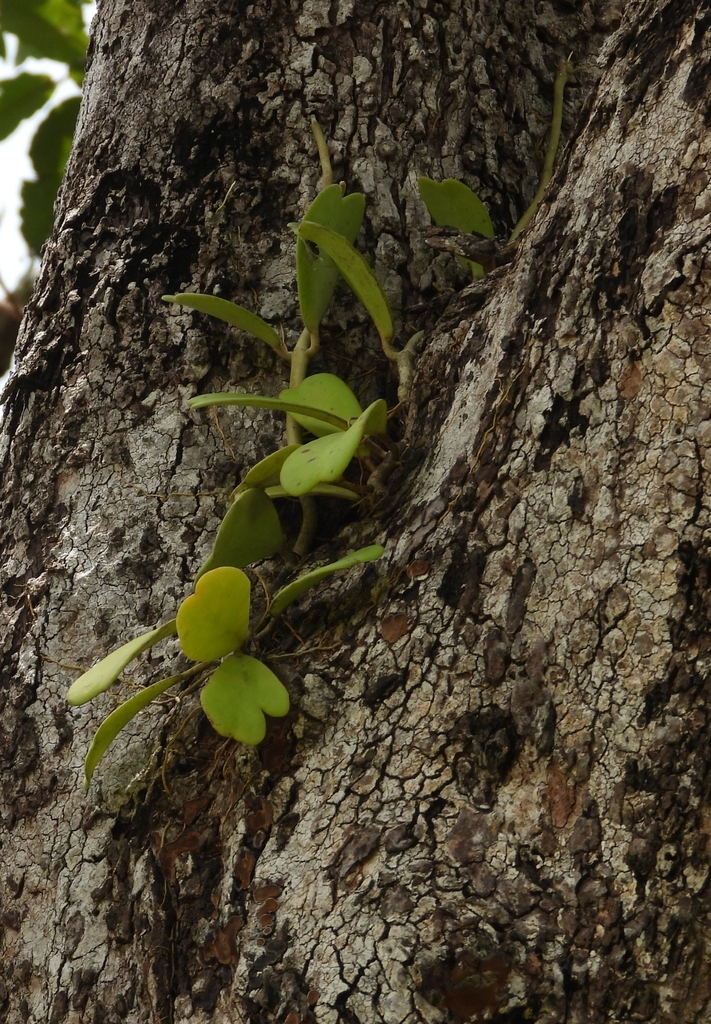
Hoya kerrii was described by William Grant Craib in 1911, based on specimens collected in northern Thailand near Chiang Mai. The species epithet honors Arthur Francis George Kerr, a British physician and botanist who spent decades collecting plants in Siam — his herbarium specimens, now held at Kew, documented hundreds of species new to Western science. The plant that carries his name grows as an epiphytic or hemiepiphytic liana in seasonal tropical forest, fixing itself to tree bark and scrambling upward toward the canopy in conditions that include a genuine dry season — which matters for how we should be growing it.
In its native range, kerrii experiences months with very little rainfall. The thick succulent leaves are an adaptation to that stress, storing water against dry periods the way a cactus stores it against desert heat. This is why a nodeless leaf-cutting can persist for years on almost no water: the leaf is a reservoir. It is not growing. It is waiting, in the way that a stone waits — patiently, without destination. Growers who understand this will water their nodeless kerriii perhaps once a month and otherwise leave them alone, accepting them for what they are rather than expecting what they cannot become.
The range extends through Laos, Cambodia, Vietnam, and down into peninsular Malaysia, with regional variation in leaf size and flower color intensity. Collectors who have grown specimens sourced from different parts of the range report subtle differences — broader leaves from some Malaysian collections, slightly more pronounced venation from certain Thai provenances — though the taxonomy recognizes a single species. There is also a natural variegated form, Hoya kerrii 'Variegata', with cream-margined leaves, that has become genuinely desirable in its own right.
The Variegated Kerrii Problem
'Variegata' is where the story gets more complicated. Variegated kerrii — leaves with cream or white margins caused by sectors of chlorophyll-deficient tissue — is propagated by stem cutting, with nodes, like any serious Hoya. It grows slowly even under good conditions, because the white portions of the leaf contribute no photosynthesis, and the plant has to do real metabolic work on reduced green area. A well-rooted variegated kerrii cutting with two or three nodes, given bright indirect light, an airy substrate, and the drydowns its native season taught it to expect, will vine. It will take its time about it.
The single-leaf variegated cutting is a separate and more insidious product. Because the variegated form is sold at a premium, some vendors sell single-leaf cuttings — nodeless — of the variegated form at prices that suggest you are buying something that will grow. You are not. A variegated single leaf has the same developmental ceiling as a green one: zero. The cream portions of the leaf do make these cuttings visually striking, which is precisely the problem. The leaf is beautiful. The leaf is static. These are not contradictory facts, but they are easy to conflate when the cutting is sitting in a four-inch pot on a well-lit shelf.
The tell is always the node. If the cutting has a visible section of stem with at least one node — identifiable as the slightly swollen point where the petiole attaches to the stem — it can grow. If it is a leaf and a petiole only, no amount of patience or premium substrate will change the outcome. Check before you buy.
What a Full Kerrii Plant Actually Does
A Hoya kerrii grown from a properly nodded cutting in suitable conditions is a different proposition entirely. The vines are stout and architectural, the internodes relatively long, the leaves arranged in opposite pairs that can reach eight to ten centimeters across on a mature plant. Given a trellis or a length of cork bark to attach itself to, a mature specimen becomes genuinely impressive — not in the way that rare aroids are impressive, with their mutations and their outrageous velvet, but in the way that a well-built piece of furniture is impressive. Solid. Proportioned. Clearly made to last.
The flowers appear in umbels from peduncles, which are the short stalks that emerge from leaf axils and, critically, persist after the flowers drop. Kerrii rebloom from the same peduncle repeatedly, which means a grower should never remove a spent peduncle — that stub is next season's flower. The blooms are small, pale yellow, and waxy in the Hoya manner, with a deep red or maroon corona. They are fragrant, particularly in the evening, with a clean sweetness that doesn't overpower a room. A plant that has been in a pot long enough to become rootbound — a condition Hoya generally prefers — will bloom more reliably than one with room to run.
Culture is straightforward once you accept the dry-season logic. A coarse, free-draining substrate — perlite, orchid bark, and a small fraction of coco coir — suits it better than any peat-heavy mix. Water thoroughly, then wait until the medium is genuinely dry before watering again. In low light, the wait will be longer; in a bright south or west window, shorter. Humidity is less critical for kerrii than for velvet-leaved species: the succulent foliage tolerates the dry air of a typical home without the chronic crisping that plagues a Philodendron gloriosum on a radiator shelf.
The Collectors Who Bother
Within serious Hoya circles, kerrii sits in an odd position. It is simultaneously the species most visible to non-collectors — the Valentine's leaf, the grocery store impulse buy — and one that dedicated growers pursue in its proper forms with genuine interest. The variegated form commands real prices when properly rooted. A less commonly circulated form sometimes called 'Reverse Variegata', with a green margin and a cream or pale center, exists and is slower-growing and harder to find than the standard 'Variegata'. Collectors who have grown both note that the reverse form requires even more patience — the reduced central chlorophyll means growth is measured in centimeters per season, not per month.
There are also growers who have maintained large kerrii specimens for a decade or more, plants that have colonized entire wall trellises or cascaded from hanging baskets in conservatories. These plants are not flashy in the way that a fenestrated Monstera obliqua or a silver-leafed Scindapsus treubii 'Moonlight' is flashy, but they have a permanence that younger collectors sometimes underestimate. A ten-year-old kerrii with a woody base and thirty nodes in active growth is not the same organism as the little pink-wrapped chip in February's checkout display. The name is the same. The resemblance ends there.
Selling the Myth, Losing the Plant
There is a reasonable argument that the Valentine's leaf-cutting introduced Hoya kerrii to people who then became interested in the actual plant. This happens. A customer buys a four-dollar leaf, watches it do nothing, reads online about why, learns what a node is, orders a properly propagated cutting, and ends up with a vining Hoya and the beginning of an education. The leaf was a gateway drug that happened to be inert.
But the scale of the Valentine's trade also does something subtler and harder to reverse: it reduces a genus of several hundred species, many of them genuinely complex and rewarding, to a single seasonal leaf that functions as a green greeting card. People who received a kerrii leaf in 2017 and watched it sit unchanged for four years are not, in general, rushing to acquire Hoya pachyclada or Hoya finlaysonii or a proper vining Hoya macrophylla 'Albomarginata'. The bad experience with a product that was misrepresented to them has done its quiet damage.
None of this is the plant's fault. Hoya kerrii is a good plant — durable, floriferous when mature, architecturally interesting, and adapted to the conditions most people can actually provide. The single nodeless leaf is not a plant. It is a shape that resembles a symbol that humans decided means something in February. The shape is real. The symbol is real. The plant that will grow from it is not.
What to Buy Instead
If you want kerrii — the actual vining, potentially flowering species — the path is a stem cutting with a minimum of two nodes, callused and rooted in sphagnum or perlite before you receive it, from a vendor who can tell you where in the propagation chain the cutting came from. The plant will be slower than you expect. Give it a bright window, let it dry between waterings, and leave its peduncles alone once they appear.
If you want the variegated form, the same rules apply with added patience factored in. Expect one or two new leaves per growing season in the first year, more once the root system is established. The cream margins are stable; you are not going to lose the variegation to reversion the way you might with some chimeric plants. What you will lose, if you overwater, is the root system — succulence in the leaves does not protect the roots from standing moisture.
The four-dollar Valentine's leaf is not a plant recommendation. It is a souvenir of a misunderstanding about how plants work. If someone in your life wants a Hoya — and Hoyas are genuinely excellent plants for a wide range of living situations — get them a rooted cutting with nodes, a pot with drainage, and twenty minutes of honest conversation about what they're actually getting into. That gift will grow. The other one was never going to.