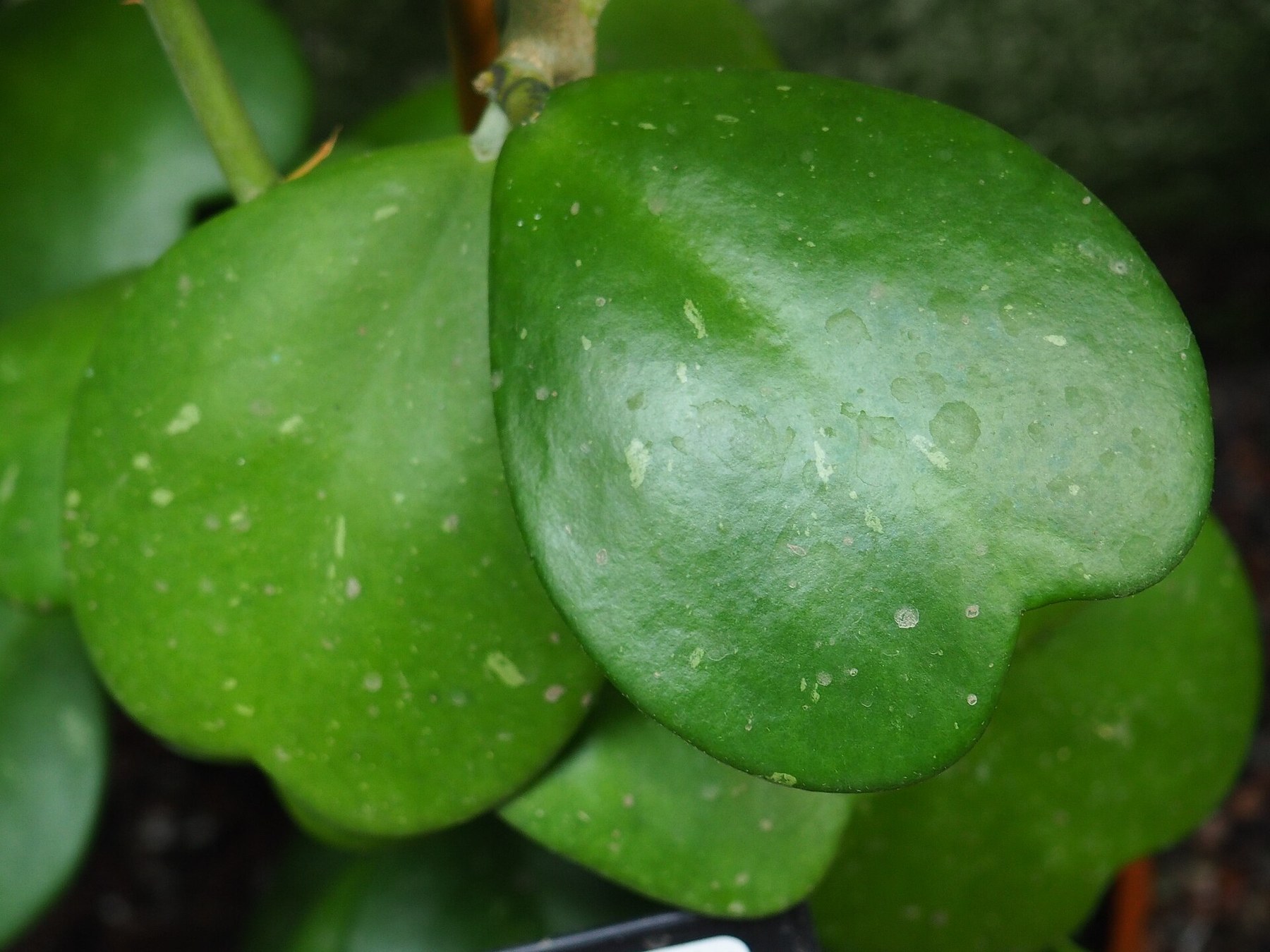
📷 Teresa Grau Ros from Barcelona / Wikimedia Commons (CC BY-SA 2.0)
Field Guide · Hoya
The sweetheart hoya is a real climbing vine with thick succulent foliage, fragrant umbels, and several variegated forms worth growing on their own merits.
The standard species, native from southern China through Thailand into Java. Mature vines push leaves 5–6 cm across on woody stems that will climb a pole or trail several meters. Flowers are tight ball-shaped umbels of fuzzy cream-and-burgundy stars, lightly fragrant at night. Worth growing in its own right, not just as a curiosity.
The speciesYellow-cream variegation bleeds out from the midrib, leaving a green margin. Slower than the plain form and slightly fussier about light — it wants more of it to hold the contrast. Old growth often reverts to near-solid green, so prune back to a strongly variegated node. The most stable variegated kerrii on the market.
Best variegateCream edges, green center — the mirror image of the inner-variegated form. Tends to throw pink and apricot new growth under strong light, which is the main reason to chase it. Growth is slow and the leaves stay a touch smaller. Watch for all-cream shoots, which won't sustain themselves and should be cut back.
Pink new growthA less common selection with scattered silver flecking across the leaf surface, similar to the splash patterning seen in H. carnosa and H. pubicalyx. Vigor matches the plain green form, which makes it the easiest variegated-looking kerrii to keep. Flecking intensifies in bright light and fades in shade.
UnderratedA rarer chimeral form combining inner and outer variegation across different leaves on the same vine. Unstable by nature — expect sectoring, the occasional all-green leaf, and slow overall growth. Only worth it if you want a project plant and are willing to prune for the patterning you like. Buy in person if you can.
Collector only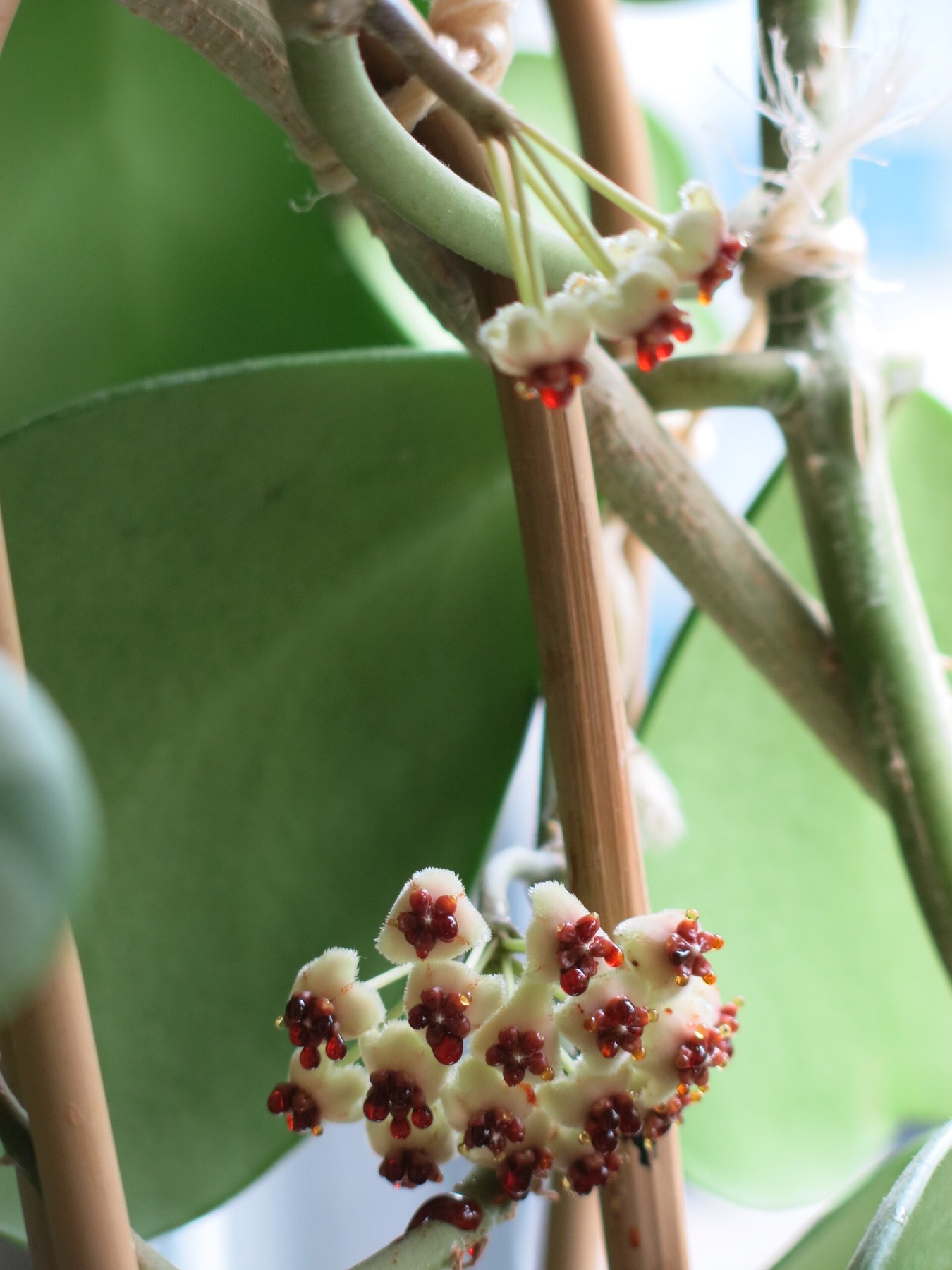
The leaf you see in checkout aisles is a real piece of Hoya kerrii — usually a mature leaf pushed into sphagnum or coir until it roots at the cut petiole. It will root. It will live, sometimes for a decade. What it almost never does is grow.
The problem is meristem. A hoya leaf cut without a sliver of stem and at least one axillary bud has no growth point to activate. The leaf photosynthesizes, stores water in its thick mesophyll, and sits there indefinitely. People report leaves that have held steady for seven, eight, twelve years without producing a single new node. That isn't failure on the grower's part — it's the physical limit of what a leaf without a bud can do.
Occasionally a leaf does vine. Those are the ones where the propagator left a hidden node attached at the base, or where the leaf was taken with a sliver of stem tissue that happened to carry a dormant bud. If you want a kerrii that will actually climb, buy a cutting with at least one node, or a rooted plant with visible stem. The single leaf is a keepsake, not a starter plant.
Hoya kerrii is succulent in the literal sense — those thick leaves are water storage. Treat it accordingly. A chunky, fast-draining mix works best: roughly equal parts orchid bark, perlite, and a small fraction of coco coir or peat for moisture buffering. Some growers add pumice or LECA for weight and aeration. The goal is a medium that wets evenly and dries within a week in a 4-inch pot.
Light is where most collections fall short. Kerrii will survive in medium light and do effectively nothing — no new leaves, no peduncles, no flowers. Give it bright indirect light minimum, and an hour or two of direct morning sun if you want any chance at blooming. Variegated forms need more light than the green species to hold their color and avoid leggy internodes. Under good light, new leaves on the outer-variegated form blush pink before hardening off.
Water deeply, then let the substrate dry most of the way through. In a bark mix that's typically every 10–14 days indoors, longer in winter. The leaves themselves are your gauge: a slight softness or wrinkle at the tip means it's time. Crispy edges and yellowing lower leaves usually mean the opposite — roots sitting wet too long. Humidity isn't critical; 45–60% is plenty. Airflow matters more than mist.
Kerrii blooms from short woody spurs called peduncles. The single most important rule: never cut the peduncle off. After a flush of flowers drops, the spur stays on the vine and reblooms from the same point, often for years. New collectors snap them off thinking they're spent growth, and then wonder why the plant never flowers again.
Bloom triggers are light, age, and a touch of stress. A vine needs to be mature — typically several feet of growth with woody lower stems — before it will spur. Push it with bright light, a slightly root-bound pot, and a drier winter rest with cooler nights in the 55–60°F range. A high-phosphorus feed in spring doesn't hurt. Flowers are creamy with a small red corona and smell faintly of butterscotch at dusk.
The other common mistakes are predictable. Overpotting kills more kerrii than underwatering — these roots are fine and want to fill a container before being moved up. Repotting an unhappy plant rarely fixes it; check light and watering cadence first. And don't trust the single-leaf novelty as a long-term plant. If you want the vine, buy the vine.
The Field Guide from Leaf People.