There is a plant sitting on a shelf in approximately one out of every three hobbyist collections, labeled Monstera adansonii, that is not Monstera adansonii. It arrived that way from a big-box store, or from a seller on a Facebook group who got it from another seller who got it mislabeled at a wholesale nursery sometime around 2018. It has oval fenestrations, a vining habit, smallish leaves, and absolutely no documentation. Everyone who owns it is confident about the name. Almost none of them should be.
This is not a story about gatekeeping. It is a story about how a single species epithet became a catch-all for at least four morphologically distinct plants, how a geographic modifier — 'Peru form' — got attached to something that may never have been collected in Peru, and why untangling the mess matters if you are trying to grow these plants well, source them honestly, or understand what you actually have climbing your moss pole.
What adansonii Actually Is
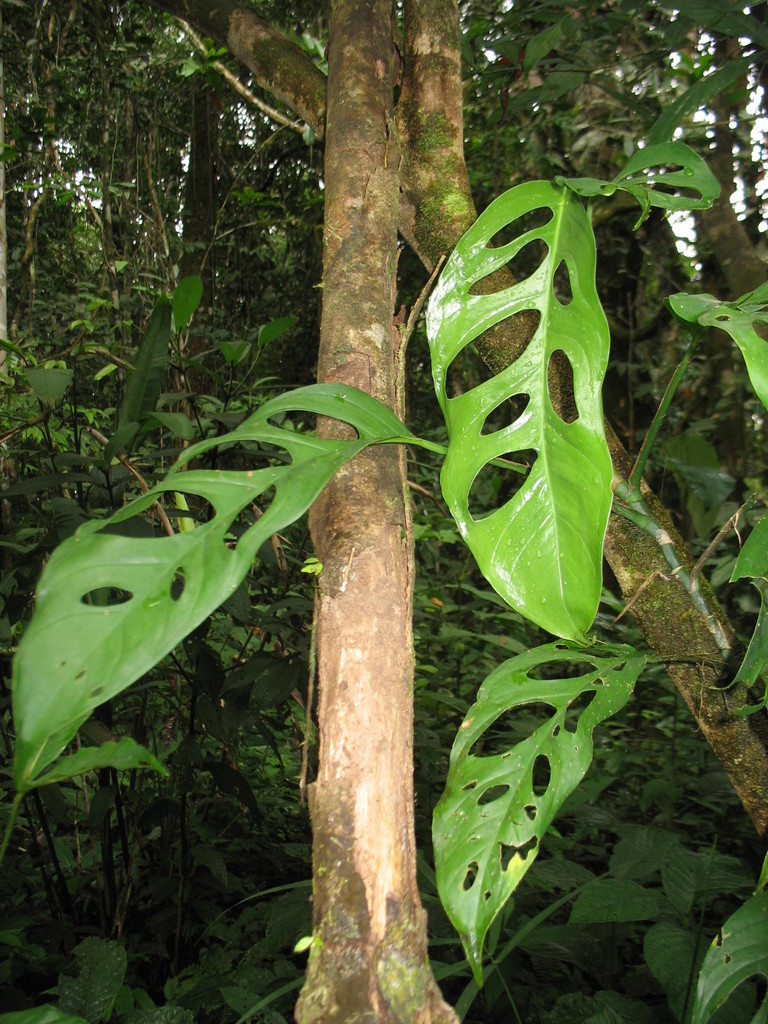
Monstera adansonii Schott is a legitimate, well-documented species with a range that extends from southern Mexico through Central America and into parts of South America, including Colombia, Venezuela, and Brazil. The type specimen is not mysterious. What is mysterious is how the name came to describe almost everything with a hole in it. In botanical terms, adansonii has relatively narrow, elongated leaves with fenestrations that tend to be arranged in neat rows flanking the midrib. The leaf texture is somewhat matte, the petiole geniculum is pronounced, and mature leaves on a climbing specimen can exceed thirty centimeters without approaching the theatrical proportions of obliqua or the so-called 'wide form.'
The wide form is where the first fracture appears. Plants sold as Monstera adansonii wide form typically show broader, rounder leaves with larger fenestrations relative to the lamina — more hole per unit of leaf, as it were. Whether wide form represents genuine intraspecific variation, a distinct ecotype, or an entirely separate species is a question the taxonomy hasn't fully resolved. What's clear is that a cutting labeled wide form does not automatically tell you where it originated, who verified the ID, or whether the seller has ever compared it to a type specimen or even a reliable herbarium image.
A geographic modifier got attached to something that may never have been collected in Peru — and the name stuck anyway.
The Peru Form Problem
Somewhere in the mid-2010s, a morphologically distinctive Monstera started circulating in the trade under the name adansonii Peru form. The leaves are narrower than typical adansonii, almost lance-shaped, with a leathery, corrugated texture that catches light differently from the flat lamina of standard material. The fenestrations are smaller and more irregularly spaced. It looks, frankly, like a different plant — because it very likely is.
The 'Peru form' designation implies geographic origin, the way 'Colombian form' or 'Ecuadorian' does in the anthurium world, where provenance sometimes corresponds to measurable morphological differences. But no reliable collector provenance attaches to the Peru form adansonii in wide circulation. The plants entered the European and North American trade through ornamental nurseries, not through documented wild collection or botanical institutions. The name Peru form is, at best, a trade convenience. At worst, it is a fiction that has calcified into accepted taxonomy among hobbyists who have never questioned it.
What the Peru form may actually be is a matter of ongoing, informal discussion. Monstera tuberculata is one candidate — a species with similar narrow, corrugated leaves documented from Central America. Monstera lechleriana has also been floated. Neither identification is settled, and the honest position is that without a proper herbarium voucher and molecular analysis, 'Peru form' is a label describing a look, not a lineage.
Enter Monstera obliqua
If adansonii is the most misnamed plant in the hobby, obliqua is the most mythologized. True Monstera obliqua Miq. is, depending on the population, so heavily fenestrated that the leaf is structurally more air than tissue — the Peru population in particular produces leaves where the holes exceed sixty percent of the total lamina area. It is also genuinely rare in cultivation, slow, finicky about humidity gradients, and not the plant most people are growing.
What most people are growing when they think they have obliqua is adansonii wide form with ambitions. The two share a vining habit and the general aesthetic of a leaf that has been aggressively hole-punched, but true obliqua is thinner, almost translucent at the margins, and structurally fragile in a way that makes it difficult to ship and nearly impossible to find in the mass trade. If you paid less than several hundred dollars for your obliqua cutting, from a seller who could not produce a photograph of the mother plant and a chain of custody, you almost certainly have something else. This is not pessimism. This is the base rate.
The confusion between obliqua and adansonii has a long history — the two were treated as synonymous by some nineteenth-century botanists, and the distinctions were not consistently recognized until relatively recently. Schott's original descriptions were working from pressed herbarium material, which compresses and distorts the very fenestration patterns that are now diagnostic. Hobbyists sorting through forum photographs are doing taxonomy under worse conditions than Schott, and arriving at worse conclusions.
Why the Misidentification Matters
There is a school of thought in the collector community that names are just labels and what matters is whether the plant is beautiful and healthy. This is a reasonable position up to a point. But care requirements, realistic expectations, and fair pricing all attach to names. If you believe you have obliqua, you may chase humidity levels and substrate conditions appropriate for an exceptionally delicate species, while your actual adansonii wide form would have been perfectly content at sixty percent humidity with a slightly coarser mix. Conversely, if you think your Peru form is just a variant of a common species, you may not give it the airflow and brighter light that its apparently distinct physiology seems to want.
There is also the question of money. Rooted cuttings of 'obliqua' have sold for four figures based on nothing more than a photograph of heavily fenestrated leaves and a seller's assertion. Some of those transactions were honest mistakes. Some were not. The corrective is not cynicism but specificity: ask for photographs of the petiole junction, the abaxial leaf surface, the growth habit of the mother plant. Ask what the seller's source was. A reputable collector can tell you where their plant came from. If the answer is 'I got it from so-and-so on Instagram,' that is a data point, not a provenance.
How to Actually Tell Them Apart
Start with leaf shape. Monstera adansonii in its typical form has leaves that are longer than wide, with a somewhat asymmetrical base and fenestrations arranged in one to three rows on either side of the midrib. The adaxial surface is mid-green and slightly glossy. The Peru form, whatever its true identity, has noticeably corrugated, almost quilted lamina with a matte finish and fenestrations that are more irregular and smaller relative to leaf size. Wide form has a rounder, broader lamina with larger holes and a somewhat more symmetrical base.
True obliqua, particularly the Peru population, has leaves where you can hold the lamina to light and see through the tissue between the veins — it is that thin. The fenestrations are not just large; they are confluent, merging into each other so that what remains is a net of green rather than a leaf with holes. The petiole on obliqua is also notably slender relative to the leaf. These are not subtle differences if you have seen both plants in person. They are nearly invisible in a heavily filtered Instagram photograph, which is where most people are making their identifications.
Juvenile leaves complicate everything. All of these plants produce juvenile foliage that is smaller, less fenestrated, and more similar across forms than mature leaves. A cutting of three or four nodes tells you very little. If you are paying a premium for a species or form, insist on a plant that has produced at least two fully mature leaves on the current stem, or on documentation of what the mother plant looks like.
The Taxonomy Is Genuinely Unsettled
It is tempting to frame the adansonii mess as a problem created by careless hobbyists and unscrupulous sellers, and those are real contributing factors. But the underlying issue is that Monstera taxonomy has been in productive chaos for decades. The genus contains somewhere between forty-five and sixty species depending on which revision you accept, and molecular phylogenetic work has repeatedly revealed that morphological boundaries do not map cleanly onto genetic ones. Plants that look similar are sometimes distantly related; plants that look different are sometimes conspecific variants responding to elevation, light, or substrate.
Monstera adansonii sensu lato — the species as broadly construed — probably encompasses more than one biological species. The wide form versus narrow form distinction may eventually resolve into separate species names with proper type specimens and molecular support. The Peru form may acquire a valid name of its own, or it may turn out to be a variant of something already described from a different part of the range. The honest position for any collector right now is to hold names loosely, document your plants as carefully as you can, and treat the label on the pot as a working hypothesis rather than settled fact.
Growing What You Have, Whatever It Is
Set aside the nomenclature for a moment. If you have a plant in the adansonii complex — typical, wide form, Peru form, or one of the other morphotypes drifting through the trade — the care framework is broadly consistent. These are hemiepiphytes that want to climb, and they reward a moss pole or coir totem with larger, better-fenestrated mature leaves. Substrate should be airy: a blend of coco coir, perlite, and orchid bark in roughly equal proportions drains fast and holds just enough moisture. Humidity above sixty percent encourages steady growth; below fifty and the new leaves tend to be smaller and more reluctant to fenestrate fully.
Light is where people consistently underserve these plants. Monstera of any kind will tolerate lower light but will not thrive in it. Bright indirect light — within a meter of a south or east-facing window, or under a full-spectrum LED at sufficient intensity — produces faster growth, thicker lamina, and more reliable fenestration. The Peru form in particular seems to want more light than typical adansonii to hold its corrugated texture.
The irreducible point is this: whatever is climbing your pole, take a photograph of a mature leaf, note the petiole length and texture, and save that documentation. The taxonomy will eventually catch up. When it does, you will want to know what you were growing all along.
The Name on the Pot
There is something clarifying about accepting that you probably cannot identify your adansonii complex plant with certainty from visual inspection alone, and that this is fine. Collectors of orchids, aroids, and ferns have always operated in conditions of partial knowledge, making reasonable inferences from available morphology and updating those inferences as better information arrived. The adansonii mess is not a crisis. It is a case study in how quickly a popular plant can out-run the science that should describe it.
What you can do is be precise about what you know and honest about what you don't. 'This is what I was sold, this is what it looks like, here is a photograph of a mature leaf' is more useful than a confident label that traces back to a wholesale nursery's inventory system. The plants are, genuinely, interesting: varied, fast-growing when happy, and capable of producing leaves that stop people mid-conversation. They do not need inflated names to be worth growing. They just need someone who looks at them carefully enough to see what they actually are.