There is a particular vertigo that comes with buying a small Monstera cutting and then, three years later, staring at a leaf the size of a dinner tray and wondering where you went wrong — or, more likely, where you went so right. The plant on your moss pole does not resemble the plant in the seller's photograph. The juvenile you carried home in a four-inch pot, its leaves pressed flat and overlapping against whatever surface they could find, has undergone something closer to metamorphosis than growth. This is not incidental to the genus. It is the whole point.
Aroids that dramatically alter their leaf shape, size, and texture between juvenile and adult stages are said to exhibit heterophylly — the production of structurally distinct leaves at different life phases. In Monstera, heterophylly reaches an extreme that makes most other genera look conservative. Understanding what triggers the shift, and how to encourage it deliberately, is one of the more satisfying puzzles in aroid cultivation.
The Shingling Strategy
Consider Monstera dubia. The juvenile form produces small, asymmetric leaves, matte silver-green with dark venation, pressed so tightly against bark that they overlap like roof tiles — shingling, in the grower's vocabulary. Each leaf lies nearly flat to the substrate, its petiole almost vestigial. There are no fenestrations, no holes, no drama. It is, frankly, a modest-looking thing, easy to overlook in a trade table full of flashier species.
What the juvenile is actually doing is eminently practical. By keeping its profile low against bark, it reduces wind resistance, retains moisture against a tree's humid surface, and outcompetes mosses and lichens for the vertical real estate it needs to ascend. The shingling form is not an immature version of the adult — it is a different strategy, tuned for a different problem. The plant needs to climb before it can afford to have leaves worth looking at.
Monstera karstenianum — better known in the trade as M. 'Peru' — offers a related case study. Its juvenile leaves are thick, almost succulent-feeling, with deeply bullate texture: a corrugated surface that helps water bead off efficiently in heavy rain. As it climbs, the leaves remain relatively small and unperforated. It is an example of a species that changes texture and dimension significantly without ever developing the fenestrations M. deliciosa made famous. Heterophylly doesn't always mean holes; sometimes it means a completely different relationship with light and water.
The juvenile you brought home in a four-inch pot and the adult destroying your ceiling are the same plant — separated by a pole, some time, and a few vertical feet.
What the Plant Is Climbing Toward
In the rainforest understorey, light is the resource everything is organized around. A seedling of Monstera germinates on the forest floor where, depending on the canopy above, it may be receiving as little as one or two percent of full sunlight — deep shade that would stress most houseplants into decline. The shingling juvenile, pressing close to bark, is not yet trying to photosynthesize aggressively. It is ascending. It is buying altitude.
Once the plant reaches a point on its host tree where light levels improve — and this can require years in the wild — the hormonal calculus shifts. Leaves begin to enlarge. Petioles extend. Blades stop pressing against the bark and begin to orient outward, toward open canopy. This transition is marked, sometimes abrupt. A M. dubia that has been climbing a mossy board in a greenhouse will sometimes produce three or four shingling leaves, then suddenly deliver a leaf twice the size of any predecessor, held away from the surface on a real petiole. When that happens, growers tend to take photographs.
The mechanism behind this shift involves the plant's own auxin gradients and, critically, its light environment. Research into the skototropism of Monstera seedlings — their tendency to grow toward darkness when young, seeking the shade of a tree trunk to climb — shows that these plants have sophisticated environmental sensing built in from germination. They are not simply reaching upward by accident. The entire juvenile phase is directional behavior: find a tree, attach, ascend, wait for the signal to become what they were always going to be.
The Fenestration Question
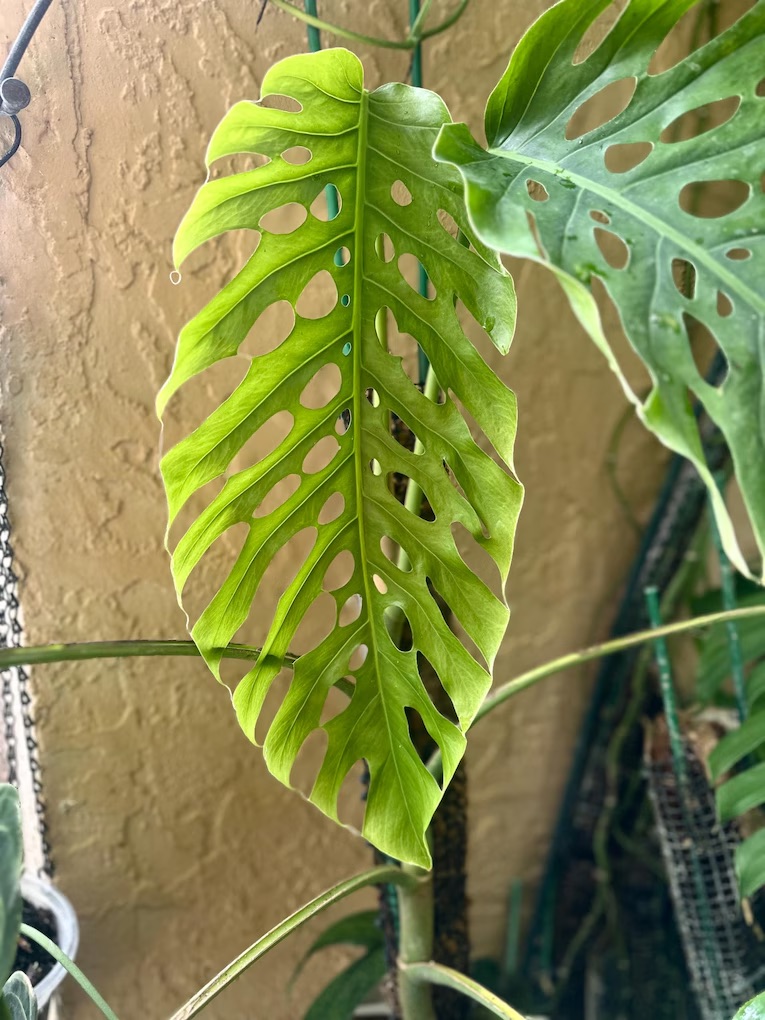
No feature of Monstera has attracted more popular attention or more confident misinformation than leaf fenestration — the holes and splits that characterize mature M. deliciosa, M. obliqua, M. adansonii, and their relatives. The prevailing explanation passed between growers — that holes allow wind to pass through large leaves without tearing them — has some theoretical support but probably isn't the whole story.
A more compelling hypothesis centers on light distribution. In a high-canopy position where sunbeams are intermittent and directional, a solid leaf the size of a M. deliciosa adult blade would shade its lower leaves severely. Fenestrations allow dappled light to fall through to older growth. There is also evidence that large leaves with holes require less investment in photosynthetic tissue to produce than a solid leaf of equivalent span — an efficiency argument that favors the perforated design once a plant has climbed high enough to generate leaves worth making expensive.
Monstera obliqua takes the fenestration argument to its logical conclusion, producing leaves that are, in some specimens, more hole than blade — a lacework of tissue that barely holds together. Growing an obliqua to that degree of perforation in cultivation requires genuinely high humidity, a solid climbing surface, and the patience to let the plant ascend rather than trail. It is one of those species that will tell you immediately whether your conditions are adequate. The leaves do not lie.
Cultivating the Transformation
The single most reliable way to encourage a shingling juvenile to mature is to give it something credible to climb. A moss pole with consistent moisture runs a close second to actual cork bark, and actual cork bark runs a close second to a living host. The plant's aerial roots need to make genuine contact with a humid substrate; a dry bamboo stake does not count. M. dubia grown on a flat wall in low humidity will remain juvenile indefinitely, a two-inch-leafed disappointment, regardless of how old it gets.
Lighting matters as much as structure. Bright, indirect light — something in the range of 200 to 400 foot-candles for a growing juvenile, with the option to push higher once the plant has established on its pole — accelerates the transition to adult growth. The plant needs to sense that it has arrived somewhere worth leafing out. A dark corner tells it to keep climbing and stay small. Adequate light tells it to stop hoarding and spend.
Substrate and root health underpin everything else. An airy mix — something in the range of forty to sixty percent perlite or pumice, with orchid bark and a small amount of coco coir to hold moisture without compacting — keeps the roots oxygenated and active. Wet, dense soil will stall a Monstera at any growth stage. The plants that stall in their juvenile phase are almost always rooted in something too retentive, growing in light that's too dim, climbing nothing substantial. Fix two of those three and the plant will often begin to move within a single growing season.
Species Worth Following Through
Not all Monstera transformations are equal in spectacle. M. dubia is the canonical showpiece of the shingling-to-fenestrated arc, its adult form producing leaves with silver variegation and eventual perforations that bear no visual relationship to its tiled juvenile state. But M. standleyana — sometimes sold as M. 'albo variegata' in its splashed white form — also shifts substantially between juvenile and adult growth, broadening and darkening as it climbs, with variegation patterns that become less predictable and, in good specimens, more dramatic.
Monstera lechleriana occupies a middle register: less extreme in its juvenile shingling than dubia, but producing adult leaves with fenestrations arrayed in a way that distinguishes it clearly from adansonii, despite frequent misidentification. Growing it alongside a correctly identified adansonii on adjacent poles is a useful exercise — the differences in leaf texture, hole placement, and eventual size become legible in a way that photographs don't quite capture.
If you want the full theatrical arc — maximum contrast between what you start with and what you end up with — M. dubia remains the answer. Buy a small shingling cutting, establish it on a cork slab with consistent moisture, give it 300-plus foot-candles of indirect light, and wait. The plant will tell you when it's decided to change. That moment, the first oversized leaf unfurling away from the bark on a real petiole, is one of the more quietly satisfying things cultivation has to offer.
What the Glow-Up Reveals
There is a tendency, in collector culture, to fetishize the juvenile form — to seek out small, tiled cuttings of M. dubia or M. karstenianum precisely because they look unusual and sell well. The irony is that the juvenile phase is, biologically, temporary and purposeful. The plant does not want to stay small and tiled. Given adequate conditions, it will leave that form behind without sentiment.
This creates an interesting tension in cultivation. The collector who optimizes for the juvenile aesthetic — keeping the plant root-bound, limiting light, growing it on a surface that doesn't allow real attachment — is, in effect, holding the plant in a kind of developmental suspension. The plant will stay juvenile longer under those conditions. Whether that is good husbandry or bad is a question worth sitting with.
The more instructive approach is to let the plant do what it is built to do: ascend, transform, produce leaves that no longer fit the original photograph. A Monstera dubia that has successfully climbed to its adult form is a record of good conditions over time — of humidity sustained, of a pole kept moist through the dry months, of light dialed in and maintained. The adult leaf is not just a pretty object. It is evidence.
Reading the Plant
Every phase of Monstera growth, from germinating seedling through tiled juvenile to fenestrated adult, is a legible communication from the plant about its environment. A shingling juvenile that has been climbing the same six inches of pole for eight months is telling you something — usually that the pole is too dry, the light too low, or the roots too constrained. An adult leaf that emerges smaller than its predecessor is telling you that conditions have declined since the last interval of growth. The size and health of successive leaves is a growth log more honest than any notebook.
This is what separates serious cultivation from casual keeping. The grower who notices that the third leaf after the transition was larger than the fourth, traces it back to a month of lower humidity during a dry winter, and adjusts — that grower is having a different relationship with the plant than someone who waters on a schedule and hopes for the best. Monstera, perhaps more than any other common aroid genus, rewards the kind of attention that reads change as information rather than inconvenience.
The shapeshifter metaphor is apt, but it undersells the determinism involved. These plants are not changing randomly. They are tracking their environment precisely and responding with structure. The fenestrated adult leaf on your pole is, in a very real sense, a portrait of the conditions you provided — and an argument for providing them again.