You find it on a seller's page: a trailing stem, fenestrated leaves marbled with cream, listed simply as Monstera adansonii variegated. The price is significant — two figures, maybe three, depending on the variegation percentage and the seller's confidence. You've seen it before, or something like it. Except that last one had narrower leaves with a more pronounced drip tip. And the one before that had almost circular lobes, holes punched closer to the margin. Different plants, identical label.
The umbrella of Monstera adansonii has stretched to cover at least several distinct entities that botanists and serious collectors regard as separate species or at minimum stable morphological forms. Add variegation, which commands its own premium regardless of what's underneath it, and you have a category where provenance is murky, taxonomy is contested, and buyers are frequently paying species-specific prices for a name that describes a complex rather than a single plant. Understanding what you're actually buying requires knowing something about the complex itself.
What the Name Actually Covers
Monstera adansonii Schott was described in 1830, and the name has since become a catch-all that serious aroid taxonomists have argued about for decades. The plants sold under that label in the hobby trade span at least three morphologically distinct groups: the narrow form, associated with Central and South American populations and characterized by elongated leaves with a pronounced acuminate tip; the round form, with broader, nearly orbicular leaf blades whose fenestrations sit closer to the midrib; and the so-called Indonesian or Archipelago form — sometimes listed as Monstera adansonii var. laniata — which has larger leaves, a glossier finish, and a growth habit more reminiscent of a juvenile deliciosa in its vigorous extension.
The round form and narrow form are both commonly sold as adansonii in the US and European markets without any further qualification. They hybridize readily in cultivation, which means many plants in the trade represent an intermediate between the two, and distinguishing a true round form from a crossed-out intermediate requires close attention to petiole geniculum length, the angle of the leaf base, and the positioning of fenestrations relative to the midrib. This is not splitting hairs for its own sake. These forms propagate differently in the sense that they grow at different rates, reach different mature sizes, and — critically for collectors — do not look identical when variegated.
The Indonesian form is the largest and the most vigorous. Given a pole or a tree fern slab with consistent moisture, it will push leaves that approach thirty centimeters in length under good conditions. Its fenestrations are often fewer and larger than those of the narrow or round forms, and its petioles are proportionally longer. Whether it represents a true species — Monstera laniata Schott, described from Sulawesi material — or a regional variety of adansonii remains contested. For collectors, the important practical point is that a plant sold as 'Indonesian adansonii' or 'Archipelago form' is genuinely different from what most people picture when they hear the name.
Variegation reveals the plant's structure the way raking light reveals brushwork — it doesn't change what's underneath, but it makes you look harder.
Variegation in a Fenestrated Leaf
Variegation and fenestration together produce a particular visual tension that makes this group unusually photogenic and unusually difficult to grow well. A leaf that is both holed and sectored — meaning half the blade is green and half is cream or white — is losing photosynthetic capacity through two independent mechanisms simultaneously. The holes remove blade tissue entirely. The white sectors contain no functional chloroplasts. A heavily variegated adansonii with large, sector-type variegation on a form with aggressive fenestration may be pushing leaves that are sixty or seventy percent non-productive, and the plant is generating those leaves on the energy reserves of whatever green tissue remains.
The variegation pattern itself varies significantly across the complex. The narrow form tends to throw sector variegation — crisp, paint-stroke divisions between green and white — while the round form more often shows a speckled or half-moon pattern, with cream freckling across the blade rather than clean divisions. Neither pattern is more stable than the other in an absolute sense; both are the product of chimeral tissue in the meristem, and both will revert or intensify depending on light, temperature, and the developmental luck of each new growth point. Expecting consistent variegation percentage from a chimeral plant is expecting the wrong thing.
What makes the Indonesian form distinctive in variegated expression is the sheer leaf size. A sectored Indonesian-form leaf at twenty-five centimeters has more visible contrast than a narrow-form leaf at twelve, and the larger green panels tend to keep the plant more metabolically stable. If you are choosing between a heavily variegated narrow-form cutting and a lightly variegated Indonesian-form cutting at similar prices, the latter will likely be easier to grow into a full plant — not because the variegation is more stable, but because there is simply more working tissue to sustain the climb.
The Indonesian Form Specifically
The plant sold in the hobby as 'Indonesian adansonii' or sometimes 'Monstera adansonii Archipelago' entered the Western collector market in meaningful numbers around 2019 and 2020, driven by Indonesian exporters who had access to wild-collected or nursery-propagated material that looked visibly different from the South American forms already in circulation. The leaves are broader relative to their length, the surface has a higher gloss, and the adaxial venation is more prominent — you can see the secondary veins as slight ridges when the leaf is backlit.
Variegated Indonesian-form material is rarer in the trade than variegated narrow or round forms, partly because the unvariegated plant is less commonly grown at scale in collector nurseries, and partly because chimeral mutations are random events that require an established cultivation base to propagate meaningfully. When you see it offered, it tends to carry a higher price point than the equivalent narrow-form cutting, which is reasonable given the relative scarcity but should not be accepted uncritically — confirm you are actually looking at the Indonesian morphology by examining petiole length, leaf width-to-length ratio, and surface texture before committing.
A genuine Indonesian-form plant is a strong grower under the right conditions: an airy mix of pumice, perlite, and chunky bark with a moss pole for aerial root attachment, humidity at sixty-five percent or above, and enough light to push photosynthesis without scorching the white sectors. Given those conditions, it is considerably more forgiving of the metabolic cost of heavy variegation than the smaller forms, which is not the same thing as saying it is easy — only that it has more resilience to work with.
Round Form Versus Narrow Form in Practice
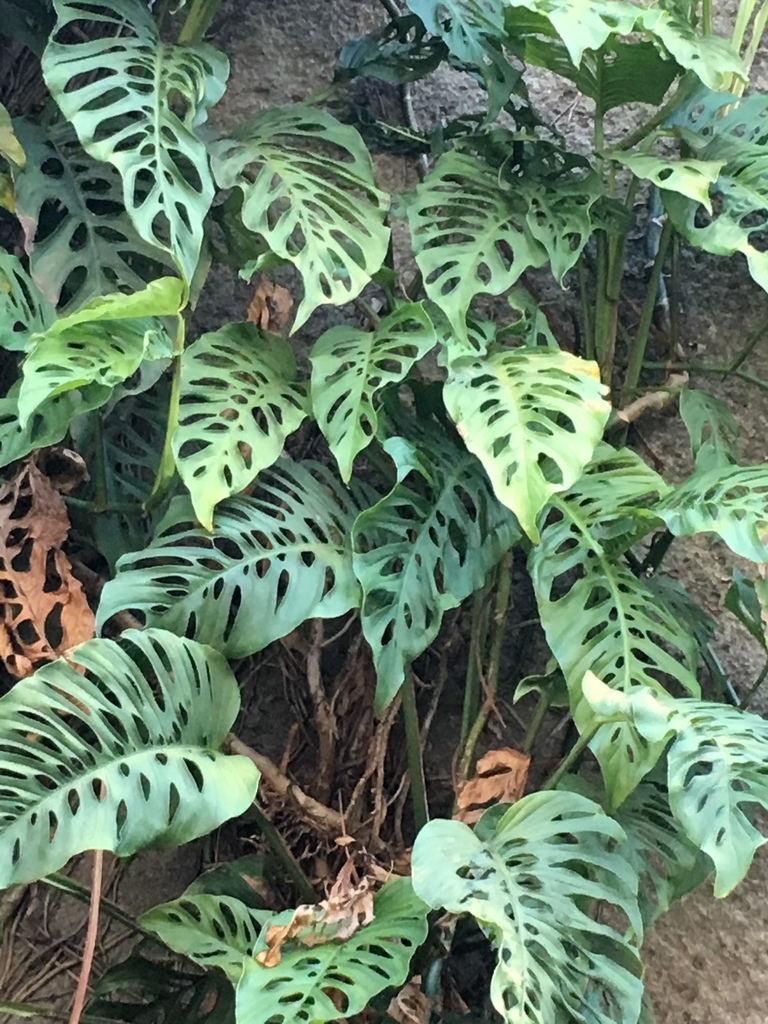
The round form is the one most collectors encountered first, typically acquired as an unvariegated hanging basket plant from a big-box garden center — though those plants are almost certainly hybrids rather than true round forms. The true round form has a leaf blade in which the width-to-length ratio approaches one-to-one on mature leaves, with fenestrations arranged in one or two irregular rows flanking the midrib. The petiole inserts at a point noticeably off-center on the blade base, giving the leaf a slight asymmetry that the narrow form does not share as obviously.
The narrow form, by contrast, has a strongly acuminate apex — the leaf tip draws out into a sharp drip point — and fenestrations that are elongated and fewer in number. Under high light it pushes new growth quickly, sometimes putting out a new leaf every two weeks on a healthy cutting. Variegated narrow-form material tends to be the most commonly available in the trade, and also the most variable in variegation expression, ranging from nearly all-white leaves that will not sustain the plant to deep green with only a few cream flecks. Selecting cuttings with approximately thirty to fifty percent variegation, with some visible green on every leaf, gives you the best odds of a cutting that will grow rather than stall.
Whether you prefer the round or narrow form is partly aesthetic and partly horticultural. The round form's broader blade shows speckled or half-moon variegation to greater effect — the cream reads as a pattern rather than a stripe. The narrow form's variegation is more graphic, more high-contrast. Neither is superior; they are different plants that happen to share a genus and a sales label.
Variegation Reveals the Underlying Structure
There is something genuinely clarifying about seeing a plant in variegated form. The cream or white panels, stripped of chlorophyll, make the vein architecture visible in a way that an all-green leaf does not. On a variegated adansonii backlit by a grow light, you can count the secondary veins, trace the angle at which they leave the midrib, see where the blade tissue thins toward the margins. Variegation reveals the plant's structure the way raking light reveals brushwork — it doesn't change what's underneath, but it makes you look harder.
This has a practical side. Collectors who study their variegated adansonii closely often develop a better eye for distinguishing the forms than those who work only with green material. The Indonesian form's secondary venation is more prominently expressed than the narrow form's, visible as subtle raised lines on the adaxial surface. The round form's cream sectors tend to be distributed more symmetrically around the midrib, reflecting the blade's bilateral symmetry. These are not diagnostic characters in a formal botanical sense, but they are useful field marks for the collector trying to identify what they actually own.
What to Ask Before You Buy
Given how loosely the name is applied, anyone spending real money on variegated material in this complex should treat the listing name as a starting point rather than a description. Ask for photographs of the petiole, not just the blade — the geniculum length and petiole cross-section (round versus flattened) vary across the forms and are harder to fake than leaf shape. Ask whether the plant is a rooted cutting or an unrooted node; unrooted nodes carrying heavy white sectors have a poor survival rate and should be priced accordingly. Ask about the parent plant if possible, and whether the seller has observed stable variegation across multiple growth cycles or whether the cutting is from a single variegated flush on an otherwise green plant.
The variegated adansonii complex rewards patience in acquisition. A rooted, actively growing cutting with moderate, stable variegation on a confirmed Indonesian or round form will outperform, over eighteen months, a cheaper unrooted node with spectacular-looking sectors that never establish. The price per leaf on the one you can actually grow is almost always lower than the price per leaf on the one you lose.
None of this is an argument against buying these plants. The combination of fenestration and variegation is genuinely unusual in the genus — Monstera produces very few naturally occurring chimeral forms in cultivation, and the adansonii complex produces more of them than most. But the purchase deserves the same scrutiny you would give any significant acquisition: know the morphology, know the source, and know what the variegation percentage means for the plant's ability to sustain itself. The name on the tag is not enough information.
Growing the Variegated Forms Well
Substrate and airflow matter more for variegated adansonii than for the green species because the plant cannot afford the additional stress of root rot or anaerobic conditions. A mix of sixty percent inorganic material — pumice, perlite, or lava rock — and forty percent organic material such as fine bark or coir keeps the roots oxygenated and dries quickly enough to prevent bacterial pressure at the root zone. Avoid pure sphagnum for long-term growing; it retains too much moisture and collapses over time, cutting off air exchange.
Light is the variable most collectors underestimate. Bright indirect light is the standard advice, but for a heavily variegated plant the practical requirement is closer to eight hundred to twelve hundred foot-candles for ten to twelve hours per day — achievable in a south- or east-facing window in summer, or under a quality LED grow panel set at an appropriate distance. Below that threshold, the plant will grow slowly enough that each new leaf represents a significant metabolic expenditure, and any that come in mostly white will set back the plant considerably. More light, within the tolerance of the white sectors, means more growth and more opportunity to select for the next leaf's variegation.
Aerial root attachment accelerates all of this. The adansonii complex wants to climb; given a moss pole maintained at consistent moisture, it will send thick aerial roots into the pole and begin pushing larger leaves within two or three growth cycles. Larger leaves mean larger green panels even at the same variegation percentage, which means more photosynthesis and faster recovery from white-heavy leaves. The moss pole is not decorative — it is part of the growth strategy.