There is a moment, maybe three or four leaves into growing Monstera siltepecana, when you realize the plant on your shelf is not the plant in the photos you were chasing. The juvenile leaves — narrow, lanceolate, sheened in dusty blue-silver with darker veins pressed into the surface like watermarks — are genuinely striking. They look less like a common houseplant than like something pressed between glass in a botanical archive. You bought it for those leaves. But the plant is already planning its exit from that phase, and if you let it, it will become something else entirely.
That transformation is the whole story of siltepecana. It is a species that most collectors encounter as a trailing juvenile and grow for years without ever seeing what it is actually capable of. Give it a pole, a slab of cork, a rough-barked post — give it something to grip — and the leaves lengthen, widen, and eventually split into fenestrated adults that look far more like a classic Monstera and far less like the silver waif you started with. The gap between those two phases is wider in siltepecana than in almost any other species in the genus, and that gap is what makes it interesting.
Where It Comes From
Monstera siltepecana is native to southern Mexico and Central America, with confirmed populations running from Chiapas through Guatemala and into El Salvador and Honduras. The species was described by Engler in 1899, named for the Siltepec district of Chiapas. It grows as an epiphytic hemiepiphyte in humid montane and submontane forests, starting life as a ground-level creeper and shingling up tree trunks as it matures — a growth strategy it shares with several other Monstera species but executes with particular visual drama.
The range matters because populations are not uniform. Plants collected or propagated from different parts of Central America show measurable variation in leaf shape, silver intensity, and mature fenestration pattern. This is not unusual for a wide-ranging species, but it became commercially relevant once collectors started paying attention to one specific population in particular.
Wild plants grow in conditions that most collectors can only approximate: year-round warmth, high ambient humidity, rainfall that comes in patterns rather than random waterings, and the dappled light of a closed forest canopy. The forest floor juveniles receive very little direct sun. The climbing adults, once they reach the canopy margin, get considerably more. Understanding that gradient is useful when you are deciding where to put the pot.
Give it something to grip and the silver waif becomes a fenestrated adult — two plants in one, separated only by altitude on a pole.
The 'El Salvador' Form
At some point in the past decade, cuttings began circulating in the collector market under the name Monstera siltepecana 'El Salvador'. The name is informal — it does not correspond to a registered cultivar, and the taxonomy does not recognize it — but it stuck because it describes something real. Plants sold under this label tend to produce larger juvenile leaves with more pronounced silvering, a more distinct dark green venation against the blue-grey ground, and a generally more ornamental appearance than standard nursery-trade siltepecana, which is often grown from tissue culture or mass-propagated cuttings of uncertain provenance.
Whether 'El Salvador' represents a genetically distinct population, a particularly well-grown clone, or simply better-selected cuttings that got a geographic name attached to them is genuinely unclear. Reputable sellers who have grown both side by side report consistent differences in leaf size and silver intensity, which suggests some real underlying variation. But the name has also been applied loosely enough that buying 'El Salvador' from an unknown vendor is no guarantee of anything except a higher price.
The practical advice is to buy from sellers who can show you leaf photos of the mother plant, not stock images. A true standout juvenile siltepecana has a leaf surface that reads almost metallic in indirect light — not pale green with a vague sheen, but a coherent silver-blue that holds color even as the leaf matures. If you are paying a premium, you should be able to see the premium before you pay it.
What the 'El Salvador' discussion reveals more than anything is how attuned the siltepecana collector community has become to intraspecific variation — the same attention that Philodendron gloriosum growers bring to round versus elongated leaf forms, or that Anthurium crystallinum growers apply to vein width and leaf finish. Species-level taxonomy is a starting point, not the end of the conversation.
The Juvenile Phase: What You Are Actually Buying
In its juvenile trailing form, siltepecana produces leaves that are roughly lanceolate to elliptical, typically 8–15 cm long in a well-grown pot plant, with a surface texture that is slightly bullate — gently puckered between the veins. The primary venation is a deep matte green, almost olive, while the interveinal tissue holds that characteristic silver-blue. The underside is plain pale green. Petioles are slender, with a slight channeling on the adaxial surface.
These leaves do not fenestrate. They will not fenestrate no matter how large the pot or how good the fertilizer. The splits and holes of mature siltepecana are not a function of age or nutrition alone — they are triggered by the plant's climbing habit. A siltepecana that trails horizontally, or hangs in a basket, will continue producing juvenile-form leaves indefinitely. This is not a failure of cultivation; it is how the species works. Juvenility is maintained by the absence of a vertical structure to climb.
This is worth understanding before you buy. Many people grow siltepecana as a trailing plant for years, love the silver leaves, and never feel the need for more. That is a completely legitimate way to grow the species. But if you are waiting for fenestrations to appear on a hanging basket, they will not come.
What Climbing Does
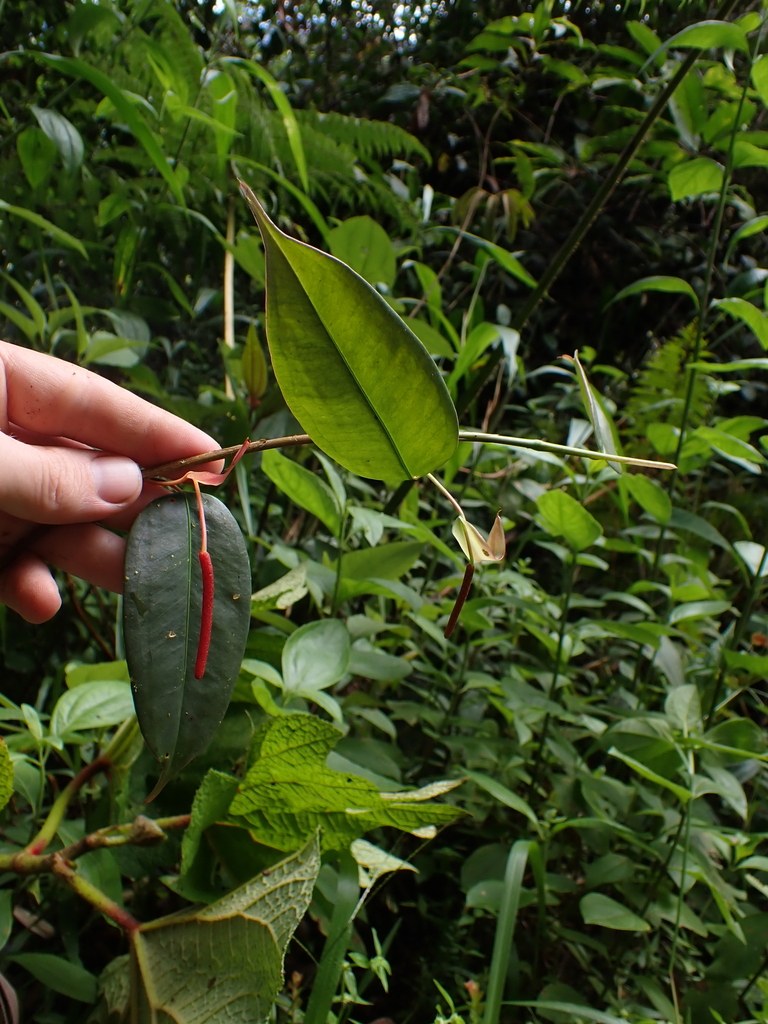
Mount siltepecana on a moss pole, a coir pole, or — better still — a slab of rough cork bark, and the leaves begin to change within a few growth cycles. The petioles shorten relative to the blade. The blade widens. The silver recedes from the center of the leaf outward, replaced by a deeper, more uniform green. After several more nodes, the leaf edges begin to undulate, then to lobe, then — given enough height and time — to develop the pinnatifid fenestrations that look unmistakably like a small Monstera deliciosa in silhouette.
The adult leaves can reach 30–40 cm in ideal greenhouse conditions, though most indoor climbers top out somewhat smaller. They are no longer particularly silver. The plant that looked like a botanical curiosity as a juvenile now looks like a competent, handsome climbing Monstera, more interesting than a standard adansonii and with better leaf texture, but no longer the ethereal blue-grey thing you started with.
The transition is not instantaneous and not always linear. Some nodes will produce intermediate leaves — widening but not yet fenestrated, still holding a ghost of silver in the margins. These transitional leaves are often the most compelling of all, and they are the ones most likely to appear in photographs captioned simply as siltepecana without any qualification about growth stage. The species has essentially three distinct visual identities, and most images show only one of them.
The quality of the climbing surface matters. Cork bark, with its irregular texture and some moisture retention, produces the fastest and most committed aerial root attachment. A smooth plastic pole may get reluctant root contact. Some growers tie early nodes loosely to encourage contact, then let the roots grip on their own. The goal is genuine attachment — roots that are pulling moisture from the medium — rather than a plant that is leaning against a pole.
Care Without Shortcuts
Siltepecana is tolerant by Monstera standards, but tolerant does not mean indifferent. It prefers bright indirect light — the kind of light that throws a soft shadow — and will grow slowly and lose silver intensity in lower conditions. Direct sun through glass will scorch the juvenile leaves; the silver surface seems to concentrate heat in a way that plain green leaves do not.
Substrate should be airy and fast-draining. A mix of coco coir, perlite, and coarse bark in roughly equal proportions works well. The plant wants consistent moisture while actively growing but should not sit in wet media for extended periods. Root rot is possible, and the thinner roots of juvenile plants are more vulnerable than the stout aerial roots that develop on mature climbers. In winter, or in lower light conditions, let the top half of the pot dry before watering again.
Humidity above 60% keeps the leaves looking their best and encourages the aerial root development that makes climbing possible. Below 50%, the leaf tips of juveniles can brown at the margins — not dramatically, but enough to be annoying. A pebble tray, a humidifier, or proximity to other plants all help. Airflow is equally important; stagnant humid air is where fungal issues start.
Feed lightly during active growth — a balanced liquid fertilizer at half strength every two to three weeks is sufficient. Siltepecana does not need aggressive fertilization to perform well. More important than feeding is giving it enough light and something to climb.
Propagation and Patience
Stem cuttings root readily. A single node with a healthy leaf and at least one developing aerial root, placed in sphagnum moss or directly into a well-aerated substrate, will establish in three to five weeks under warm, humid conditions. Water propagation works but tends to produce roots that are poorly adapted to substrate; moss or perlite gives a better transition.
Collectors propagating the 'El Salvador' form should take cuttings from the most silver, most ornamental juvenile nodes rather than from climbing sections already past the transitional phase. If you want to preserve the juvenile look — in a separate pot, as a trailing plant — take cuttings before those nodes commit to the climbing program. A cutting taken from high on a mature climber will continue producing adult-phase leaves even without a pole, at least for a while, though it tends to revert toward juvenility over several growth cycles if left to trail.
Patience is required either way. Siltepecana grows at a moderate pace indoors — not as slow as Philodendron gloriosum or some of the ornate anthuriums, but not as fast as Monstera adansonii at peak summer growth. Give it a season to establish after repotting before expecting strong new growth.
Why It Holds the Collector's Attention
Monstera siltepecana is not the rarest plant in the genus. Tissue culture has made standard juvenile plants widely available at accessible prices, and even the 'El Salvador' form is not difficult to find if you follow collector groups for a few months. What keeps it interesting is not scarcity but behavior — the way it encodes so much visual change into a single lifespan, the way it demands a decision from the grower about what kind of plant they actually want it to be.
A trailing siltepecana is a silver-leaved curiosity, beautiful on a shelf. A climbing siltepecana is an architectural plant that will eventually reach your ceiling and produce leaves the size of your forearm. Those are different commitments, and the plant itself does not make the choice. You do, by giving it a pole or withholding one. Very few species in cultivation offer that kind of forking path so clearly.
That dynamic also makes it a useful gateway species. Collectors who start with siltepecana — drawn in by the silver, curious about what climbing does — often find themselves thinking differently about the other members of the genus. They start looking at Monstera standleyana, at M. lechleriana, at the various climbing forms that reward vertical growth with transformed leaves. The question of what a plant becomes, given the right conditions, is one of the more compelling questions in the hobby. Siltepecana poses it plainly.