The listing went up at 9:02 on a Sunday night and read, in full: Anthurium BVEF x papi NSE, F2 sib cross, mother pictured, $480 shipped CONUS, no holds. Within four minutes it was gone, and somewhere in Ohio a person was refreshing a sold-out page wondering what, exactly, they had just failed to buy. Not the species — that part was obvious. The grammar around it was the problem.
Rare-aroid selling has developed its own pidgin over the last decade, a compressed shorthand that lets growers cram parentage, generation, provenance, and breeder lineage into the 80 characters of an Instagram caption. To outsiders it looks like a license plate. To collectors it's a contract. Learn to read it and a $480 seedling either becomes a steal or a polite pass — but at least you know which.
Why the shorthand exists at all
Most houseplants are clones. The Monstera deliciosa in your kitchen and the one in your neighbor's kitchen are, genetically, the same plant — a cutting taken from a cutting taken from a stock plant in a Florida tissue-culture lab. Provenance is irrelevant because there is no variation to discuss. A deliciosa is a deliciosa.
Rare anthuriums and the velvet philodendrons broke this model. Most of the prized species — Anthurium papillilaminum, A. forgetii, A. dressleri, A. luxurians — root poorly from cuttings, lose vigor in tissue culture, or simply aren't being mass-propagated. They're grown from seed. And seed-grown aroids segregate: siblings from the same pod can show wildly different leaf shape, venation contrast, blade thickness, and bullate texture. One seedling looks like the cover of a Dewey Fisk monograph; its littermate looks like a slightly disappointing andraeanum.
So when you buy a seedling, you aren't buying a known quantity. You're buying a probability distribution defined by the parents. The shorthand exists to describe those parents — and the cross itself — with enough precision that a buyer in Portland can evaluate a seedling pod produced in Bangkok without ever seeing the mother plant in person.
The shorthand isn't gatekeeping. It's the only honest way to describe a plant whose value lives almost entirely in its parents.
Breeder initials: BVEF, NSE, EC and the rest
The strings of capital letters that prefix or follow a species name are almost always breeder or grower codes. BVEF is Bob Voorhees, an American grower whose papillilaminum and dressleri stock has become foundational; a BVEF mother means seedlings descended, somewhere, from his lines. NSE refers to Natural Selection Exotics, a Florida operation known for serious papillilaminum work. EC in anthurium circles often signals Enid Offolter's NSE-adjacent material or, depending on context, Ecuagenera stock — and the ambiguity itself is a useful lesson: codes are not standardized, and the same letters can mean different things in different communities.
Other initials you'll see: JM (Jay Vannini's lines, particularly the Guatemalan dressleri and luxurians material), PT (Peter Rockstroh, in older dressleri provenance discussions), EM for Equatorial Exotics. None of these are trademarks. They're conventions, passed grower to grower, and they collapse a lot of context into two or three letters: who selected the parent, what their selection criteria were, and how long the line has been worked.
The honest sellers use the codes the way a winemaker uses an appellation — a claim that needs to be backed by photos of the mother, ideally the father, and sometimes a cross date. The dishonest ones use them as flavor text. If a listing says BVEF but the seller can't tell you which BVEF mother the seed came from, that's not a pedigree. That's marketing.
F1, F2, sib crosses, and the math of inheritance
F1 means first filial generation: the seedlings produced by crossing two distinct parents. If someone crosses a wild-collected papillilaminum from Panama with a separate wild papillilaminum from a different population, the resulting seedlings are F1. F1 plants from two strong, unrelated parents often show hybrid vigor — they grow fast and look uniform.
F2 is what you get when you cross two F1 siblings, or self-pollinate an F1. This is where segregation gets dramatic. Recessive traits that were hidden in the F1 reappear, which is why breeders run to F2 when they're trying to fix a specific look — heavier bullation, darker velvet, narrower sinus. It's also why F2 batches are gambles. You might get the best plant of the decade. You might get a runt with thin leaves and a crooked petiole.
A sib cross is exactly what it sounds like: pollen from one sibling onto the stigma of another. It tightens the gene pool. BC or backcross means crossing a hybrid back to one of its parent species, usually to reinforce a trait from that parent. None of this is exotic — it's the same vocabulary orchid and rose breeders have used for a century. Aroid people just adopted it later, and use it on Instagram instead of in stud books.
Selfed, OP, and the question of fatherhood
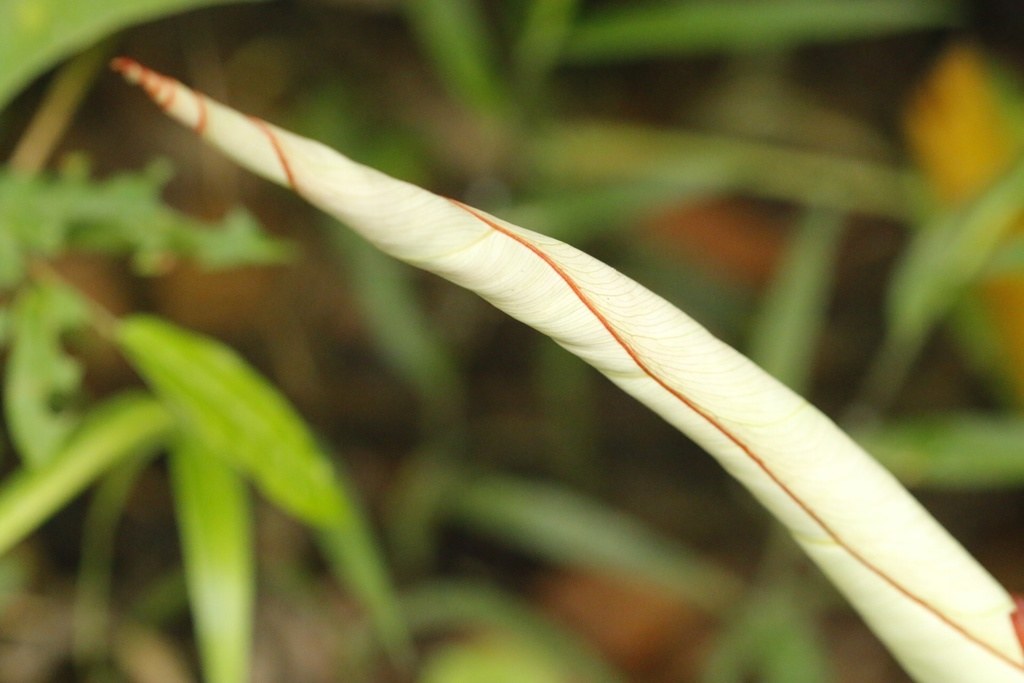
Selfed (sometimes written self or S1) means the plant was pollinated with its own pollen. Anthurium inflorescences are protogynous — the female phase precedes the male phase — so true selfing requires the grower to collect and store pollen from an earlier male phase and apply it during a later female phase, sometimes on the same plant, sometimes on a different inflorescence. Selfed seedlings are genetically narrow, which makes them useful for stabilizing a line and risky for vigor.
OP means open-pollinated: the grower didn't control the pollen source. In a greenhouse with multiple flowering anthuriums and a stray thrips population, OP seed could be anything. Reputable sellers disclose OP status. Less reputable ones quietly sell OP seedlings as if they were a known cross, which is how the market ends up with a generation of mystery papillilaminum × who-knows-what plants being passed off as pure species.
If a listing says papillilaminum selfed, the seedlings should be reasonably uniform and recognizably the species. If it says papillilaminum × papillilaminum with both parents pictured, even better. If it just says papillilaminum seedlings with no parent info — assume OP, assume some doubt, and price your bid accordingly.
The species-versus-hybrid question
A lot of what's sold as species in the rare-aroid market is, strictly, hybrid. Anthurium 'Dark Phoenix', 'Quechua Queen', 'Michelle' — these are named hybrid grexes, often with papillilaminum on one side and something like dressleri or luxurians on the other. Listings will sometimes write them with a multiplication sign (papillilaminum × dressleri) and sometimes just slap a cultivar name on the pot.
The shorthand here matters because hybrids don't come true from seed. If you buy a seedling labeled 'Dark Phoenix' and the seller produced it by selfing a 'Dark Phoenix' mother, you're getting an F2 of a hybrid — a genetic shuffle that may or may not resemble the parent. That's not necessarily bad. Some of the most interesting plants in collections right now came out of exactly that lottery. But it should be priced as a lottery ticket, not as a guaranteed copy of the famous mother.
The cleanest sellers distinguish between species (both parents the same species, ideally with locality data), intraspecific crosses (different forms of one species), and interspecific hybrids (two different species). When that distinction collapses in a listing, the price should collapse with it.
Locality codes and the ghost of wild collection
Occasionally you'll see a place name appended: dressleri Cerro Brewster, papillilaminum Cerro Jefe, luxurians Chocó. These are locality references — points on a map in Panama or Colombia where the original wild material was collected, often decades ago, often by a small handful of named botanists and explorers. A locality tag is a provenance claim: this plant descends, through however many generations of greenhouse propagation, from a specific wild population.
Locality matters because populations vary. Cerro Jefe papillilaminum tend to have one look; lowland Darién material tends to have another. Collectors who care about preserving distinct wild forms — and not blending them into a generic greenhouse soup — track locality the way wine people track vineyards. The shorthand is how that tracking survives a sale.
It's also where the market gets most prone to invention. There is no registry. No one is auditing whether a 'Cerro Brewster' seedling actually descends from Cerro Brewster material. You're trusting the chain of custody, and the chain is only as strong as the growers in it. Which brings the whole vocabulary back to where it started: the codes are useful only insofar as the people using them are honest, and the only way to know that is to spend enough time in the community to learn whose word means something. The shorthand is the surface. The reputation underneath it is the actual currency.