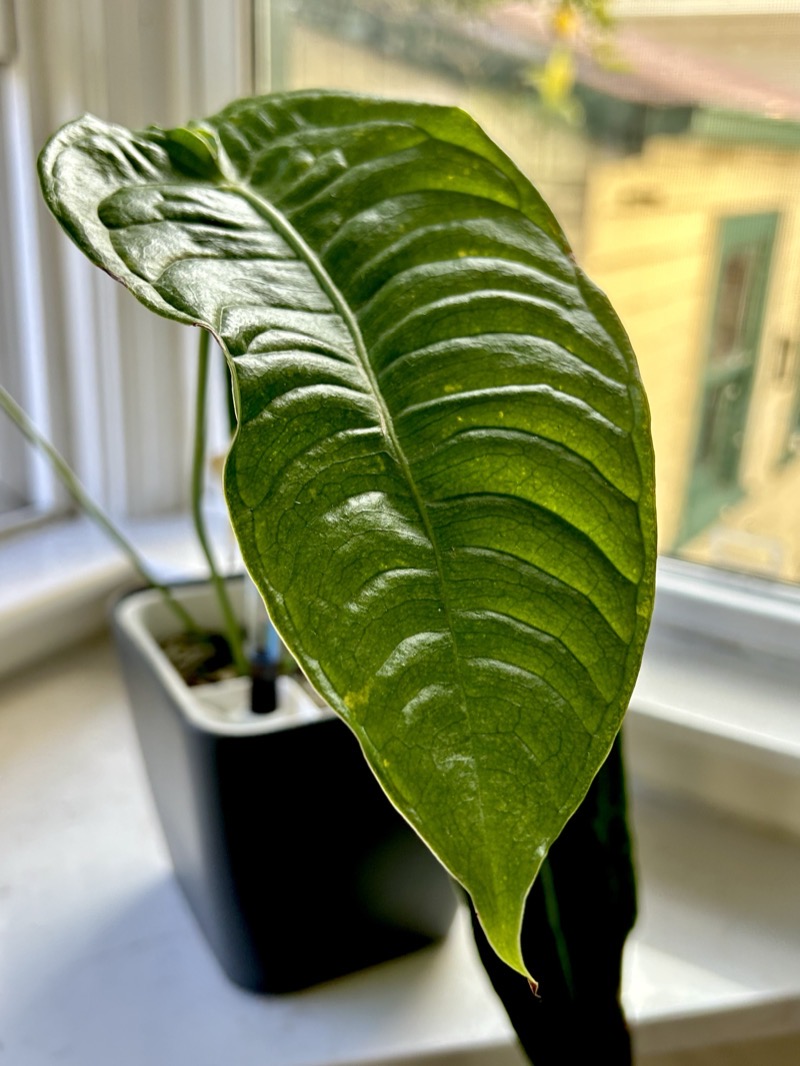
There is a moment, familiar to anyone who has grown Anthurium veitchii seriously, when you realise the pot is no longer the point. The pot is almost irrelevant. What matters is the leaf — the one unfurling now, pale green and tightly accordion-folded, like a letter that has been folded and refolded until the creases have become the message. It will take weeks to fully extend. When it does, it may reach a metre and a half, hanging in a long, corrugated strap from a stem no thicker than a finger. You will have to move something else to make room for it.
That is the deal with the King Anthurium. Anthurium veitchii does not share space politely. It dominates whatever structure you have built, pendulous leaves cascading from a mounted board or a hanging basket, each one a small engineering marvel of parallel ribs and glossy corrugation. Serious collectors clear shelves. They rebuild wire racks. They raise ceilings in grow tents, metaphorically if not literally. The plant is not difficult to keep alive — its requirements are specific but achievable — yet it will test the physical limits of your setup long before it tests your horticultural skill.
Named for Chelsea, Found in Colombia
Anthurium veitchii was formally described in 1876 by the botanist Heinrich Gustav Reichenbach, who named it in honour of the Veitch nursery — the celebrated Chelsea firm of James Veitch & Sons that spent much of the nineteenth century sending collectors into equatorial forests and returning with plants that astonished European horticulture. The Veitches introduced hundreds of species to cultivation; that one of the most spectacular aroids carries their name is fitting and, given the plant's sheer scale, not entirely surprising.
The species is native to the Colombian cloud forests, primarily in the departments of Antioquia and Chocó, growing as an epiphyte at elevations roughly between 1,000 and 2,000 metres. At those altitudes, temperatures rarely exceed 25°C and rarely fall below 13°C. The forest drips. Humidity is not a variable — it is a constant. Moss accumulates on everything. Roots reach into pockets of organic debris wedged into bark, not into soil in any conventional sense. Veitchii grows dangling from steep slopes and vertical trunks, its leaves hanging free of any surface, catching the diffuse light that filters through the canopy above.
Understanding that origin geography explains almost every care decision you will need to make. The plant has never in its evolutionary history experienced a hot, dry afternoon. It has never sat in waterlogged substrate. It has always had airflow — the cloud forest moves, mist rolls through, the canopy breathes. Growing veitchii in a static, humid box without ventilation is asking it to live in a place it has never been.
A veitchii leaf is essentially architecture: parallel ribs, a long pendulous drape, and corrugation deep enough to cast its own shadow.
The Leaf as the Whole Point
Most anthuriums are grown for flowers, or for the interplay of leaf texture and colour — the silver tessellation of Anthurium crystallinum, the near-black velvet of Anthurium papillilaminum. Veitchii is grown for one thing: the length and architecture of its leaves. Mature specimens in optimal conditions produce leaves that routinely reach 90 centimetres to 1.2 metres, and in exceptional cases approach two metres. These are not broad, open leaves. They are strap-shaped, with a high length-to-width ratio, and their surface is so deeply corrugated — ridged between parallel lateral veins — that a single leaf held to the light looks like a folded silk ribbon. The corrugation is not merely decorative; it increases the surface area of a leaf that would otherwise be too narrow to capture sufficient light.
New leaves emerge almost white, sometimes with a faint blush of pink at the midrib, and they harden off over several weeks to a deep, glossy green. The transition is one of the genuine pleasures of keeping the plant — watching a pale, tightly pleated spear slowly unfurl and deepen in colour is a slow-motion event that rewards the kind of attention that collectors tend to pay anyway. The petioles are long and stiff, holding the leaves out from the mount before they bend under their own weight and begin to drape downward. A plant with four or five mature leaves simultaneously in different stages of this progression looks, from across a room, like a living waterfall.
The spathe and spadix are present, of course — veitchii does produce inflorescences — but they are modest, greenish-cream, and most growers barely register them. Nobody is growing this plant to pollinate it for the fruit. They are growing it for the leaves, full stop.
The Narrow Form and Wide Form Debate
Ask a room of veitchii collectors whether they prefer the narrow form or the wide form, and you will learn something about the collector's disposition toward restraint versus spectacle. The two forms — neither formally recognised as distinct varieties in the botanical literature, but consistently differentiated in the hobby — differ primarily in the width of the leaf blade relative to its length. Narrow-form plants produce leaves with a more pronounced strap shape: slimmer, more pendulous, with a certain austere elegance. Wide-form plants produce leaves that are noticeably broader, the corrugation spread across a more generous blade, giving the leaf a more immediately dramatic presence.
Neither form is inherently superior. The narrow form rewards long-term commitment — its leaves, given sufficient length, drape with a particular gravity that wide-form plants rarely match. The wide form, at a younger or smaller size, tends to look more immediately impressive; the proportions resolve sooner. Collectors who sell plants often prefer wide-form seedlings because they photograph better early on. Collectors who grow for decades tend to develop affections that are harder to explain and more resistant to photography.
What complicates the debate is that seedling-grown veitchii is variable. Plants grown from seed — crosses made in cultivation, or seed from wild-collected specimens — do not reliably reproduce either form. A flat of ten seedlings may produce six narrow-form plants, three intermediate plants, and one that leans wide. Tissue culture has changed availability significantly, bringing the price of entry-level plants down, but it has also introduced more uncertainty about what form a given batch will express at maturity. The serious collector grows on, observes, and decides later.
Mounting, Substrate, and the Logic of Epiphytic Roots
Veitchii can be grown in a pot, but growing it mounted is not an affectation — it is closer to the plant's actual experience of being alive. A tree fern panel, a cork slab, or a rough-barked wooden mount allows the roots to grip a surface, spread laterally, and access air between watering events. The roots of epiphytic anthuriums are adapted to rapid drying after saturation; they are not built for prolonged contact with moisture. A mounted plant that dries within 24 to 36 hours of watering is a plant in conditions it recognises.
For collectors committed to potting, the substrate must be exceptionally airy. A mix built around chunky orchid bark (medium or coarse grade), perlite, and a small proportion of sphagnum or coco coir can work, but the emphasis must be on structure and drainage. Anything that compacts, holds moisture uniformly, or excludes airflow from the root zone will cause problems over months even if it looks fine in the short term. Top dressing with long-fiber sphagnum to retain surface moisture while the core of the mix drains freely is a common approach among collectors who grow in baskets.
Baskets — open-sided, wire or wooden slatted — are arguably the best compromise between mounting and potting. Roots can exit the basket laterally and grip the outside surface. The open structure allows the substrate to breathe. Hanging the basket means the leaves can hang freely without contact with a bench or shelf. The plant's whole morphology makes more sense when it is elevated.
Light, Temperature, and Humidity in Practice
The Colombian cloud forest does not deliver direct equatorial sun. It delivers bright, diffuse, consistent light, often through mist and canopy cover. In a grow room, this translates to bright indirect light — 200 to 400 foot-candles is a reasonable target — from a quality LED panel positioned to avoid hot spots. Veitchii does not need supplemental lighting to grow, but it grows faster and produces larger leaves when light is consistent. In a north-facing apartment with no supplemental lighting, the plant will survive but progress slowly.
Temperature is where the cloud forest origin matters most. Veitchii is not a lowland tropical plant. It tolerates warmth — mid-20s Celsius are fine — but it does not need or particularly benefit from high temperatures, and it dislikes heat above 28°C. It is also one of the more cool-tolerant anthuriums in cultivation; healthy specimens handle 13 to 15°C without damage, which makes winter management in poorly heated spaces less fraught than it would be for, say, Anthurium besseae or Anthurium regale. Some collectors run their veitchii slightly cooler than the rest of their collection deliberately, to simulate altitudinal conditions and slow fungal pressure.
Humidity above 65% is the standard recommendation, and 70 to 80% is better. Critically, humidity must be paired with airflow. Still, humid air above 80% for prolonged periods invites fungal problems — bacterial infections at the petiole base, botrytis on new growth in cool conditions. A small fan running continuously at low speed does more to keep veitchii healthy than any specific humidity target.
The Long View of Growing Veitchii
Veitchii is a plant that unfolds slowly across years, not months. A juvenile plant, six months from a tissue culture flask, has small, relatively narrow leaves that look nothing like the mature form. The corrugation is there — it is always there, even on the smallest leaves — but the proportions are wrong. The length-to-width ratio is off. The drape is absent because there is not enough blade to drape. Collectors who buy a young plant and expect transformation in a season will be disappointed. Collectors who understand that they are making a three-to-five year investment will find the patience easier.
The reward, when the leaves begin to reach their genetic potential, is in the weight of the thing. A full-size veitchii leaf has a physical presence that photographs do not convey. The corrugation creates shadows along each rib. The leaf moves differently from other plants — not fluttering in air movement, but swaying, slowly, as a single unit. The glossiness is structural, not decorative; it is the same wax layer that sheds water in a dripping cloud forest. Standing next to a large specimen in good health, you feel the scale of the leaves before you consciously register it.
There are flashier anthuriums in the current collector market — species with extraordinary velvet texture or dramatic silver venation that photograph better on social media and turn over faster in private sales. Veitchii has always appealed to a different kind of collector: one who is growing for the long arc of the plant's life rather than for the moment of acquisition. That disposition is worth examining. The King earns its name incrementally, over years, in the actual growing.
Provenance, Access, and What to Look For
Wild-collected veitchii material circulated in the European and American hobby for decades before Colombian export regulations tightened and CITES oversight of aroid collection became more consistent. Much of the named stock in cultivation — plants described as 'wide form' or 'narrow form' by specific sellers — traces back to that earlier period of collection, grown on through multiple generations of division or seed. The provenance of any given plant is difficult to verify, and the labels attached to forms in cultivation should be understood as descriptive rather than documentary.
Tissue-cultured veitchii is now widely available from laboratories in Southeast Asia and increasingly from domestic producers in the United States. The quality is variable. Some TC batches acclimate cleanly and grow vigorously once established; others show slow establishment, unusual susceptibility to bacterial rot during the transition out of agar, or variable expression at maturity. Buying from a seller who has grown their TC plants on for at least six months before offering them — past the vulnerable early acclimation phase — substantially reduces risk.
What to look for in a healthy specimen at any size: roots that are white to pale tan and firm, not grey and collapsing; new growth that is pale and tightly furled but upright and structurally sound; no soft patches at the petiole base, which is where bacterial rot typically initiates. A plant showing one large, healthy, mature leaf and one emerging new leaf is in good condition regardless of overall size. A plant covered in many small, yellowing leaves with no visible new growth is not, regardless of what the seller says about its form.