Somewhere in a grow tent in the Pacific Northwest, under a bank of LED bars dialed to 60% intensity, a single Anthurium papillilaminum leaf is unfurling. The grower watching it has paid more for cuttings of this plant than for their last bicycle. They have a spreadsheet. They have opinions about which Panamanian collection the mother plant came from. They are, by any reasonable measure, obsessed — and they are not alone.
Anthurium papillilaminum is not the rarest velvet anthurium in circulation. It is not the most expensive. What it is, arguably, is the most consequential: the species whose genes appear, directly or at one remove, in a staggering proportion of the dark-leaf velvet hybrids that have defined high-end anthurium collecting over the last decade. Understanding it means understanding where the obsession came from, why provenance suddenly matters as much as phenotype, and what it costs — in money, in time, in ideological commitment — to chase a plant whose identity is now genuinely contested.
What the Leaf Actually Does
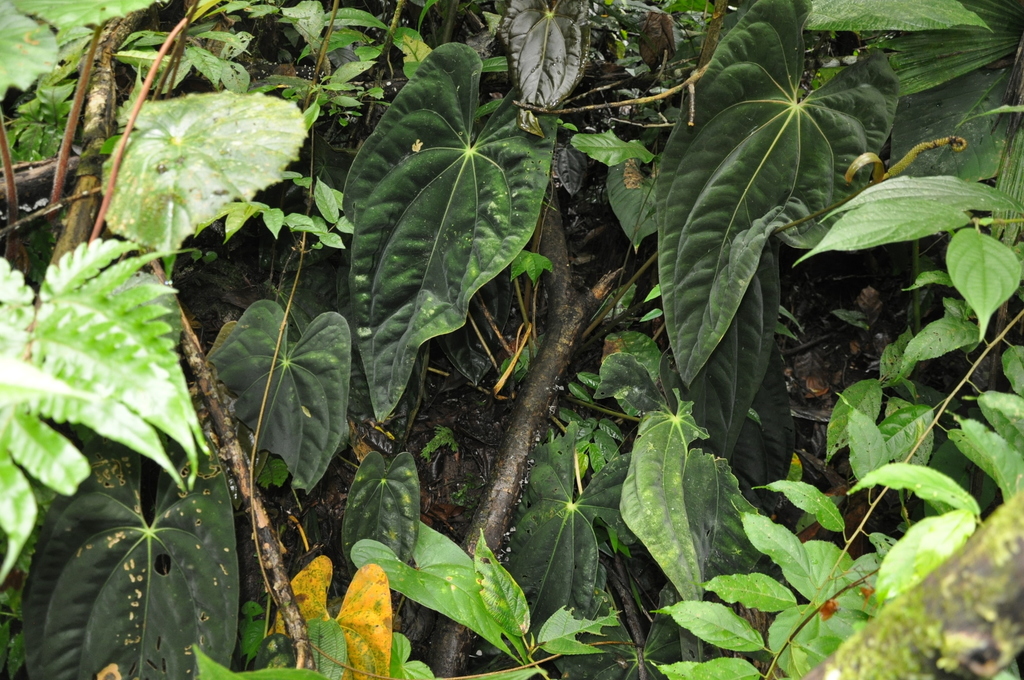
Anthurium papillilaminum is native to Panama, collected from wet montane forest in habitats that run cool and humid through most of the year. The leaf is cordate to sagittate, deep olive-green to near-black at maturity, and covered in microscopic papillae — tiny surface protrusions that scatter light and produce that signature matte velvet finish. Under magnification the papillae are dense and regular, more so than in most of the other velvet species collectors commonly grow. This is not merely aesthetic. In the forest, the texture likely aids water shedding on a near-vertical leaf face; in a grow room, it is the single trait breeders have spent years trying to concentrate and intensify.
The venation on a mature papi runs pale silver-green, with primary lateral veins that are subtly sunken, and the contrast between vein and blade deepens as the leaf ages and darkens. A young leaf can emerge a flushed copper-bronze, which makes the full adult form — a near-black matte panel with restrained silver architecture — feel like an earned result rather than an accident of genetics. That developmental arc is part of why papi hybrids are so collectible: the juvenile form is already beautiful, and the adult form is different and frequently better.
The petiole is terete, medium-length, and lacks the pronounced geniculum flare of some related species. Spathe and spadix are unremarkable; this is not a species anyone grows for its bloom. What the flowers do is produce pollen and ovules, and that is where the plant's commercial and cultural importance lies entirely.
The leaf surface of a true papi is so densely papillate it reads as matte velvet under a loupe — not a metaphor, a structural fact.
How It Became the Velvet Backbone
The velvet anthurium hybrid wave did not begin with papillilaminum, but papi arrived at exactly the right moment. Breeders working in Central America, the Philippines, and Indonesia in the early 2010s were already crossing Anthurium crystallinum with A. magnificum and hunting for darker, more velvety phenotypes in the offspring. A. papillilaminum offered something neither of those species had in abundance: extreme papillate density on a naturally dark blade, in a plant that proved relatively tractable as a pollen donor. Cross papi onto crystallinum and you frequently get offspring with better velvet than either parent. Cross it onto magnificum and you can push the blade color darker while retaining the broad, almost shield-shaped leaf.
The hybrid Anthurium 'Ace of Spades' sits at the center of this story. Whether it is a direct papillilaminum × crystallinum cross or involves a further-removed parent depends on which breeder you ask, and several breeders have claimed or implied authorship at various points. What is not disputed is that the phenotype — near-black, densely velvety, with pronounced silver veins — reads as heavily papillilaminum-influenced, and that its commercial success created enormous demand for the parent species itself. Collectors who wanted the child suddenly also wanted the parent, for the same reason a wine buyer becomes interested in terroir after discovering a bottle: you want to know where something came from.
That logic cascaded. Anthurium 'Ninja', various 'Dorayaki' phenotypes, the darker selections within what the trade loosely calls 'Black Velvet' anthuriums — all carry papillilaminum lineage to varying degrees, documented or presumed. By 2019 or so, papi had gone from a specialist curiosity to something closer to a foundational text: a species collectors felt they had to understand, and to own, in order to understand what they were already growing.
The Provenance Problem
Here is where it gets complicated. Anthurium papillilaminum in cultivation exists in multiple distinct lines, and those lines are not equivalent in phenotype. Plants from older Central American collections — material that entered specialist hands before the hybrid boom — tend toward larger adult leaves, darker blade color, and denser papillation than material that was propagated rapidly through tissue culture labs during the 2019–2022 surge in demand. Whether this reflects genuine genetic variation within the species, or the expected phenotypic plasticity of a forest plant suddenly grown under controlled conditions by people optimizing for throughput rather than trait expression, is genuinely unclear.
What is clear is that the collector community has responded by developing an almost archival concern with line provenance. Serious growers will ask: Is this Ecuagenera material? Is it from the Selby or Marie Selby Botanical Gardens accessioned lines? Is there documentation? The questions are not always answerable, and the market rewards confident claims regardless of whether documentation exists. This creates obvious incentives for misdescription, even unintentional misdescription — a vendor who genuinely believes their plant is old-collection material because that is what they were told has no way to verify the claim.
The result is a two-tier market in which 'true papi' commands a premium over 'papi' without elaboration, and in which buyers invest significant energy trying to distinguish real provenance from post-hoc story. The honest answer, which few vendors offer, is that unless a plant traces directly to a documented accession — a botanical garden record, a named collector's original purchase receipt — the lineage is inferred, not confirmed.
Growing Papi in a Temperate House
Set aside provenance for a moment and consider the plant as a living thing that needs specific conditions to do its best. Anthurium papillilaminum in the wild experiences temperatures roughly between 16°C and 28°C year-round, high ambient humidity, and the kind of bright but deeply filtered light that comes through a closed-canopy forest understory. In a grow room, that translates to: 65–80°F (18–27°C), relative humidity at 70–80% with consistent airflow, and light levels around 50–150 foot-candles of indirect or diffused LED — enough to fuel decent growth without bleaching or desiccating the papillae that give the leaf its character.
Substrate should be chunky and free-draining: a blend of orchid bark, perlite, and a small proportion of coco coir will move water fast enough to prevent the root rot that kills more papi plants than any other cause. The roots are moderately thick, not as coarse as an A. veitchii or A. warocqueanum, and they want to stay moist between waterings without sitting in saturated media. Letting the mix approach dryness — not bone dry, but approaching it — before watering again is sound practice.
Where growers go wrong is usually humidity without airflow. High humidity in a stagnant environment promotes bacterial and fungal rot on the petiole and spathe. A small circulation fan running on a timer, or continuously at low speed, does more to keep plants healthy than a fog machine. The velvet surface of the leaf does not need misting; ambient humidity is sufficient, and direct water on the blade can cause spotting that is purely cosmetic but irritating given what the plants cost.
What Breeders Are Doing With It Now
The first wave of papi hybrids prioritized dark color and velvet texture. The second wave, which is still underway among the breeders paying closest attention, is more nuanced. Growers in Indonesia and the Philippines — where the anthurium hybrid trade operates at industrial scale relative to the hobbyist collectors in Europe and North America — are now crossing papi-influenced lines back onto species with unusual venation patterns: Anthurium luxurians, with its bullate, almost quilted blade; A. forgetii, which lacks the posterior lobes of most anthuriums and has a clean, formal outline; and various undescribed or informally named collections from Colombian and Peruvian cloud forests.
The goal is not simply darkness or velvet, but a more complex surface: the papillation of papi on a blade architecture borrowed from another species, with venation that is clearly patterned rather than merely present. Whether this represents artistic ambition or market calculation — or both — the results are genuinely novel. Some of the F2 selections from these programs show phenotypes that neither parent species anticipates, which is part of what makes hybrid breeding in this genus so difficult to predict and so easy to chase.
The risk, acknowledged openly in forums and less openly in sales listings, is genetic dilution of the papi character itself. When you back-cross a hybrid that is 50% papi onto another species, the offspring carry 25% papi genetics, and the papillate density that made the original parent valuable may not express strongly at that concentration. The breeders who understand this are working with larger populations, selecting hard for texture at each generation. The ones who don't are selling F1 crosses as 'papi hybrids' and letting buyers discover the limits of that description when the plants mature.
The Ethics of the Label
There is a conversation that runs beneath the collecting community like a fault line, surfacing periodically in forum threads and DMs: at what point does a hybrid described as 'papi' carry enough of the actual species to justify the name? No formal standard exists. The trade uses 'papi hybrid' to describe anything from a direct F1 cross with documented parentage to a multi-generation selection whose connection to papillilaminum is genealogical memory at best.
This matters for several reasons beyond pride. Buyers who pay premium prices for papi-adjacent genetics and receive plants that express minimal velvet or dark coloration feel, reasonably, that they were misled — even if no lie was technically told. The compressed nomenclature of the collector trade, where an evocative name does the work of a full species description, is efficient until it isn't, and then it damages trust in exactly the vendors and communities that the hobby depends on.
A simpler convention would help: F1 crosses labeled as such, with both parents named where known; multi-generation hybrids described by their most recent documented cross rather than by a great-grandparent's name. Some vendors already do this. More should. The plants are interesting enough to sell on their actual merits — the specific traits they express at maturity, the documented parents, the growing conditions that produced the mother plant — without leaning on a species name as shorthand for quality.
Why It Stays Worth Chasing
None of the provenance anxiety, the naming confusion, or the market volatility has reduced interest in Anthurium papillilaminum as a species. If anything, the complications have deepened it. Collectors who started with a hybrid and worked backward to the parent find themselves in possession of a plant that rewards close attention: the papillae that change with humidity and light angle, the slow darkening of the blade over eighteen months or more, the occasional offset from the base that can be removed for propagation once it has two or three leaves and a visible root.
There is also the fact that growing a species — a real, documented, field-collected species with a Panamanian forest at the far end of its lineage — satisfies something that a hybrid, however beautiful, does not quite reach. Hybrids are arguments about what a plant could be. The species is what it is. The two enterprises are not opposed, and most serious growers pursue both, but they feel different in practice. A healthy A. papillilaminum in a well-maintained setup, leaves properly dark and matte, is a complete thing in a way that few manufactured phenotypes are.
The breeders who use it will keep using it. The collectors who track its lineage through hybrids will keep tracking. And somewhere, in that Pacific Northwest grow tent, the new leaf is almost fully expanded now — cordate, dark, papillate, expensive — and the grower with the spreadsheet is already deciding which plant to put next to it.