There is a moment, the first time you see a mature Anthurium clarinervium leaf flattened under a grow light, when the word 'leaf' stops feeling adequate. The surface is dark green, almost matte, and the veins are white — not pale, not cream, but the particular white of old bone or unglazed porcelain. The shape is a broad, blunt heart, deeply cordate at the base. Most collectors encounter that species first and think they have understood something. Then they find Anthurium crystallinum, which does the same trick in a larger register, and they revise their understanding upward. And then, eventually, they find the round ones.
A small group of velvet anthuriums produces leaves that are nearly perfect discs — peltate, with the petiole attaching not at the margin but somewhere near the center of the blade. Anthurium dressleri, A. папилламинум, and a handful of undescribed or rarely circulated species sit in this corner of the genus. The geometry is so clean, so insistently circular, that growers who encounter it for the first time often assume they are looking at a cultivated selection, something tissue-cultured toward an ideal. They are not. The shape is wild-type. Evolution arrived there first.
What Peltate Actually Means
Botanists use 'peltate' for any leaf where the petiole inserts away from the margin — somewhere on the lower surface of the blade rather than at its edge. The word comes from the Latin for shield, pelta, and the shield analogy holds: the leaf is held out from the stem like a buckler, presenting its full face rather than hanging from a corner. In most anthuriums the petiole meets the blade at a sinus, that notch between the two basal lobes. Pull the lobes away, close the gap, migrate the attachment point inward, and you arrive at the peltate condition. It sounds simple as a geometric operation. As a developmental fact it involves significant changes in how the lamina expands during growth.
The lobes of a cordate leaf are not decorative. They represent the two halves of the blade base that bracket the petiole. When a leaf is peltate, those lobes are, in effect, dissolved — the blade closes behind the petiole, completing the disc. What you lose in the peltate condition is the classic aroid silhouette. What you gain is a surface with no interruption, no notch, no asymmetry at the base. The vein network, which in a cordate leaf fans out from a single point at the sinus, instead radiates from the point of petiole insertion like spokes from a hub. In Anthurium dressleri, under good light, you can trace every primary vein from that central hub to the leaf margin without the eye snagging on a lobe or a gap.
This matters aesthetically in a way that is hard to articulate without sounding mystical, but the mathematics are real. A circle is the shape with the highest ratio of area to perimeter. A peltate disc-shaped leaf is, among leaf forms, unusually efficient at presenting surface. The bone-white veins that collectors prize in the velvet anthuriums — the contrast against that dark, light-absorbing lamina — read most dramatically when the surface they cross is unbroken.
The geometry is so insistently circular that growers assume they are looking at a cultivated selection. They are not. Evolution arrived there first.
Anthurium dressleri and the Problem of Provenance
Anthurium dressleri is the species most collectors mean when they talk about a truly peltate velvet anthurium. It was described by Thomas Croat in 1986 from material collected in Darién Province, Panama, in lowland wet forest. The species grows as a terrestrial or low-climbing hemi-epiphyte in deep shade, at elevations under 200 meters, in conditions that are warm, saturated, and still by the standards of most aroid habitats. The leaf on a mature plant can exceed 60 centimeters across. The velvet texture comes from the density of papillae on the upper surface — tiny epidermal protrusions that scatter light and give the blade its depth.
In the collector market, dressleri has a provenance problem that is worth naming honestly. The species is coveted enough that the name has been applied, over the years, to plants that are not dressleri — round-leafed seedlings of uncertain parentage, hybrids with crystallinum or magnificum that retain some peltation, and tissue-cultured material of unclear origin. A true dressleri should show a nearly perfect circular blade, pronounced velvet, primary veins that are clearly white against the dark green lamina, and petiolar insertion well inside the margin. If a plant is labeled dressleri but shows even a shallow sinus, it is worth scrutiny. That is not a dismissal of the plant — a well-grown hybrid can be extraordinary — but accuracy matters when plants trade for significant money.
The legitimate scarcity is real. Anthurium dressleri is not common in habitat and is poorly represented in botanical collections. Most plants in collector hands trace back to a small number of import events or to in-vitro propagation by a handful of specialized labs. Knowing the lineage of your plant — who tissue-cultured it, from what source material — is not obsessive. It is the only way to have confidence in what you are growing.
The Velvet Surface and What It Does
The velvet texture that defines this group of anthuriums — the 'velvet clade' is an informal but widely used term — is a convergent adaptation across multiple unrelated lineages within Anthurium. The papillae that produce it function as a micro-optical layer. They increase the apparent darkness of the leaf by causing light to bounce between adjacent protrusions rather than reflecting cleanly off the surface, a mechanism similar to what makes velvet fabric look darker than the same dye on a flat-woven textile. The practical effect for a plant in deep shade is an increased capture of diffuse light.
For a collector, the velvet surface also means the leaf reads differently at different angles. Move your head six inches to the left and the whole blade shifts in tone — lighter along the vein ridges, darker in the fields between. This is not an illusion but an accurate perception of a three-dimensional microstructure. It is why photographs of velvet anthuriums rarely do justice to the plant in person, and why collectors who have seen only photos are often surprised by the depth of the real thing.
In dressleri the velvet is among the densest in the genus. The papillae are tall enough that the surface has a directional quality — run a finger from the petiole toward the margin and the resistance is slight but perceptible, like very fine corduroy. This also means the surface is easily marked. A water droplet left to dry on a velvet anthurium leaf leaves a faint ring. Overhead watering on established plants is worth reconsidering for this reason.
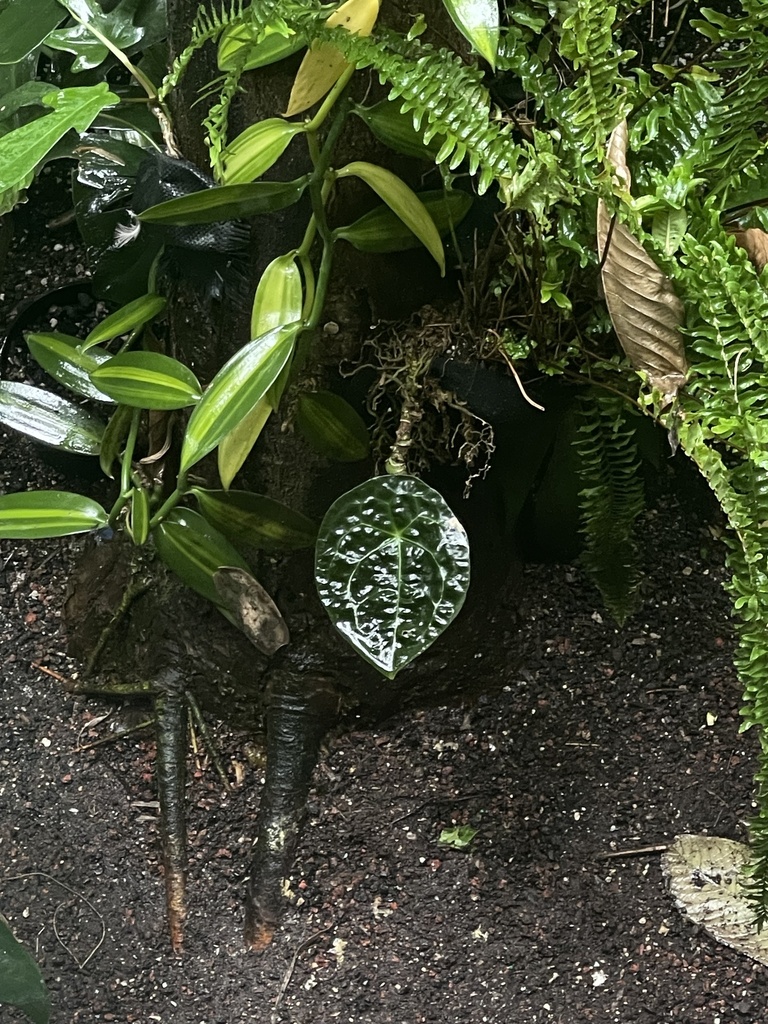
Growing Conditions That Actually Match the Habitat
Darién lowland forest sits at roughly 27–30°C during the day and drops no lower than 20°C at night. Relative humidity is persistently above 85 percent. The forest floor where dressleri grows is not waterlogged — it is well-drained, leaf-litter-deep, rich in organic matter, and aerated by the constant small movement of decomposition gases through the substrate. Understanding this matters for growing.
Collectors who kill velvet anthuriums usually do it in one of two ways: too wet at the root zone, or too cold. The second failure is less often discussed. Anthurium dressleri has no cold tolerance worth noting — sustained temperatures below 15°C will check growth and prolonged exposure to temperatures near 10°C can cause irreversible root damage. In a northern hemisphere grow room this means winter night temperatures require active management. A space that feels comfortably warm to a person can drop into the danger zone for a Darién lowland species after the lights go out.
Substrate for dressleri should be chunky and fast-draining: a base of fine-grade orchid bark, amended with perlite, a small proportion of worm castings, and perhaps some horticultural charcoal to keep the mix sweet. The goal is a root zone that holds moisture for 24–36 hours after watering and then dries — not bone dry, but without standing moisture. Roots that sit in wet media for three days will begin to deteriorate. At the right moisture cycle, the plant rewards you with new leaves on a schedule that feels almost mechanical: one flush, followed by a rest, followed by another flush, the new leaf unfurling from the cataphyll with that distinct russet-pink color before it hardens to green.
The Geometry of Other Peltate Anthuriums
Anthurium dressleri is not alone in the peltate condition, though it is the most often discussed. Anthurium папилламинум — the name is sometimes seen spelled inconsistently in trade — is a Panamanian species with a similarly circular blade but a somewhat coarser velvet texture and a more prominent central rib. Anthurium kunayalense, described from Guna Yala territory in Panama, is smaller and less frequently circulated but produces a blade that, on a mature plant, achieves an almost architectural roundness. There are undescribed collections from Colombia and Ecuador that circulate under provisional names or collection numbers, and which show varying degrees of peltation.
The interesting evolutionary question is why peltation appears repeatedly in this part of the genus and what selective pressure maintains it. The leading functional hypothesis is shade optimization: a peltate leaf held horizontally in understory conditions presents its full area to diffuse overhead light without the gaps that a deeply lobed leaf would show. Whether that explanation is sufficient or whether peltation involves other factors — mechanical stability, water-shedding, protection from herbivory — remains genuinely open. Aroid evolutionary ecology is underfunded relative to the collector interest in the plants.
What the collector can observe, without a research budget, is that peltate anthuriums in a grow room tend to orient their blades with remarkable consistency toward the primary light source. The petiole rotates. The disc tracks. On a mature dressleri with a long petiole, this movement is visible over a few days if you mark the blade position. The geometry that looks passive — a flat circle, waiting — is in fact actively managed by the plant.
What the Market Does to an Unusual Shape
When a plant has a trait as visually distinctive as a peltate disc leaf, the market for it behaves differently than the market for plants whose value is subtler. Anthurium dressleri has traded at prices that reflect genuine scarcity, genuine demand, and — at various moments — genuine confusion about what is and is not being sold. The peak prices of 2020–2021 for rare anthuriums compressed a lot of wishful attribution into plant labels. A round-leafed seedling became a dressleri. A hybrid with one peltate parent became a hybrid worth a premium.
The correction that followed brought prices down but did not entirely resolve the identification problem. Right now, a plant sold as dressleri from a reputable source with documented tissue-culture lineage trades at a fraction of the 2021 peak, which is probably close to where it belongs. It is still not a casual purchase. But the price is no longer so aspirational that it attracts the kind of misrepresentation that was common two or three years ago.
For a collector seriously considering the genus, the practical advice is to prioritize provenance over price. A cheaper plant of uncertain identity is not a bargain if it turns out to be a hybrid of no particular distinction. A more expensive plant with documented lineage from a lab with a known track record is a known quantity. The round leaf, the velvet, the white veins radiating from the hub — these are worth having accurately labeled.
The Leaf Itself, Finally
Set aside the market, the provenance questions, the care parameters. Sit with the leaf. A mature Anthurium dressleri blade held to diffuse light from a southeast-facing window in February — which is the kind of gray, oblique light that does nothing for most houseplants — will look like something drawn rather than grown. The circle is not quite perfect; leaves are not machined. But the deviation from a perfect circle is small enough that the eye corrects for it, rounds it up to the platonic form the plant is clearly reaching toward.
The white veins do not glow, exactly. They are simply white, which is rare in a leaf. Chlorophyll so completely dominates plant coloration that true white in a vein — not pale green, not cream, but white — signals an absence of pigment the eye is not accustomed to finding. Against the dark velvet field of the lamina, the effect is high-contrast in a way that feels almost like a diagram: here is a leaf, here is how it works, here are the channels.
There is a version of this observation that slides into the mystical, into talk of perfection and intention, and it is worth resisting that. The leaf is the product of selection pressure in a Panamanian forest, not of design. But selection pressure in a Panamanian forest, operating for millions of years on a lineage of understory aroids, has produced something that a person sitting in a grow room in January finds inexplicably moving. That is not nothing. It is, maybe, the whole point of collecting.