The seller's name is a string of lowercase letters and a leaf emoji. The listing is one photograph: a glass jar, a chunk of moss, a node with a half-furled cataphyll the color of wet paper. Anthurium papillilaminum, Panama line, mother plant tagged. Bidding opens at $180. Twelve minutes in, it's at $260. By the time the seller's eight-hour auction window closes — she set it to end at 10 p.m. Central, when the West Coast buyers are home from dinner — the node has sold for $415 to a buyer in Edmonton who already owns the mother's sibling.
None of this is unusual. On any given Sunday night, somewhere between two and three thousand aroid cuttings change hands on Instagram, Etsy, private Discord servers, and a handful of dedicated marketplaces. The plants are tiny. The transactions are not. And the people moving them — growers, flippers, importers, hobbyists trimming back a mother that got out of hand — have built, almost without meaning to, one of the strangest small economies in horticulture.
The Three Tiers of Seller
At the top sit the importers and the established growers — people with CITES paperwork, phytosanitary certificates, and relationships with nurseries in Ecuador, Costa Rica, Indonesia, and Thailand. They bring in stock plants, grow them out for a season or two, and sell verified cuttings with provenance: a clone code, a parent photo, sometimes a video of the mother in their greenhouse. Their Anthurium dressleri is the dressleri everyone else's dressleri gets compared to. They charge accordingly and rarely discount.
Below them is the broad middle — serious hobbyists who have grown the same Philodendron spiritus-sancti or Anthurium luxurians for three or four years, taken cuttings as the plant outgrew its space, and built a small reputation in a Facebook group or a Discord. These sellers are the spine of the market. They photograph in daylight, they pack in sphagnum and heat packs, and they answer questions about substrate ratios at length. They are usually selling to fund the next plant.
At the bottom, and growing fastest, are the flippers. They buy a four-node cutting of something rising — a year ago it was Philodendron 'Florida Beauty' variegated, this season it's been Monstera 'Mint' and a couple of the better Anthurium crosses — and they cut it into singles before it has rooted. They list each node within days. Some are honest about what they're doing. Many describe themselves as growers. The plants often arrive stressed, and the photos in the listings, more often than not, are the photos the flipper bought the cutting from in the first place.
A node is a bet on a future leaf. The market prices the bet, not the plant.
Who Is Buying, and Why
The buyer base is harder to characterize than the sellers, because almost everyone in this market is, at some point, both. But there are patterns. The most active buyers tend to be in their thirties and forties, work in tech or healthcare or design, and have either a dedicated grow tent or a converted room with IKEA cabinets retrofitted with grow lights and clip fans. They have killed enough plants to know what they are doing and bought enough to know what they want.
A smaller cohort — perhaps fifteen percent — are speculators. They buy nodes the way other people buy sneakers: hold for six months, let the plant push two leaves, resell at a markup. The math works often enough to be tempting. A $120 node of a Philodendron 'Ring of Fire' high-variegation cut, grown out into a rooted four-leaf plant, can list at $400 if the variegation holds. Half the time it reverts, and the speculator quietly takes the loss.
The rest are collectors in the older sense: people who want the plant because they want the plant. They will pay a premium for a node from a specific clone — the verrucosum with the redder petiole, the gloriosum with the wider white midrib — and they will not resell it. These buyers anchor the market. Without them, the whole thing would be flippers selling to flippers, which is a structure that does not last.
The Price Arc of a Node
Consider one cutting, tracked across a year. A grower in Florida takes a four-node section off a mature Philodendron billietiae × gloriosum — a cross with a long orange petiole and a velvet leaf — and sells it whole, unrooted, for $320 to a hobbyist in Seattle. The Seattle buyer waters it into pure sphagnum, watches one node go to mush, and is left with three viable nodes and a rooted top cut.
Six weeks later, the top cut has pushed a leaf. She lists it as a rooted, established plant for $260. The remaining three nodes, each now showing root initials, go up separately at $95, $95, and $110 — the third has a visible new leaf forming and commands the premium. Her total: $560, against a $320 outlay and maybe forty dollars in heat packs, moss, and shipping supplies. She has also kept nothing for herself.
One of those $95 nodes ends up with a flipper in New Jersey who lists it ten days later for $140, photographed against the same piece of cork bark every plant in his shop sits on. It sells in an hour. The buyer is a first-time collector who has been watching the cross for months and does not know — has no way of knowing — that the same node, two transactions ago, cost less than her wine bill from the weekend. The plant itself is fine. It puts out a leaf in three weeks. The market has done what markets do.
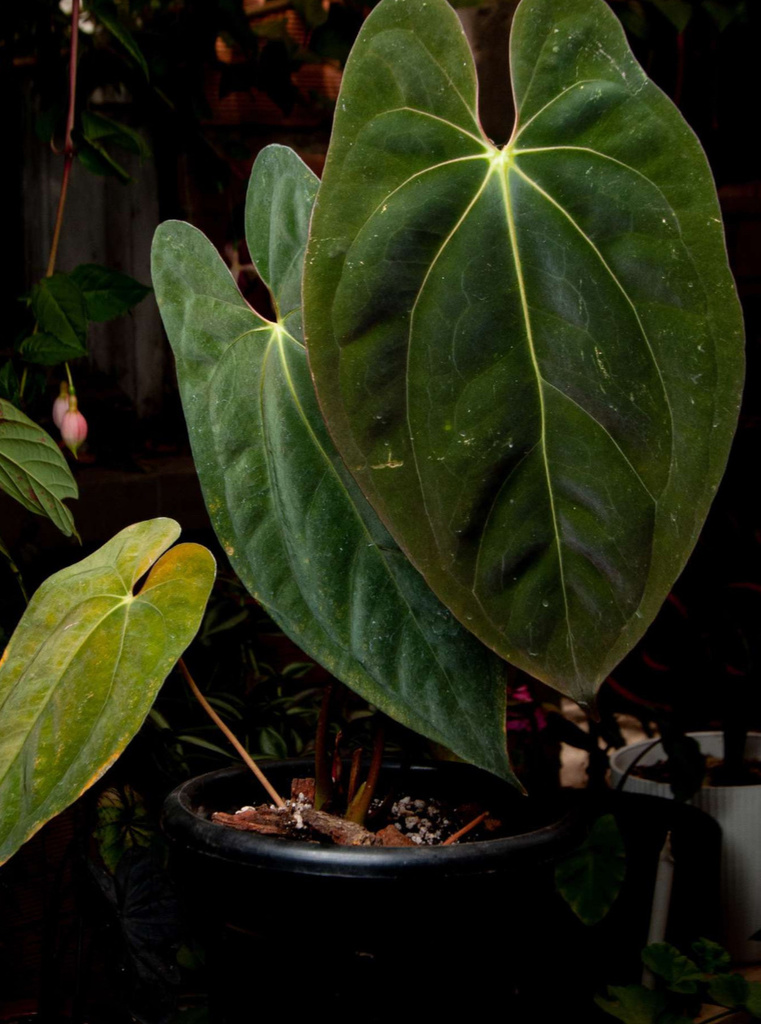
What the Photograph Is Selling
Almost nothing in this market is sold in person. The photograph is the product. A good listing photo shows the node clearly — the bump where the aerial root will emerge, the sheath of the next cataphyll, the cut clean and callused. It shows the mother plant in the background, or in a second image, with a piece of paper bearing the seller's handle and the date. This last detail, the dated paper, became standard around 2021 after a wave of stolen-photo listings on Etsy.
The best growers have, over time, developed a visual signature. You can recognize a Gabriella Plants cutting or an Ecuagenera import by the moss, the pot, the light. This is not branding in any deliberate sense. It is the accumulated evidence of someone who actually grows the plant, photographed in the same corner of the same greenhouse week after week. Buyers learn to read it. A listing without that texture — a node floating on a white background, no mother, no context — is increasingly assumed to be a flip until proven otherwise.
The Quiet Role of the Discord Server
The public auctions on Instagram get the attention, but a meaningful share of the high-end trade happens in invite-only Discord servers and the back channels of two or three private Facebook groups. Membership is by referral. The plants posted there are often unreleased crosses, sibling seedlings from a known breeder, or single specimens with documented provenance back to a wild collection permit.
Prices in these rooms can run higher than the public market, because the buyers are fewer and the certainty is greater. A $900 Anthurium seedling, F2 from a known cross, sold in a Discord drop, will not appear on a public feed. The buyer does not want to advertise the purchase, and the seller does not want twenty more requests for the next one. The room functions, in practice, as a private gallery — a way of moving rare material between people who already know each other's collections.
This is also where most of the disputes get settled. If a cutting arrives dead, or a clone turns out not to be what was advertised, the public sellers prefer to handle it inside the server rather than risk an Instagram callout. The reputational economy is tighter there. A grower who burns a customer in a Discord of three hundred serious collectors will not sell to any of them again.
What the Market Cannot Price
For all the apparent precision — the bids, the clone codes, the screenshots of past sales used as comps — the market is bad at pricing the things that matter most to the plant itself. A node cut from a stressed mother roots more slowly. A cutting shipped in February through a Memphis hub in a cold snap may look fine on arrival and decline three weeks later. None of this shows up in the listing photograph, and none of it is recoverable once the transaction has closed.
The result is a quiet inefficiency that experienced buyers learn to price in. They pay more, willingly, for cuttings from growers who refuse to ship in winter, who include a second heat pack, who note that the mother has been in their care for two years. The premium is not for the plant. It is for the absence of risk. In a market that runs on photographs of single nodes, the most valuable thing a seller can build is the boring, expensive reputation of being someone whose plants arrive alive.
The Node as a Unit of Belief
A node is not, in any honest sense, a plant. It is a swelling on a stem with the potential to become a plant, given time, humidity, and luck. The fact that a piece of tissue smaller than a thumbnail can sell for the price of a weekend hotel says less about horticulture than it does about what collectors are actually buying: the next year of their own attention, the leaf they have not seen yet, the chance to grow the thing themselves rather than buy it finished.
This is also why the market, for all its volatility, has not collapsed under the weight of its own flipping. The people at the bottom of the chain — the first-time buyer in Ohio paying $140 for a node she could have bought for $95 two weeks earlier — are not, in the end, being cheated. They are buying the same thing the grower in Florida sold: a small green bet on a leaf that does not yet exist. The price is what someone will pay to make that bet today. The plant, if it lives, will outlast every transaction it was part of.