Somewhere in the lowland Atlantic Forest of Espírito Santo state, on a slope that has probably been logged twice since anyone bothered to count, a philodendron is growing that most collectors would trade significant money — and a little dignity — to own. Its leaves run to sixty centimeters or more, a matte, heavily bullate surface the color of a storm cloud, the lateral veins sunk so deep they look like they were pressed in with a thumb. The petiole is round, pale, faintly glaucous. There is nothing else in the genus that looks quite like it in person. Photographs, and there are very few good ones, do not adequately explain why people lose their minds over it.
The plant is Philodendron spiritus-sancti, named for the state where it was first collected. The botanical record shows it described from a small population; current field estimates, depending on who is counting and how optimistically, place the number of mature wild individuals somewhere between six and a few dozen. The IUCN lists it as Critically Endangered. In the hobby, it sells — when it sells — for prices that would buy you a used car. Both of those facts are true simultaneously, and sitting with both of them is the only honest way to talk about this plant.
What the Forest Looked Like
The Atlantic Forest — Mata Atlântica — once ran continuously along Brazil's eastern coast, from Rio Grande do Norte south into Rio Grande do Sul and inland through Minas Gerais and Espírito Santo. Botanically, it was among the most biodiverse biomes on earth, a different thing from Amazonia: older in some lineages, more fragmented by geography, with enormous endemism at the species level precisely because its ridges and river valleys acted as barriers that allowed populations to diverge. Philodendrons speciated abundantly in that isolation. Philodendron melanochrysum, P. gloriosum, P. verrucosum — these are Atlantic Forest and Andean forest plants, not Amazonian ones, and the distinction matters because the Atlantic Forest is also the most destroyed biome in the Americas. Less than twelve percent of the original cover remains, and what remains is mostly fragmented.
Espírito Santo sits in the heart of what botanists call the Southern Bahian Forests, a subregion of particular endemism. Spiritus-sancti was almost certainly never common — epiphytic or hemi-epiphytic philodendrons with highly specific microhabitat requirements rarely are — but the forest that surrounded whatever populations existed is now largely gone. What remains of the wild plants is essentially stranded in a shrinking island of habitat with no meaningful corridor to allow genetic exchange or range expansion. The species did not decline because it was over-collected from the wild, though that may have played a role in accessible populations. It declined because the forest it lived in was converted to cattle pasture and eucalyptus plantations over the course of about fifty years.
A plant can be Critically Endangered and also overproduced in tissue culture; the categories are not mutually exclusive, and neither one makes the other disappear.
The First Appearance in the Hobby
Spiritus-sancti entered collector awareness slowly, then suddenly. For most of the twentieth century it was a herbarium curiosity, known from type specimens and a handful of citations in Brazilian botanical literature. It began appearing in the hands of Brazilian collectors in the 2000s, propagated vegetatively from plants of uncertain provenance — whether those founders came from wild collection, from botanic garden stock, or from some combination, is genuinely unclear and probably unresolvable now. What is clear is that by the mid-2010s, cuttings were reaching the international market, and by 2020 the price had reached a kind of absurdity. Single-node cuttings sold at auction for figures that collectors in other hobbies would find difficult to explain to anyone outside the room.
The market peak coincided with the broader pandemic-era houseplant surge, but spiritus-sancti operated in a different register from the Monstera deliciosa 'Thai Constellation' craze that was running in parallel. Thai Constellations were expensive but available; spiritus-sancti was scarce in a way that felt structural rather than logistical. There simply were not many plants. Every cutting that existed traced back to a small number of founders, and even aggressive propagation couldn't change that math quickly. The scarcity was real, which made the prices feel legitimate to buyers in a way that purely hype-driven scarcity never quite does.
Tissue Culture and the Democratization Question
Tissue culture changed the calculus. Starting around 2021, labs — primarily in Thailand and the Netherlands, with some Brazilian operations following — began producing spiritus-sancti from meristem culture. Suddenly the plant existed in quantity: not abundant, but no longer singular. Prices collapsed by sixty to eighty percent depending on the market and the seller. Collectors who had paid four or five figures for a cutting watched their investment evaporate in roughly eighteen months, which is a familiar story in the hobby and one that generates a particular species of forum grievance.
But tissue culture also raised a question that the hobby tends to skip past: what, exactly, is being cultured? With a species this genetically narrow — a captive population derived from a small number of wild founders, with essentially no documented breeding program to broaden the base — tissue culture produces genetic copies of what was already there. The plants are healthy, they are genuine spiritus-sancti, they are accessible to collectors who couldn't previously afford them. And they represent, collectively, a very shallow gene pool. A plant can be Critically Endangered and also overproduced in tissue culture; the categories are not mutually exclusive, and neither one makes the other disappear.
The conservation value of ex-situ cultivation is real but limited. Botanic gardens with documented provenance, managed breeding programs, and coordination with Brazilian institutions can make a meaningful contribution to species preservation. A tissue culture flask sold by an online vendor to a collector in Ohio contributes to awareness, perhaps, and to reduced pressure on any remaining wild plants that might otherwise be poached — but it is not conservation in any rigorous sense. The distinction matters less when you are talking about a common ornamental. It matters considerably more when the wild population may number fewer individuals than fit in a single shipment.
How to Grow One
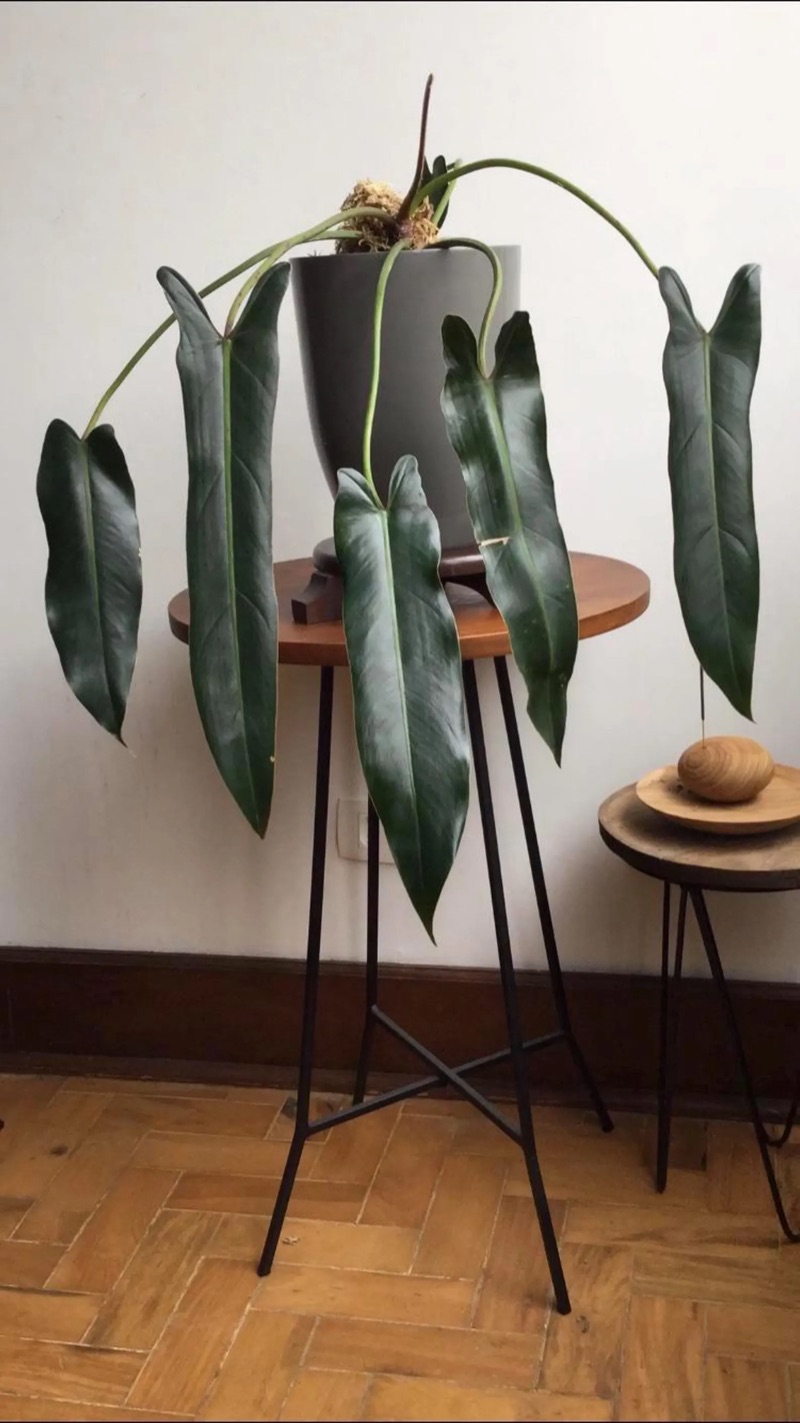
If you have a spiritus-sancti — tissue culture plantlet, rooted cutting, or something older and established — the care is demanding but not mysterious. The plant is a hemi-epiphyte from a humid lowland forest with good airflow and no dry season to speak of. It wants humidity above sixty-five percent consistently, bright indirect light (an east-facing window with supplemental LED, or a well-designed grow tent, works better than a dim interior), and a substrate that holds some moisture while draining freely. A chunky mix — coco coir, perlite, and orchid bark in roughly equal parts — is more forgiving than straight sphagnum, which holds too much moisture at the root zone during slow growth periods.
The plant climbs. Without a support, it will produce progressively smaller leaves as it searches for something to ascend; given a moss pole or a plank of cork bark it will reward you with the large, heavily bullate foliage that justifies the entire enterprise. Fertilize at quarter strength with every watering during active growth — a balanced formula with micronutrients, not a purely nitrogen-heavy one. The petioles are somewhat fragile relative to the leaf size; staking new unfurling leaves is not excessive caution. Root rot is the primary way people lose these plants, almost always traceable to a substrate that stayed wet too long in low-light or cool conditions. Keep temperatures above 18°C at night; below that and growth stalls, and prolonged cold will cause decline.
The Ethics of the Chase
There is a version of this conversation that ends with a simple prohibition: rare wild plant, don't buy it, case closed. That position is coherent but it doesn't survive contact with how plant conservation actually works, or with the genuine complexity of what it means to maintain a species ex-situ while its habitat disappears in situ. Brazilian law prohibits export of native flora without specific authorization, which means that essentially all spiritus-sancti in international collections arrived through channels that were not fully legal at some point in their history. This is also true of many other philodendrons, anthuriums, and hoyas that collectors treat as unproblematically ownable.
What changes when you name it is the nature of your relationship to the plant. Owning a spiritus-sancti and knowing its history — knowing that the wild population is critically small, that the habitat is fragmented, that the legal framework around its export was almost certainly violated — is a different thing from owning it in ignorance. The collector community is capable of holding this complexity, even if the conversation is uncomfortable. The plant is not made more or less endangered by whether you feel good about owning it. But the practice of knowing, of not performing ignorance as a form of ethical insulation, seems like a reasonable standard.
Some collectors have responded by directing money toward Atlantic Forest restoration organizations — SOS Mata Atlântica is the largest, with documented work in Espírito Santo specifically. This doesn't launder the provenance history of their plants, and it isn't meant to. It's a separate act, motivated by a recognition that the place this plant came from is worth caring about independent of the plant itself.
What the Leaf Actually Looks Like
It's worth spending a moment on the phenomenology of the thing, because the abstract rarity can obscure why this plant became a fixation in the first place. The bullation on a mature spiritus-sancti leaf is more pronounced than on a P. gloriosum and differently textured — less velvety, more structural, like a surface that has been worked rather than grown. The primary lateral veins are pale, almost silver-gray against the dark green, and they catch light from angles that other philodendrons don't. The overall silhouette is cordate with a somewhat narrow sinus, giving the leaf a slightly formal, elongated quality compared to the broad hearts of gloriosum or crystallinum.
In a collection context, the plant reads differently depending on scale. A small tissue culture specimen with three-inch leaves gives almost no indication of what it will become; you are essentially growing on faith. A mature plant with leaves approaching fifty centimeters in a well-lit space is something else — genuinely arresting in a way that has nothing to do with its price or its story. The story makes it more interesting. The leaf makes it worth the story.
A Conservation Story in Plain Terms
What Philodendron spiritus-sancti actually illustrates, stripped of the auction-price drama and the forum mythology, is a problem that will repeat across the genus and across the broader aroid hobby: the plants that are most desirable to collectors are often endemic species with narrow ranges, specific microhabitat requirements, and declining wild populations. P. joepii, found in French Guiana, is another example. P. dodsonii from Ecuador. The pattern is not coincidental — the traits that make a plant extraordinary in a collection often reflect evolutionary pressures from specific, unusual environments, and those environments are frequently under threat.
The collector community is not the cause of these declines, mostly. Habitat destruction is the cause, driven by agricultural and timber economics that operate at a scale that makes individual plant purchases look irrelevant. But the community is also not wholly separate from the story. The demand for wild-type and wild-collected plants creates incentives that reach into the forest. The premium placed on non-tissue-culture provenance — 'TC' is practically a pejorative in some circles — rewards exactly the chains of custody that are most likely to involve problematic collection. Naming this is not an accusation. It's a description of a market that the hobby participates in and could, collectively, shape differently.
None of this means stop growing philodendrons. It means grow them with the full knowledge of where they came from and what is happening to the places they came from. A spiritus-sancti in a well-maintained collection, documented, cared for, propagated responsibly, and connected in its owner's mind to the Atlantic Forest it represents — that is a different object than the same plant treated purely as a status marker. The leaf is the same. The relationship to it isn't.