There is a particular moment that serious aroid collectors remember clearly — sometimes with embarrassment, sometimes with something closer to fondness. It usually involves a dimly lit vendor table at a plant swap, or a blurry photo on a Facebook group, or a cutting shipped in damp sphagnum that arrives when you were only casually interested in houseplants. The plant in question has leaves the color of a rainforest floor after rain: deep matte green, almost black in low light, cross-hatched with veins so pale they look airbrushed. You bought it thinking you understood what it was. You probably didn't.
That plant — or the idea of that plant — is almost certainly Anthurium crystallinum. Or Anthurium clarinervium. The distinction matters more than most beginners realize and less than some veterans pretend. Both species are real, both are beautiful in specific and different ways, and between them they have done more to drag ordinary plant hobbyists into the obsessive end of aroid collecting than any other genus. Understanding why requires looking at where these plants come from, what they actually are, and what the endless confusion between them says about how collectors learn — or fail to — to see.
Two Species, One Silhouette
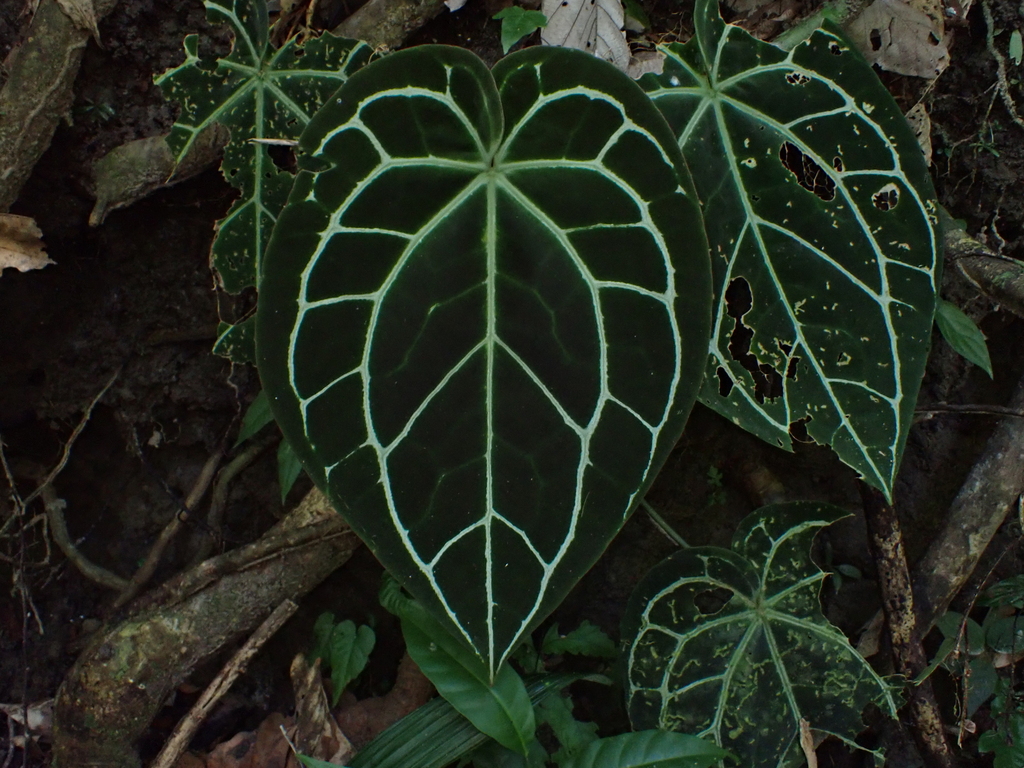
Anthurium crystallinum is native to Colombia, Panama, and parts of Peru, growing as an epiphyte or hemiepiphyte in humid montane forest, usually between 500 and 1,500 meters. The leaves are cordate, elongated, and can reach 60 centimeters or more at maturity under good conditions — broader than they are long when young, stretching longer with age. The venation is silver-white to cream, quilted into the leaf surface with that characteristic three-dimensional texture that catches light differently depending on the angle. New leaves emerge in shades of copper and burgundy before hardening off to deep green. That color shift alone is one of the things that hooks people.
Anthurium clarinervium, by contrast, is a Mexican species — endemic to Chiapas, growing terrestrially on limestone outcrops in seasonally drier forest than most anthuriums prefer. Its leaves are broader and more rounded, the white veins thicker and more boldly spaced, the texture even more pronounced. The back of a clarinervium leaf is typically pale, almost white, with prominent venation visible from the underside. A mature specimen in good health is a genuinely striking object. It is also, critically, a different plant from crystallinum in almost every meaningful way: geography, substrate preference, water requirements, growth habit.
The confusion between them is not entirely the collector's fault. Photos compress three-dimensional texture into flat images, and both plants are sold under each other's name with disconcerting frequency. A cutting labeled crystallinum at a swap may well be clarinervium, or a hybrid of uncertain parentage, or something else entirely from the velvet anthurium complex that includes species like magnificum, regale, and warocqueanum. The visual similarity, especially in juvenile leaves, is close enough that even experienced growers sometimes need a mature specimen and some botanical patience to be certain.
Every collector has a first velvet anthurium. The plant itself matters less than what it opens.
What the Petiole Tells You
Experienced collectors learn to read the petiole before the leaf. On Anthurium crystallinum, the petiole is roughly terete — cylindrical, slightly flattened on one side — and typically green, sometimes with purple tinting. On clarinervium, the petiole is more distinctly D-shaped in cross-section, with a flat or slightly concave adaxial surface and a rounded back. It's a small difference that becomes automatic once you've held both plants, and it's far more reliable than leaf shape alone.
The cataphyll — the papery sheath that protects each emerging leaf — also differs. Crystallinum cataphylls tend to persist longer and dry to a tan or brown, remaining attached to the stem for some time. Clarinervium cataphylls are similar but often shed more cleanly. Neither character is diagnostic on its own, but together with petiole shape, substrate response, and origin information, they build a picture. Botanical identification is rarely about a single feature. It's about the accumulation of details that tell a coherent story.
Hybrids complicate this further. Anthurium crosses readily under cultivation, and the velvet species in particular have been combined by hobbyist breeders chasing specific combinations of leaf shape, vein width, and manageable size. A plant sold as 'crystallinum' might carry magnificum genes that explain unusually broad leaves or a particularly thick petiole. Without provenance — ideally traceable back to a tissue culture lab or a known wild-collected parent — many plants in circulation are best described as 'velvet anthurium type' rather than assigned to a species with confidence.
The Rabbit Hole Has a Shape
Ask any collector with more than thirty species what their first anthurium was, and a significant portion will name one of these two. The gateway quality of the velvet anthuriums is not accidental. They are visually dramatic in a way that photographs well and photographs honestly — the plant in person looks like the plant in the listing, which is not true of all aroids. They are also available. Both species have been in cultivation long enough, and propagated widely enough, that they can be found at reasonable prices through reputable vendors, at local swaps, and occasionally in better independent garden centers.
The problem — or the gift, depending on your temperament — is that owning one makes you curious about the others. Crystallinum leads naturally to questions about magnificum, whose venation is similarly bold but whose leaves are larger and whose petioles are winged. Magnificum leads to regale, which can produce leaves approaching a meter in length under ideal conditions and requires either a greenhouse or a serious commitment of floor space. Regale leads to the warocqueanum, the queen anthurium, with leaves that can hang two meters in a mature specimen and whose culture requirements are unforgiving enough to separate serious growers from casual ones fairly quickly. Each species is a door. None of them is the last door.
This is the mechanism of the rabbit hole, and the velvet anthuriums are particularly effective at triggering it because they reward close observation. The more carefully you look at crystallinum — the way the venation reticulates toward the leaf margin, the particular sheen of a newly hardened leaf, the geometry of the sinus at the base — the more you want to see that same level of detail in a related species. Collecting aroids at depth is partly horticultural and partly taxonomic and partly just the pleasure of sustained attention to things that reward it.
Care That Actually Works
Both species are more forgiving than their price tags historically suggested, though neither is content with benign neglect. Anthurium crystallinum prefers conditions that mimic its montane Colombian habitat: high humidity (65–80%), bright indirect light without direct midday sun, and a substrate that retains some moisture without staying wet. An airy mix — chunky perlite, bark fines, and a small amount of coco coir or peat — drains fast enough to prevent rot while holding enough moisture to avoid the stress of complete desiccation between waterings. In practice, watering when the top third of the medium has dried works well for most growers.
Anthurium clarinervium wants similar conditions but tolerates — and arguably prefers — slightly drier intervals between waterings, consistent with its limestone habitat in Chiapas. The plant evolved on substrate that drains rapidly and dries unevenly, and its roots reflect that: they're somewhat thicker and less prone to rot than crystallinum roots, but they dislike sitting in sustained moisture. Many growers find that a slightly coarser substrate, or the addition of more perlite and pumice, gives clarinervium the drainage it wants.
Fertilizer is where both species respond visibly. A balanced liquid fertilizer at quarter strength, applied weekly during active growth, produces noticeably larger leaves with better color and more pronounced venation than irregular or heavy feeding. The veins on a well-fed crystallinum are whiter and more defined than on a stressed one; the difference between a thriving plant and a surviving one is obvious to anyone who has seen both. Airflow matters too — a small fan on low, running intermittently, reduces fungal pressure and strengthens petioles, which on large-leaved species can otherwise become floppy.
The Misidentification Economy
The scale of misidentification in the velvet anthurium trade is worth taking seriously, not because it's scandalous but because it affects purchasing decisions, care expectations, and the frustration that comes when a plant doesn't behave as the label promised. A buyer expecting the growth rate of a well-grown clarinervium — which in good conditions pushes several leaves a season — may be confused by a true crystallinum that grows more slowly in the same conditions, or vice versa.
Social media has both improved and worsened this situation. Improved it, because species identification groups on Facebook and Discord allow collectors to post detailed photos and receive informed opinions from growers who have kept both plants for years. Worsened it, because the same platforms distribute misidentified photos at scale — a confidently labeled image accumulates hundreds of shares before anyone with the relevant knowledge sees it and objects. The correction rarely travels as far as the original error.
The honest position for most collectors is uncertainty, held lightly. If you bought your plant from a reputable tissue culture lab or a vendor with traceable stock, you probably have what the label says. If you bought it from a swap table or a Facebook group listing, you have a velvet anthurium of some kind, probably beautiful, possibly hybrid, whose exact identity is an interesting open question rather than a problem requiring solution. Grow it well and see what the mature leaves tell you.
Why It Matters That You Started Here
Every collector has a first velvet anthurium. The plant itself matters less than what it opens. These species work as gateways not because they're easy — though managed carefully, they're not especially difficult — but because they make visible a quality of attention that most plants don't demand. To grow crystallinum or clarinervium well is to start caring about humidity in a specific way, about substrate composition, about the relationship between light and leaf color. These are the same concerns that drive collectors toward more demanding species, toward greenhouse builds, toward seed-grown dressleri and wild-type papillilaminum and the slow, patient cultivation of something that genuinely shouldn't survive in your climate.
The confusion between the two species — the constant misidentification, the hybrid ambiguity, the petiole debates in online groups — is itself a kind of education. You learn to look more carefully. You learn that a label is a starting point, not a guarantee. You learn that the plant community contains people with serious botanical knowledge and people confidently wrong in equal measure, and that distinguishing between them is a skill worth developing. This is how the hobby actually works: not through mastery arrived at cleanly, but through accumulated error, correction, and the slow accumulation of specific knowledge about specific plants.
Neither crystallinum nor clarinervium will be your most expensive plant, or your most demanding, or the one you end up writing about in detail to other collectors years later. But the moment you started paying close attention to that first velvet leaf — tracing a vein with your finger, adjusting the humidity tray, wondering what the new unfurling was going to look like — that moment is where the real collection started.