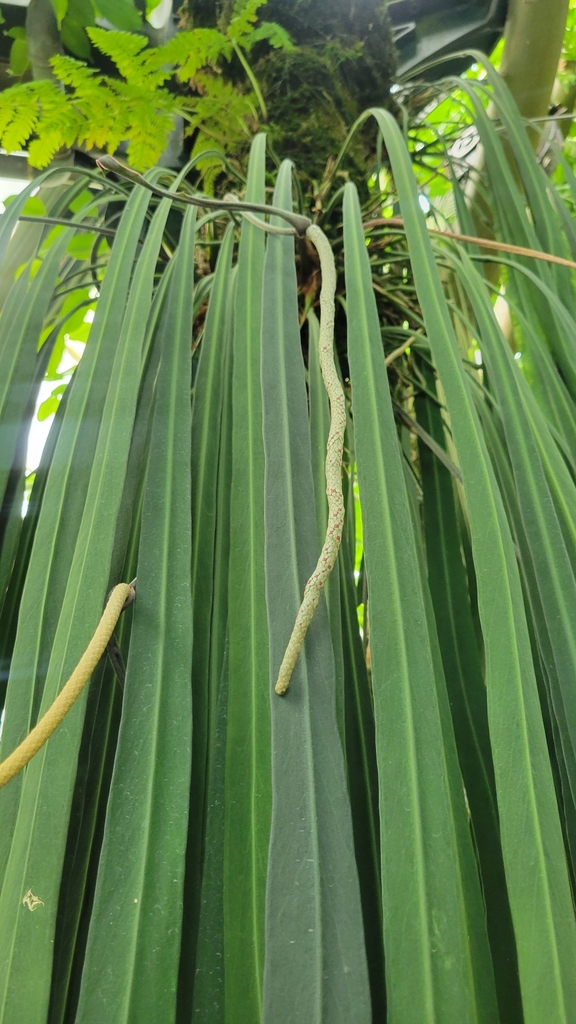
Imagine a plant that refuses to sit in a pot on a windowsill and look decorative. Anthurium vittarifolium does not do that. Its leaves — narrow, ribbon-like, sometimes exceeding a metre in length — hang straight down from a rosette that grips its host tree ten metres off the Amazonian forest floor. The inflorescence, when it comes, is a modest spadix. The aftermath is not modest at all: a column of berries that ripens to hot pink, almost fluorescent, strung like a wet bead curtain against the descending foliage. In a collection of rare aroids, it is the plant people stop at and ask what it is.
There is a category of collector — you know the type — who pursues velvets and windows and silver venation, who measures a leaf's sinus depth and photographs new growth before it finishes unfurling. Vittarifolium attracts a slightly different obsessive: someone drawn to form rather than surface, to silhouette and scale, to the question of how you suspend a living chandelier in a room with eight-foot ceilings and make it work. The answer, it turns out, involves a decent hanging basket, a lot of sphagnum, and a willingness to let the plant define the space rather than the other way around.
Where It Comes From and Why That Matters
Anthurium vittarifolium is native to the western Amazon basin — Colombia, Peru, Brazil — where it grows as an epiphyte in humid lowland and premontane forest. The name nods to the fern genus Vittaria, the ribbon ferns, because someone thought the leaves looked similar. They do: long, pendulous, entire, with no lobing or fenestration to interrupt the clean downward line. In habitat, the plant anchors itself to a rough-barked host and lets gravity do the rest, the leaf tips sometimes touching the understory shrubs several feet below the rosette.
Understanding the epiphytic origin is not trivia — it is the instruction manual. Vittarifolium has no tolerance for a dense, moisture-retentive potting mix. Its roots evolved to cling to bark and pull moisture from passing air and brief rain events, not to sit in sodden peat. Collectors who grow it well are almost always growing it in a chunky mix: coarse orchid bark, perlite, maybe some New Zealand sphagnum for water retention, nothing that stays wet for more than a day after watering. The substrate question is where most losses happen.
The species belongs to section Cardiolonchium, a group within Anthurium that includes a number of pendant-leaved epiphytes. A. andreanum, the familiar cut-flower anthurium with its waxy spathe, is nowhere near this corner of the genus. The family resemblance, if you came to vittarifolium expecting something like a florist's anthurium, is essentially absent.
Vittarifolium does not decorate a room. It reorganises one — leaves falling like ribbons cut from a rainforest canopy.
The Leaves: Scale, Texture, and the Problem of Space
A mature vittarifolium leaf can run 90 to 120 centimetres in length and stay narrow — perhaps four to six centimetres across at its widest point. The surface is a medium green, slightly glossy, with a central midrib and fine lateral venation that catches raking light. There is nothing velvety about it, no silver wash, no bullate texture. The appeal is entirely structural: that length, that hang, that multiplication of identical pendants from a single rosette until the plant reads less as a houseplant and more as an installation.
New leaves emerge from the centre of the rosette, pale and a little limp, and take their time hardening. During that process the plant can look a bit ragged — a half-unfurled ribbon flapping next to a row of mature leaves that have been hanging in place for months. It is one of those aroids that rewards patience and suffers from impatient re-potting. Every time you disturb the roots aggressively, the plant pauses, and a paused vittarifolium produces nothing interesting.
The hanging habit is non-negotiable. Potted on a shelf, the leaves curl awkwardly at the tips when they hit the surface below. The plant wants to be suspended — a hanging basket, a mounted slab if you have a humid enough environment, or a pot sitting on something elevated enough that leaves can fall freely for their full length. In practical terms, that means ceiling hooks, and it means accepting that this plant will claim vertical real estate in a way that few aroids do.
Berries: The Part Nobody Mentions Until They See Them
The inflorescence of vittarifolium is a slender, erect spadix on a relatively short peduncle, subtended by a narrow, often greenish or pale spathe that makes no effort to compete with the leaves. Most collectors barely register it. What comes after is different. As the berries develop over months, they swell and push outward from the spadix in the characteristic aroid pattern, and they ripen to a colour that has no business existing on a plant: a saturated magenta-coral-pink that reads almost synthetic against the green foliage.
A fully berried spadix is one of those things that photographs well but looks even better in person, because the berries catch light from multiple angles and the colour shifts from salmon to true pink depending on where you are standing. Each berry contains one or two seeds. Collectors who want to attempt seed propagation harvest them when the berry separates easily from the spadix, clean the pulp off immediately — anthurium pulp contains irritating calcium oxalate crystals and will also rot the seed if left on — and sow into a damp, fine medium. Germination rates from fresh seed are reasonable; stored seed is rarely worth the effort.
It is worth saying plainly that not every vittarifolium in cultivation berries reliably. Hand pollination helps. The technique is straightforward: collect pollen from a spadix in male phase (the flower surfaces are receptive and slightly tacky) and transfer it to a different plant's spadix in female phase. Without a second plant, or at least a spadix at a different phase, you are waiting on luck. Some growers in humid greenhouse setups report spontaneous pollination; windowsill growers generally do not.
Care Parameters: What the Plant Actually Needs
Humidity above 60 percent is the baseline; the plant grows faster and more consistently above 70. That does not mean it collapses at 55 — established plants are more resilient than their forest-floor reputation suggests — but it does mean a dry centrally heated room in February is not the right environment without supplementation. A humidifier running nearby, or a grow tent, will close the gap.
Light should be bright and indirect. Direct sun scalds the leaves, which are thin enough to show damage quickly. An east-facing window or a metre back from a bright south-facing one works well. Under artificial light, a full-spectrum LED fixture running 14 to 16 hours produces good growth, and the pendant habit means you can hang the plant directly under the fixture without worrying about a leaf canopy blocking itself.
Fertiliser should be dilute and consistent rather than heavy and occasional. A quarter-strength balanced liquid feed at every watering during the growing season, backing off in winter when growth slows, is a sensible approach. The chunky, fast-draining substrate that the roots need also means nutrients flush out quickly; a light, frequent schedule compensates. What you want to avoid is any fertiliser salt buildup around roots that are already sensitive to stagnant conditions.
Getting a Plant: What Circulates and What to Avoid
Anthurium vittarifolium circulates in collector trades with reasonable regularity — not as commonly as clarinervium or magnificum, but not rare enough to command the prices those velvet leaves do. Tissue culture has brought costs down for clean, established stock. Cuttings and divisions move through hobbyist sales and specialty vendors. What you want is a plant with documented stable leaf morphology; there is variability in cultivation, and some stock sold as vittarifolium has produced shorter, wider leaves that suggest either hybrid origin or mislabelling.
Seedling provenance is harder to verify than it sounds. Because seed is relatively easy to produce once you have a fruiting plant, seedlings appear regularly in trades, but their parentage is not always certain. Buying from a collector who has grown the parent plant to maturity, and who can show you photographs of the full adult foliage and the berrying spadix, gives you more confidence than buying blind from a marketplace listing. This is not unique to vittarifolium — it is standard practice for any aroid where a species name carries real meaning.
The Question of Scale and Why It Selects Its Growers
Most people who ask about vittarifolium after seeing one in a collection do not end up growing it. The reason is almost always space. A mature specimen in a hanging basket is not a plant you tuck into a corner; it is a plant that becomes the corner. The vertical drop of the leaves, the basket itself, the clearance needed so nothing sits below catching drips — you are committing a meaningful column of air to one plant. In a small apartment collection, that is a significant ask.
The collectors who thrive with it tend to have either a dedicated growing space — a greenhouse bay, a grow room, a spare bedroom that has gradually become something subtropical — or a living situation where ceiling height and south light conspire to make a hanging specimen look intentional rather than chaotic. There is also a personality type: the grower who wants fewer, larger, more architecturally commanding plants rather than a dense shelf of small pots. Vittarifolium rewards that preference completely.
It is not a difficult plant, which is worth stating clearly. It does not throw tantrums, does not require the obsessive humidity management of a velvet anthurium or the careful temperature control of something like warocqueanum in a cool season. It wants a basket, a chunky mix, reasonable humidity, and room to hang. Give it those things and it grows with quiet consistency, adding length to its leaves season by season until the effect it produces — those parallel ribbons descending in the filtered light — starts to look less like horticulture and more like something you planned all along.
Why It Earns Its Place
There is a version of aroid collecting that is entirely about surface: the depth of velvet on a gloriosum, the silver fracture lines on a crystallinum, the tessellation of a regale. Vittarifolium does not participate in that. It offers form, movement, and one moment of extravagant colour when the berries arrive. For certain collectors that trade is not interesting enough. For others — the ones who have stared at a mature specimen in full berry and felt the room reorganise itself around it — no explanation is required.
The chandelier comparison is obvious enough that multiple collectors have reached for it independently. But a chandelier is static, fixed, symmetrical. Vittarifolium moves in the slightest air current, each leaf swaying independently, the berried spadix catching the light from a slightly different angle than it did an hour ago. It is a living thing in the most literal sense — one that happens to have found, in the suspended air of a collector's grow room, something not far from what it was doing in the canopy above the Amazon basin all along.