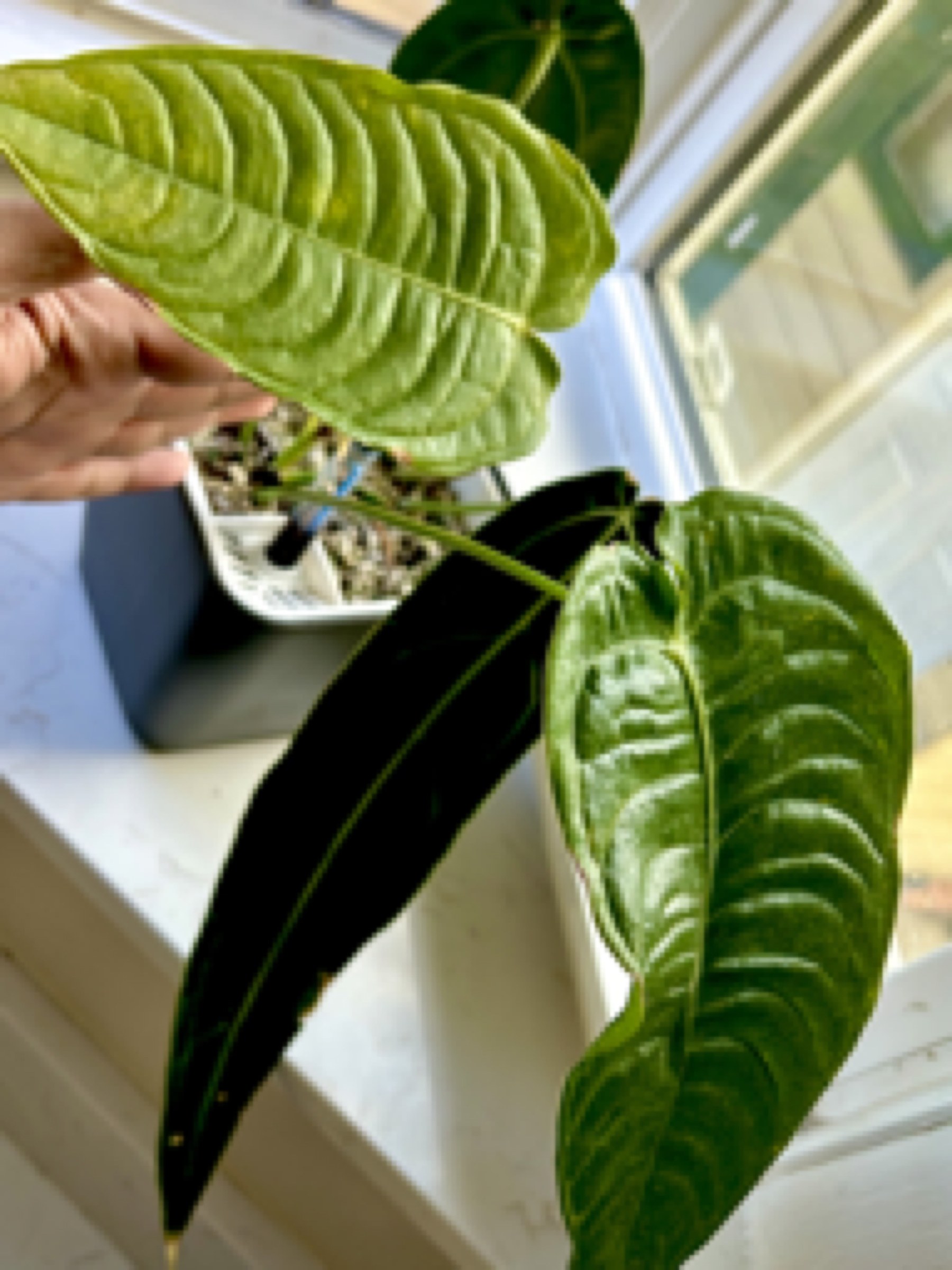
The plant is on the kitchen island because that is where the window is. A young Anthurium luxurians x dressleri, three leaves, the newest still hardening, bullate enough that the surface reads like hammered green metal under the right light. You have agreed to trade a cutting and the other collector wants photographs. Not the kind your phone wants to make for you — the saturated, sharpened, slightly violet ones — but something closer to the plant in the room.
This is the small, unsexy craft inside the hobby. Whether the picture is going on a marketplace listing, into a private trade DM, or into the archive you keep so you can argue with yourself in two years about whether a leaf has actually gotten bigger, the same principles apply. Photograph the plant, not the idea of it.
Why honest photographs matter more than flattering ones
The rare aroid market runs on trust and on pictures. A buyer in Hamburg looking at a Philodendron spiritus-sancti in Tampa is buying the photograph first and the plant second. If the picture lies — even by accident, even because the auto white balance pulled the greens toward teal — the disappointment when the box opens is real, and it sticks to your name. Sellers who shoot honestly tend to sell again. Sellers who shoot with a ring light and a Lightroom preset called "Jungle" sometimes do not.
The same logic governs trades. A trade is a long conversation between two people who already know more than average about plants, and bad photographs make that conversation slower and more suspicious. Show the truth: the small chew on leaf two, the bit of edema on the underside, the petiole color you cannot quite name. Disclose with the camera before you have to disclose with words.
Archive shooting is the third reason, and the one collectors most often skip. A leaf photographed every month against the same background, in the same window, at roughly the same time of day, becomes a record. It will tell you, later, whether your Anthurium forgetii is actually getting rounder and more cordate with maturity, or whether you have been telling yourself a flattering story.
A good aroid photograph is a contract. It says: this is what arrived in my house, under ordinary light, on an ordinary afternoon.
Light: north windows, overcast days, and the myth of the ring light
Velvet aroids are difficult subjects because the trait that makes them desirable — the way light scatters across the trichomes and the dark anthocyanin sublayer — is also the trait that defeats most cameras. Direct sun blows the highlights into chalky patches and crushes the venation into black ditches. A bare LED panel does roughly the same thing in miniature.
What you want is large, soft, slightly directional light. A north-facing window on an overcast day is, frankly, ideal, and is the reason a lot of the best aroid photographs on the internet come from the Pacific Northwest, the Netherlands, and the UK in November. If you do not have that, the next best thing is a south or east window with a white bedsheet pinned across it as a diffuser. A single softbox, fired through a second layer of diffusion, will get you close enough.
Position the plant so the light rakes across the leaf at roughly 30 to 60 degrees, not straight on. Raking light is what makes a Philodendron melanochrysum look like melanochrysum instead of a dark green oval. For deeply bullate leaves — luxurians, dressleri, papillilaminum — push the angle steeper until the bullae cast small shadows. Then back off until the shadows stop looking theatrical.
Angle: photograph the leaf, then photograph the plant
Most listings fail at angle. The seller stands over the pot and shoots down, and the result is a foreshortened blob that flatters nothing. A leaf is a roughly two-dimensional object hanging in three-dimensional space, and the camera should be parallel to it.
Hold the camera so the sensor plane matches the leaf plane. For a pendant Anthurium warocqueanum, that means kneeling. For a climbing gloriosum on a pole, that means standing back six feet and zooming in rather than walking closer, which keeps the perspective from distorting the petioles. A 50mm equivalent is fine; an 85mm equivalent is better. Phone ultrawides will bend a long petiole into a banana.
Then, separately, photograph the whole plant: pot, pole, substrate line, every leaf in order from oldest to newest. Buyers want the hero shot and the inventory shot. Trades want both, plus the back of the newest leaf, plus the growth point. The archive wants all of it, dated.
Scale: the hand, the ruler, the coin
Aroid photographs without scale are nearly useless, and yet half the listings on any given marketplace omit it. A Monstera leaf shot tight against a black backdrop could be eight inches or thirty. Resolve the ambiguity before anyone has to ask.
A clean ruler held alongside the leaf, in the same plane, is the professional move. A hand is fine if the ruler is not at hand, but be consistent — your hand, in your photographs, eventually becomes a known unit to your repeat buyers. A coin works in a pinch, though it reads as slightly amateur and tends to roll off the substrate at the worst moment.
For the archive, I prefer a small folding ruler in the corner of every monthly shot of mature specimens. It is faintly ridiculous and it has saved me from a dozen arguments with my own memory. Anthurium regale leaves do, in fact, get that big. The ruler said so in March.
Color accuracy: white balance, gray cards, and the listing that does not lie
The single most useful tool in aroid photography costs about eight dollars: a gray card. Photograph it once at the start of a session, in the same light you will shoot the plant in, and use it to set a custom white balance in post. If you shoot JPEG on a phone, hold the card in the first frame and use any free editor to neutralize off it. Suddenly the greens are green, the petiole is the color it actually is, and the new leaf is not magenta.
Auto white balance is the enemy of velvet. It sees a leaf that is 80 percent dark and concludes the whole scene must be underexposed and warm, and it compensates by pushing everything cool and bright. The leaf you photographed as deep oxblood-green arrives in the buyer's inbox as a kind of dusty olive. Lock your white balance manually. Daylight (around 5500K) under window light, tungsten (around 3200K) under most household bulbs, and adjust from there.
Saturation is the other temptation. The eye is forgiving; the slider is not. If your Philodendron verrucosum photograph makes the petiole hairs look like red velvet ropes from a nightclub, you have gone too far. Pull it back until a friend who has seen the plant in person nods.
Backgrounds, and what the floor of your apartment is saying about you
A messy background reads as a messy grower, fairly or not. You do not need a studio. A piece of neutral gray foam board from an art store, propped behind the plant, will carry you through a hundred listings. Matte black works for pale variegates and for Anthurium species with strong venation; matte white works for dark velvets but blows out easily; mid-gray is the safest and most honest choice.
Avoid patterned fabric, avoid the kitchen counter with the dish rack in the corner, avoid the cat. The cat will be in the photograph anyway, eventually, but try.
For archive work, pick one background and never change it. Consistency is the whole point. Two years of Philodendron spiritus-sancti photographs against the same gray board, in the same window, at roughly noon, is a document. The same plant photographed variously on a sofa, a windowsill, the bathroom floor, and a friend's balcony is a scrapbook, which is a different and lesser thing.
A short workflow you can actually keep
Set the plant in front of soft, lateral light. Wipe the leaves with a damp cloth — not leaf shine, never leaf shine, which photographs as a plastic sheen and tells every experienced collector that you have something to hide. Place the gray card in the first frame. Shoot the whole plant, then each mature leaf in plane, then the newest leaf front and back, then the growth point, then the substrate surface, then the root system if you are repotting anyway.
Edit minimally. Correct white balance off the gray card. Adjust exposure if needed. Crop. Resist everything else. If the photograph needs heavy editing to look good, the light was wrong; reshoot rather than rescue.
Name the files with the date, the species, and the leaf count. 2024-03-14anthuriumdressleri3leaves.jpg_ is boring and it will still be legible to you in 2031, when you are trying to remember whether the fourth leaf came in before or after the move. The archive is a slow gift to your future self, and the future self is, almost always, grateful.