The leaf arrived in a heated box at 7:42 on a Tuesday morning in February, packed in sphagnum so dry it crackled. The seller had photographed it on a black velvet cloth under a softbox: an Anthurium magnificum x crystallinum, mature blade roughly fourteen inches, silver venation arranged with the symmetry of a cathedral window. Two thousand dollars. By Thursday the leaf had a half-inch tear along the lower margin, the kind that happens when a plant is unboxed in a 38% humidity living room and asked to behave.
The buyer, a friend, was crushed. Not because the plant was failing — it wasn't — but because the leaf, the specific leaf he had paid for, the leaf he had screenshotted and zoomed into for a week, was no longer the leaf in the photograph. He had bought a noun. What arrived was a verb.
Where the obsession comes from
Velvet aroids are photogenic in a way that few houseplants are. The light-trapping epidermis of a Philodendron gloriosum or an Anthurium clarinervium doesn't reflect — it absorbs and then quietly broadcasts back a single saturated green, with the silver veins doing the work of a jeweler's setting. Photograph it well and the image is closer to a still life than a snapshot. Photograph it badly and it still looks good. This is unusual.
The hobby's center of gravity moved onto Instagram around 2018 and onto TikTok around 2021, and with that move came a quiet shift in what people were actually buying. The plant became inseparable from its portrait. Sellers in Java and Medellín and South Florida learned, correctly, that a clean, symmetrical, fenestrated, fully-hardened leaf shot against a neutral backdrop would clear at three to five times the price of the same plant photographed honestly on a greenhouse bench.
So a generation of collectors has been trained, without ever being told, to expect plants to look like their listing photos. They don't. They can't. A listing photo is a plant at one specific hour of one specific week of a multi-year life, usually the best hour it will have for months.
A leaf is not an object you own. It is a sentence the plant is in the middle of saying, and it will end with abscission.
What a 'perfect' leaf actually is
A flawless mature leaf — no edge damage, no thrips stippling, even coloration, full expansion, hardened cuticle — represents a narrow window. For most large-leaf philodendrons and anthuriums, the leaf is at peak presentation for roughly three to six weeks after hardening off, and then it begins a slow decline that can last a year or more before abscission. The leaf you bought the photo of was, statistically, near the end of that window when the photo was taken. Sellers aren't lying. They're just photographing leaves at the moment leaves are most photographable.
The other thing worth saying plainly: many of the most-coveted photographs are of leaves that grew in 85% humidity, under 250–400 PPFD of filtered light, with constant air movement and a substrate that drains in under ten seconds. They were not grown in your apartment. The leaf is not a defect-free Platonic ideal. It is the output of a specific set of conditions, and asking your plant to reproduce it under different conditions is asking a sentence to translate itself into a language with different grammar.
The damage that doesn't matter
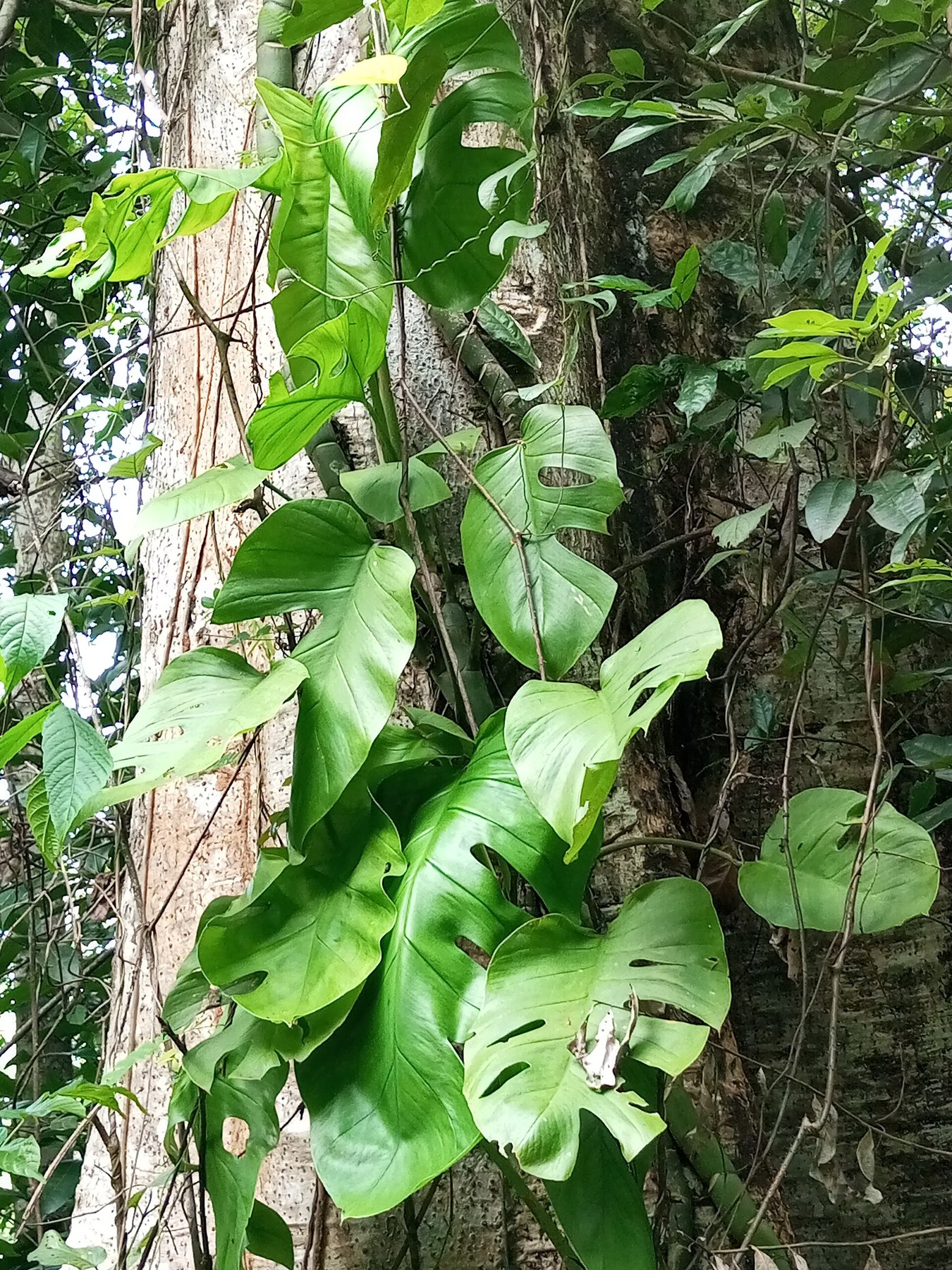
A torn margin on an otherwise healthy Philodendron luxurians tells you almost nothing about the plant. Tears happen in shipping, in repotting, in the cat's nightly patrol. The leaf will not heal — aroid leaves don't — but the plant doesn't care, because the plant's investment in that leaf was amortized the moment it hardened. From the plant's perspective, the leaf is a solar panel with a known service life, and a notch in the panel reduces output by a percent or two.
Small thrips scars from a past, treated infestation are similarly cosmetic. Minor edge crisping from a single low-humidity week is cosmetic. Mild calcium spotting on an Alocasia is cosmetic. An asymmetrical lobe on a juvenile Monstera — not a thing to worry about; the next leaf will be more symmetrical, or it won't, and either way the plant is fine.
The collector who culls a plant because the current leaf is imperfect is doing the horticultural equivalent of selling a violin because it has a scratch on the varnish. The instrument is in the wood.
The damage that does
What matters is the new growth. A plant pushing a smaller leaf than the last one, repeatedly, is telling you something — usually about light, sometimes about roots, occasionally about a pest you haven't found yet. A plant whose petioles are progressively shorter and whose internodes are stretching is telling you the light is too low and possibly too far. A plant whose newest leaf emerges chlorotic, or with interveinal yellowing that doesn't green up after hardening, is telling you about the substrate or the water.
Root condition is the honest signal. Pull a Philodendron out of its pot. White and firm with active tips means the plant is fine regardless of what the current leaves look like. Brown, mushy, hollow, or absent means the plant is in trouble regardless of how good the current leaves look. The leaf above the soil is a lagging indicator. The roots are the present tense.
Likewise, watch the cataphyll on philodendrons and the spathe-and-spadix behavior on anthuriums. A plant producing cataphylls on a regular cadence — every three to six weeks for most mid-sized velvet philodendrons in good conditions — is a working plant. A plant that hasn't produced a cataphyll in four months has stopped, and the question is why.
The grower's eye versus the buyer's eye
Spend a day in a working aroid greenhouse — the kind with shade cloth patched in three places and a concrete floor that never fully dries — and you'll notice that the growers don't talk about leaves the way buyers do. They talk about pushes. They talk about how a particular Anthurium papillilaminum clone roots, how reliably a forgetii seedling sizes up, which warocqueanum line holds its venation as the leaves mature versus which one fades to plain green by leaf four.
A grower looks at a plant and sees a trajectory. A buyer looks at a plant and sees a still image. Both are valid, but only one of them survives contact with a living organism. The collectors who stay in the hobby past the two-year mark are, almost without exception, the ones who quietly switch from the buyer's eye to the grower's eye. They stop photographing the current leaf and start photographing the unfurling one.
This is also when people stop buying the most expensive specimens and start buying smaller, younger plants from growers they trust. A rooted cutting from a known mother is, in every way that matters, a better purchase than a mature plant of unknown origin with one spectacular leaf.
What to chase instead
Chase provenance. A cutting from a documented Anthurium dressleri mother in a serious collector's greenhouse is worth more, in any honest accounting, than an unlabeled plant from an import lot, even if the import lot plant has a bigger leaf today. Provenance is the only thing that survives the current leaf.
Chase vigor. A plant that pushes consistently under your conditions is a plant you actually own. A plant that sulks for a year and then dies having produced one half-sized leaf was never really yours; you were just storing it. Vigor under your specific light, water, and humidity is the only metric that compounds.
Chase the plants that reward attention. Philodendron gloriosum creeping along the top of a mossed tray, putting out a new leaf every five weeks, each one a little larger than the last — that is the actual experience of the hobby. The flawless listing photo is a single frame from a film you are now responsible for continuing to shoot.
The leaf in the photograph
My friend's magnificum x crystallinum is now two years older. The torn leaf abscised eleven months ago. The plant has produced seven leaves since, the most recent one slightly larger than the one in the original listing photo and, to his eye, better proportioned. He no longer has the listing photo saved. He couldn't tell you, without checking, what the original leaf looked like.
This is the arc, when the hobby works. You buy a leaf. You learn, sometimes expensively, that you didn't buy a leaf — you bought a plant, which is a process, which is a relationship with a specific organism under your specific roof. The leaf you were sold becomes the leaf you grew, and then the leaf you grew becomes compost, and the plant keeps going. Perfection turns out to have been the wrong category all along. What you wanted, without knowing it, was continuity.