There is a particular quiet that settles over a grow room around the third year. The humidifier still clicks on at dawn. The Anthurium warocqueanum still pushes a new leaf every six weeks, broader than the last. But the phone stays in the kitchen. The Instagram grid, once updated twice a week with fresh pulls and unfurls, hasn't moved since February. Friends in the hobby send DMs that go blue and unanswered. The plants are fine. The grower is somewhere else.
Ask around long enough and you'll find them: people who spent three or four years chasing Philodendron spiritus-sancti or a verified Anthurium dressleri, paid four figures more than once, built a wall of IKEA cabinets retrofitted with Kasugen fans and Inkbird controllers, and then, without announcing it, simply went silent. They didn't sell the collection. They didn't quit. They just stopped performing it.
The shape of the chase
Every collector I know can draw the same arc on a napkin. It starts with a gateway plant — usually something charismatic and obtainable, a Philodendron gloriosum from a big-box rescue cart, or a Monstera deliciosa that turns out to fenestrate beautifully under a cheap Barrina. Then comes the genus lock-in: velvet philodendrons, or the silver anthuriums, or the bullata-leaved hoyas. The want list gets written down. Discord servers get joined. The first import from a Thai or Indonesian seller arrives wrapped in damp sphagnum and customs tape, and something in the brain rewires.
For the next two or three years the chase is the hobby. You learn which European nurseries actually ship clean stock. You memorize the difference between a true A. magnificum and the crystallinum × magnificum hybrids that flood the market every spring. You develop opinions about leca versus pon versus chunky bark mixes, and you defend them. You photograph every new leaf against the same gray wall. The dopamine loop tightens.
Then one day the want list is mostly crossed off. The spiritus-sancti is established. The luxurians has put out a leaf bigger than your forearm. And the loop, which had been pulling you forward like a current, releases.
The chase is a story with a shape. Stewardship is weather. One has a third act; the other only has Tuesdays.
What burnout actually looks like
It is rarely dramatic. Nobody dumps a warocqueanum in a compost bin. The plants keep getting watered, because the routines are deep by now — Sunday morning is still grow-room morning, and the muscle memory of mixing a half-strength MSU feed survives long after the enthusiasm for it does.
What dies first is the documentation. The photos stop. Then the captions stop having ideas in them. Then the posts stop. Trades get declined politely. The collector still reads the Discord but doesn't type. When a new leaf hardens off — a leaf they would have once made a ten-slide carousel about — they glance at it, note that the venation came in cleanly, and close the door.
Some of them describe it as boredom, which isn't quite right. Boredom implies the plants got less interesting. They didn't. What got less interesting was the version of themselves that needed to show the plants to other people. That's a different, more uncomfortable diagnosis.
The economics of the trough
Part of the burnout is financial honesty catching up. The 2021–2022 aroid market was a strange weather system. A four-inch Philodendron billietiae variegata moved for four figures. Tissue-cultured Monstera 'Thai Constellation' went from unicorn to Costco within eighteen months. People who bought near the top watched the floor drop out on plants they'd financed on credit cards, and the math stopped being something you could avoid by posting another unfurl video.
The growers who quietly stop posting are often the ones who did the arithmetic. They added up the cabinet build, the electricity, the imports, the losses to thrips and to a bad week of root rot, and they decided not to keep performing abundance they no longer felt. Selling down feels like failure. Going quiet feels like privacy. Most people choose privacy.
There's also a less talked-about piece: the social economy of rare plants depends on scarcity, and scarcity depends on other people wanting what you have. When the market softens, the audience thins, and the reward for posting a rare leaf shrinks accordingly. The plant is the same. The room around it has changed.
Stewardship is not a story
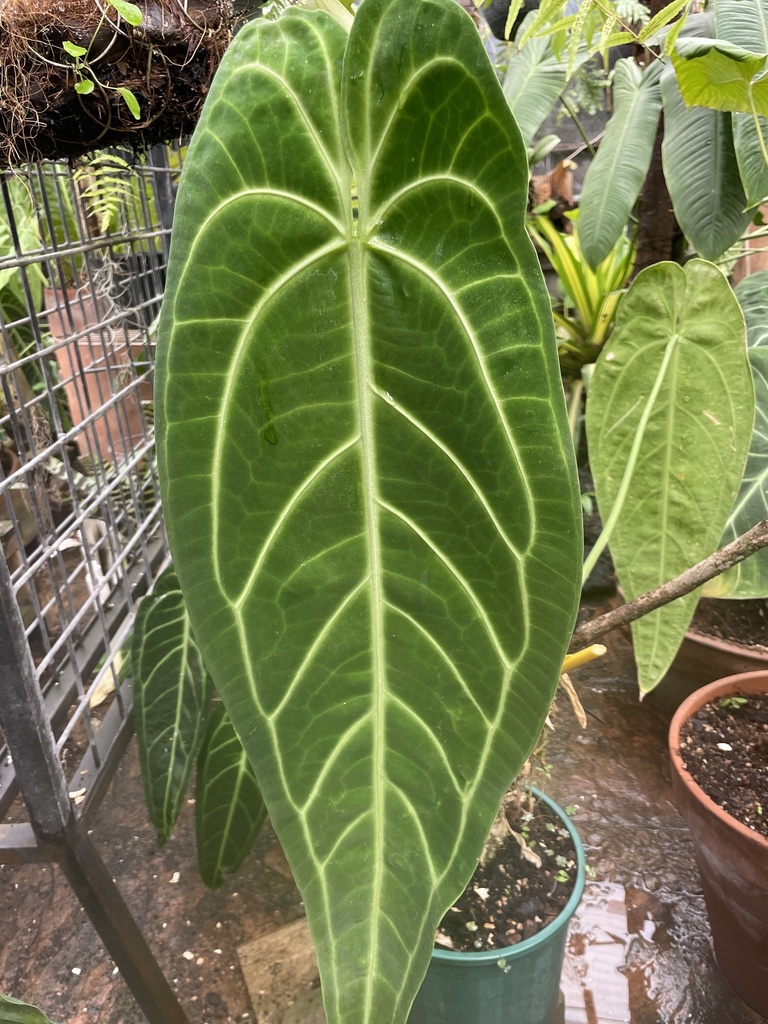
The chase has narrative structure. There's a protagonist, an obstacle, a quest object, a resolution. Posting fits inside that structure naturally — each acquisition is a chapter, each new leaf a small climax. Stewardship, which is what comes after, has no such shape. A mature Anthurium forgetii that has lived with you for four years and reliably pushes a peltate leaf twice a year is not a story. It's a relationship. Relationships are bad content.
This is the part most collectors don't anticipate. You think you're building a collection, and you are, but you're also slowly aging out of the phase of the hobby that social platforms reward. The algorithm wants newness. Your plants are getting older. Their leaves are getting more beautiful and less photogenic, in the specific sense that nobody on a feed will stop scrolling for a leaf that looks roughly like the last one, only larger and more correct.
Growers who make it through the trough tend to be the ones who quietly accept this. They start keeping a paper notebook again. They measure petioles. They photograph for themselves, badly, with the overhead lights on. The pictures are worse and the observation is better.
The plants that survive the silence
There's a sorting that happens in the quiet years. Plants that were bought for the post — the Philodendron 'Pink Princess' with one good half-moon leaf, the variegated Monstera adansonii that needed constant intervention to stay marbled — tend to drift to the back of the shelf and eventually move on. What stays is what the grower actually likes to look at when nobody else is looking.
For a lot of people that turns out to be the unflashy stuff. A well-grown Philodendron mamei with silver pulled tight across each leaf. A Hoya carnosa compacta on a south window, blooming on the same peduncle for the fourth year. A bench of Begonia bipinnatifida and a few U-series rexes under a humidity dome, plants that almost nobody outside the genus cares about. The collection narrows and deepens at the same time.
This is, I think, the actual end state of the hobby — not a finished want list, but a small group of plants you understand. The collectors who quietly stop posting often turn out to be the ones who finally started growing.
Coming back, or not
Some of them do come back. Usually it's tied to a specific plant: a dressleri that finally throws its first adult leaf with the bullate texture intact, or a Philodendron luxurians seedling outgrowing its prop box. They post once, without fanfare, and a few old friends in the comments say good to see you. Then they go quiet again. The cadence is different now — seasonal, almost agricultural, tied to actual growth and not to a content schedule.
Others don't come back at all, and that's fine too. The hobby has a bad habit of treating departure as defeat, as if anyone who isn't visibly collecting has somehow failed at it. Plenty of the best growers I know are functionally invisible online. They trade cuttings through email. They show up at one society meeting a year with a leaf in a Ziploc and quietly correct someone's ID.
If you're in the trough now — grow lights still on, phone face-down, vaguely guilty about a feed you haven't updated since spring — it's worth knowing that this is a normal phase and not the end of anything. The plants don't need the audience. They never did. The chase was the loud part. What comes after is the part that actually lasts.