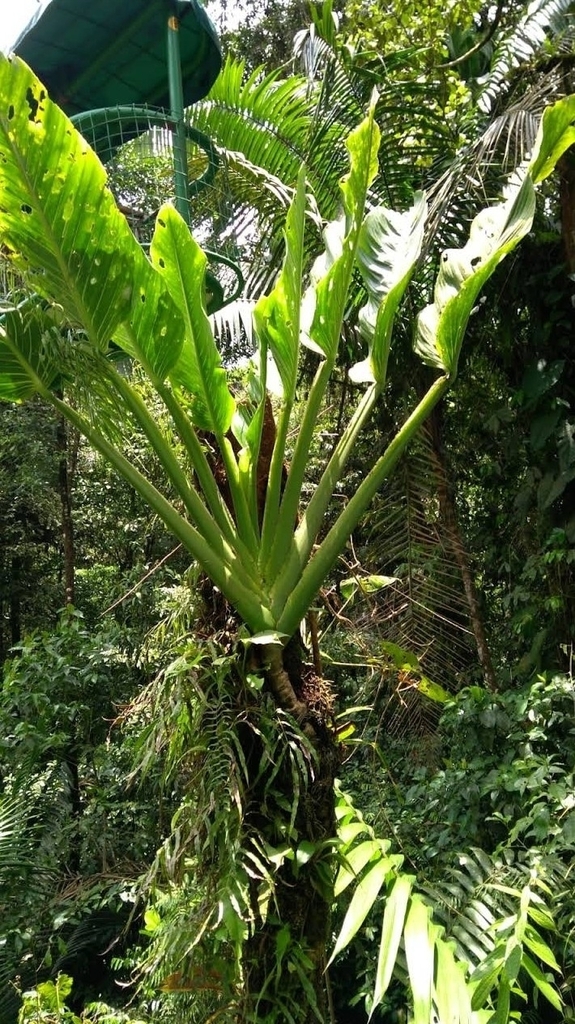
The first thing I noticed at Marcos's place outside Pereira was the sound: a low, constant hush of misters cycling on a relay, and underneath that, the tick of condensation falling from polycarbonate onto banana leaves on the floor. He had told me on WhatsApp that his Anthurium luxurians stock was "doing well." Standing in front of the bench, I understood that "doing well" had meant something I could not have guessed from a phone — six mother plants in twenty-gallon nursery pots, each with three or four bullate leaves the size of a dinner plate, the newest still bronze and not yet hardened.
I had bought from Marcos twice before without meeting him. The plants had arrived bare-root in sphagnum, healthy, fairly priced. I thought I knew who he was. I did not. Ten minutes inside his shade house rewrote a year of assumptions — about him, about his pricing, about which of his plants I actually wanted, and about how much of this hobby is being conducted, badly, through a small glowing rectangle.
The Photograph Lies, Even When It Doesn't Mean To
Every plant photograph is a negotiation between a leaf and a phone. Growers shoot in the brightest corner of the shade house, at the angle that flatters venation, on the day a new leaf hardens off. They are not lying. They are doing what anyone selling anything does. But the cumulative effect, scrolled across a hundred sellers' grids, is that you stop being able to estimate a plant's real size, vigor, or condition. Every Philodendron spiritus-sancti looks like the same plant. Every Anthurium papillilaminum has the same chalky black velvet.
Standing in front of Marcos's bench, I watched him pick up one of his luxurians and turn it so the light raked across the leaf surface. The bullations cast shadows like a relief map. Then he turned it back to the angle he uses for Instagram and the texture flattened into a flat green oval. "This one," he said, tapping the flat-looking image on his phone, "sells. This one," tapping the raking-light version, "is the plant." He said it without irony. He was explaining his job.
After that I started asking sellers to send a video panning slowly under top light, and to include a shot with the leaf held edge-on so I could see substance and undulation. About a third stop replying. The ones who do are the ones I now buy from.
A DM is a sales channel. A greenhouse is an argument — about water, light, ethics, and what a plant is actually worth.
You Can Smell a Healthy Collection
A well-run aroid greenhouse smells like wet bark, a little like fresh mushrooms, and faintly like nothing at all — which is to say, not like rot, not like fungus gnats hatching out of peat, not like the sour iron tang of anaerobic media. The first time you walk into one that is genuinely thriving, you recognize the smell as the absence of every smell you've been quietly tolerating in your own grow space.
Marcos's substrate was almost entirely coarse pine bark, perlite, and a little charcoal, with a top dressing of long-fiber sphagnum kept slightly damp. No coir, no peat. He watered heavily and often — twice a day in dry season — because the mix drained in seconds. I had been keeping my own papillilaminum in a denser mix and watering once a week, terrified of root rot. I came home and repotted six plants in the next two days.
You cannot smell a greenhouse through a DM. You also cannot see the floor. Marcos's floor was gravel over a slight slope to a drain, swept clean. A grower whose floor is a swamp of spilled mix and old leaves is telling you something about how they treat root systems, even if their photographs are immaculate.
Provenance Is a Conversation, Not a Caption
Online, provenance gets compressed into a single line: "ex-Ecuagenera," "Panama locality," "from Dr. So-and-so's collection." These phrases function as price multipliers, and in roughly half of cases they are approximately true in a way that would not survive five minutes of in-person questioning.
In person, provenance becomes a story with names, dates, and gaps. Marcos walked me through which Anthurium came from a 2018 trip with a friend who works in Chocó, which were seed-grown from his own crosses, and which he had bought as tissue culture from a lab in Florida and grown out for three years. He was candid about the TC plants — they were cheaper, faster, and indistinguishable from division-grown adults once mature. He did not pretend they were wild-collected. He did not need to. The plants were good.
I have since stopped paying premiums for vague provenance claims in DMs. If a seller cannot tell me who they got the mother plant from, or what year, or what the seedling rate looked like, the "rare locality" line is decoration. It may still be a fine plant. It is not a more valuable one.
Price Makes Sense in the Room
Online, prices feel either insulting or insulting in the other direction. A Philodendron luxurians for $180 seems like a steal until you remember the last one you saw went for $90, and then you wonder what's wrong with it. A Monstera obliqua Peru for $1,400 seems like robbery until you stand in front of one and watch how slowly it grows.
In Marcos's shade house, prices stopped being abstract. The luxurians mothers were eight years old. He took maybe two divisions a year off each, and each division needed another year on the bench before it would ship without setback. The math was not greedy; it was arithmetic. Meanwhile, a flat of seed-grown Anthurium forgetii × papillilaminum that he was selling for $40 each represented about eighteen months of his time and a pollination he did with a paintbrush at 6 a.m. before driving his kid to school.
I came home with a different sense of which plants in my own collection were actually expensive — not by sticker, but by how much living labor they represented. The cheap ones, often, were the ones I had paid the most for.
The Grower's Eye Is the Real Inventory
What you cannot buy online, ever, is the grower walking the bench with you and stopping at one specific plant out of two hundred and saying, "This one. Take this one." Marcos did this with a Philodendron mcdowellii that was, to my eye, slightly smaller than its neighbors. He pointed at the petiole — shorter internodes, thicker caliper — and at the underside of the newest leaf, where the venation was already deeply impressed on a leaf only six inches long. "It will be the best plant on this bench in two years," he said. "The others will catch up in size but not in structure."
I bought it. Two years on, he was right. The plant has the architecture of something twice its age. I would never have picked it from a photograph; in the photograph it was the runt.
This is the part of the hobby that the marketplace flattens hardest. Algorithmic sorting rewards the leaf that photographs best today, not the seedling that will be the best mature plant in 2027. Growers know the difference. Most of them will tell you, in person, if you ask. Almost none of them will put it in a caption.
Trust Compounds, and It Doesn't Transfer
After the visit, my relationship with Marcos changed in a way that surprised me. I bought less from him, not more. I stopped speculatively grabbing things from his story posts. Instead, I would message him once a quarter and ask what he had that he thought I would actually want, given what he had seen in my own grow space (he asked me for photos, with raking light). He would send three options. I would buy one.
This is, I think, what the hobby looked like before the marketplace ate it — a small number of long relationships with growers who knew your conditions, your taste, and your tolerance for risk. The DM era has given us access to a hundred times more sellers and roughly none of that context. The trade-off has not been worth what we think it has.
Trust also does not transfer. Marcos vouching for another grower in Medellín got me a good first transaction and nothing more. I had to go visit that grower too, eventually, before I understood what his plants actually were. There is no shortcut. The greenhouse is the document. Everything else is a footnote.
What to Do If You Cannot Fly to Colombia
Most collectors will never visit the growers they buy from. That is fine; the lesson of the visit is not that you must travel, but that you should buy as if you had. Ask for video under top light, edge-on. Ask what the substrate is and how often it is watered. Ask the age of the mother plant. Ask whether the offering is a division, a seedling, or tissue culture, and do not punish honest answers with lower offers — that is how you train the market to lie to you.
Pay attention to which sellers answer these questions easily and which get defensive. The easy answerers are people who have nothing to hide and, usually, a clean floor. Build a short list of four or five of them and buy deeper from fewer sources. Your collection will get better faster and cost less in the aggregate.
And if you ever do get the chance to stand in one of their greenhouses — say yes, even if it is inconvenient, even if you do not buy a single plant that day. You will come home and look at your own benches differently. That, more than any specimen you could have carried back in a suitcase, is what the visit is for.