The first time someone offers you a wet stick, you should not be alarmed. You should ask what node count, whether it has roots, and what mother plant it came off. If you answer correctly, the seller relaxes a little. You have passed a small test you didn't know you were taking.
Every serious hobby develops a private language, and rare aroids are no exception. The vocabulary that has grown up around Philodendron, Anthurium, and Monstera collecting is part Latin nomenclature, part horticulture, and part eBay slang from 2019. Used well, it's precise. Used badly, it sounds like a teenager trying to buy a car. What follows is a working glossary — not exhaustive, but enough to read a Facebook group thread without embarrassing yourself, and enough to spot the seller who's bluffing.
Propagation: jump, pup, wet stick, chonk
A cutting is the broadest term — any severed piece of stem with at least one node, the swollen ring from which roots and leaves emerge. Beyond that, the vocabulary gets oddly specific. A wet stick is an unrooted node cutting, usually leafless or nearly so, sold cheap because the buyer is taking on the risk that it will actually wake up. A chonk is the same idea but bigger: a thick, multi-node piece of mature stem, often from a climbing Philodendron that has already hardened off and started producing adult foliage. Chonks cost more and root faster.
A pup is an offset — a young plant growing from the base of a clumping species. Anthurium warocqueanum throws pups eventually if it's happy; so do most Alocasia. Division is the act of separating those pups from the mother, ideally with their own root system intact. A jump is more colloquial: a leaf that comes in dramatically larger than the previous one, the visual proof that a plant has decided, finally, that it likes where it lives. Collectors post jumps the way other people post their kids' report cards.
Acclimation is the period — anywhere from two weeks to two months — during which a new arrival adjusts to your conditions. Hardening off is the related process of moving a plant from high-humidity propagation (a tent, a tub, a bag) into open room air without it collapsing. Both are skills. Neither is glamorous.
The vocabulary is a filter. It tells you, within about ninety seconds, whether the person on the other end of the DM has actually grown the plant.
Provenance: NOID, sib cross, tissue culture, line
NOID stands for No Identification — a plant of uncertain species, often a hybrid or a wild collection that never got matched to a type specimen. NOID Anthurium from Ecuador are their own category of obsession; people pay real money for what amounts to a botanical question mark. Aff. (short for affinis) means "close to but not confirmed as" a named species. Sp. means "species, undetermined." Both are honest hedges. Cf. (confer) means "compare with" — a similar hedge used by people who know what they're looking at but won't commit.
A sib cross is a sibling crossing — two plants from the same seed batch crossed back to each other. Selfed means a plant pollinated with its own pollen. Both produce variable offspring, which is why two Philodendron spiritus-sancti seedlings from the same pod can look noticeably different at maturity. A line or bloodline refers to a specific lineage maintained by a particular grower; certain Anthurium luxurians lines, for example, have larger bullation or deeper venation than others.
TC is tissue culture — plants propagated in sterile flasks from meristem tissue. TC plants are cheaper, available in volume, and sometimes carry juvenile traits for longer than cutting-grown stock. Cutting-grown or stem-grown stock comes from a known mother plant and reaches maturity faster. Neither is inherently better, but the distinction matters when you're spending three figures on a small plant.
Morphology: bullate, sinus, peduncle, geniculum
This is where the vocabulary gets unforgiving. Bullate means blistered or puckered — the quilted leaf surface of Anthurium luxurians or a good Begonia melanobullata. Velvet or velutinous describes the matte, light-absorbing texture of Philodendron melanochrysum and gloriosum. Crystalline or sparkly is the iridescent surface of Anthurium crystallinum and clarinervium, caused by specialized epidermal cells that catch light.
The sinus is the gap at the base of a heart-shaped leaf, where the two lobes meet (or don't). On a mature Philodendron gloriosum the sinus is open and rounded; on a Philodendron pastazanum it closes up tight, lobes overlapping. The petiole is the leaf stem. Its cross-section is diagnostic: a D-shaped, winged, or terete petiole can settle an identification argument that photos of the leaf cannot.
The geniculum is the small joint where petiole meets leaf blade — the hinge that lets the leaf reorient toward light. On Anthurium, geniculum length and color are taxonomically useful. The peduncle is the stalk holding up an inflorescence; the spathe is the modified leaf that wraps it; the spadix is the fleshy column of true flowers inside. If you intend to pollinate anything, you will learn all three within a week.
Variegation: stable, sectoral, chimeric, reverted
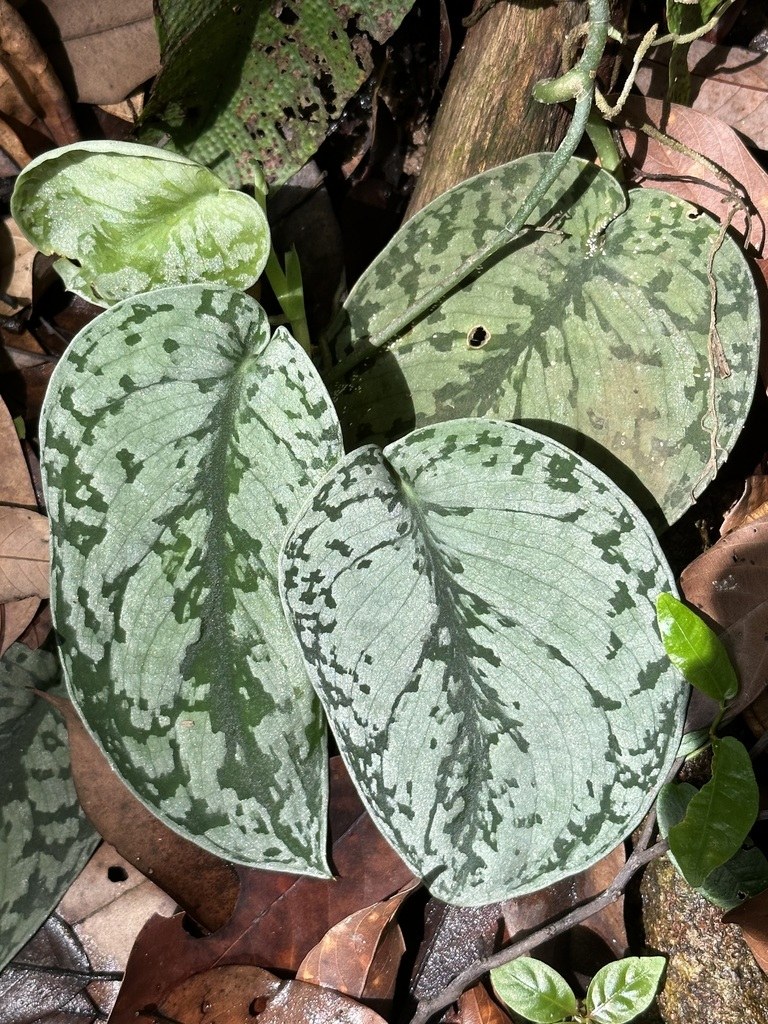
Variegation is the general term for any pattern of non-green tissue — white, cream, yellow, pink — caused by reduced or absent chlorophyll. Chimeric variegation, the kind that matters, is genetic: two distinct cell lines in the same plant, inherited through cuttings if you take them correctly. The albo Monstera, the mint Monstera, the Philodendron 'Pink Princess' — all chimeric.
Sectoral variegation comes in clean wedges or halves; marginal runs along the leaf edge; mosaic scatters in fine flecks. A half-moon is a leaf split roughly fifty-fifty between green and white tissue — beautiful, but a warning sign if it keeps happening, because the white half has no chlorophyll and the plant is running on the green half alone. A destabilized or reverted plant has lost its variegation, usually because someone propagated from an all-green section.
Viral variegation is the exception — patterns caused by a plant virus rather than genetics, sometimes attractive, always contagious, never worth buying. The classic case is the so-called Aglaonema 'Pictum Tricolor' counterfeits, but viral mottling shows up across the trade. If a pattern looks like watercolor bleed rather than crisp sectors, ask questions.
Conditions: VPD, IBC, LECA, semi-hydro
VPD is vapor pressure deficit — the difference between how much moisture the air is holding and how much it could hold at that temperature. It's a more useful number than relative humidity alone, because a plant at 80% humidity and 60°F is in a very different situation from one at 80% humidity and 80°F. Serious growers chase a VPD around 0.8 to 1.2 kPa for most aroids.
An IBC is an intermediate bulk container — those big white cube tanks in metal cages, sawed in half and converted into walk-in propagation chambers. Pon, LECA, and lava rock are inorganic substrates used in semi-hydro setups, where the plant sits in inert media with a reservoir of nutrient solution below. Semi-hydro reduces root rot in plants that resent wet organic media — many Anthurium, in particular — but it asks you to learn fertilizer chemistry.
Airy mix is the catchall term for a chunky, fast-draining substrate: bark, perlite, pumice, charcoal, sometimes coco chunks or sphagnum. The exact recipe is a religion. What matters is that water moves through it freely and roots get oxygen between waterings. Soggy peat kills more rare aroids than any pest.
The social vocabulary: grail, FOMO flip, OG, on the hunt
Then there are the words that aren't about plants at all. A grail is the species you've been chasing for years — for some collectors it's Philodendron spiritus-sancti, for others a true Anthurium dressleri or a wild-collected Monstera obliqua Peru. A holy grail is a grail you no longer expect to own. On the hunt means actively looking, usually publicly, in the hope that someone will surface a cutting.
A FOMO flip is buying a plant at the top of its hype cycle and reselling it before the market corrects — the Philodendron 'Pink Princess' market in 2021, the Monstera 'Thai Constellation' market in 2022. OG marks an early import or a long-established clone, as opposed to a newer TC release. Mother is the plant you cut from; pieces are what you sell off her.
The vocabulary is a filter. It tells you, within about ninety seconds, whether the person on the other end of the DM has actually grown the plant or whether they're moving boxes from a wholesaler in Florida. Both transactions are legitimate. They are not the same transaction. Learning the words is how you tell the difference — and, eventually, how you stop being the one being filtered.